
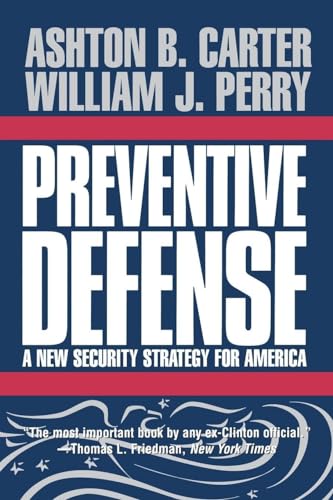
Preventive Defense: A New Security Strategy for America
Carter, Ashton B.; Perry, William J.
ISBN 10: 081571307X ISBN 13: 9780815713074
Editorial: Brookings Institution Press, 2000
Usado
Paperback
Librería:
ThriftBooks-Dallas, Dallas, TX, Estados Unidos de America
Calificación del vendedor: 5 de 5 estrellas

Vendedor de AbeBooks desde 2 de julio de 2009
Este artículo en concreto ya no está disponible.
Descripción
Descripción:
Pages can have notes/highlighting. Spine may show signs of wear. ~ ThriftBooks: Read More, Spend Less. N° de ref. del artículo G081571307XI3N00
Sinopsis:
"
William J. Perry and Ashton B. Carter, two of the world's foremost defense authorities, draw on their experience as leaders of the U.S. Defense Department to propose a new American security strategy for the twenty-first century. After a century in which aggression had to be defeated in two world wars and then deterred through a prolonged cold war, the authors argue for a strategy centered on prevention. Now that the cold war is over, it is necessary to rethink the risks to U.S. security. The A list--threats to U.S. survival--is empty today. The B list--the two major regional contingencies in the Persian Gulf and on the Korean peninsula that dominate Pentagon planning and budgeting--pose imminent threats to U.S. interests but not to survival. And the C list--such headline-grabbing places as Kosovo, Bosnia, Somalia, Rwanda, and Haiti--includes important contingencies that indirectly affect U.S. security but do not directly threaten U.S. interests. Thus the United States is enjoying a period of unprecedented peace and influence; but foreign policy and defense leaders cannot afford to be complacent. The authors' preventive defense strategy concentrates on the dangers that, if mismanaged, have the potential to grow into true A-list threats to U.S. survival in the next century. These include Weimar Russia: failure to establish a self-respecting place for the new Russia in the post-cold war world, allowing it to descend into chaos, isolation, and aggression as Germany did after World War I; Loose Nukes: failure to reduce and secure the deadly legacy of the cold war--nuclear, chemical, and biological weapons in Russia and the rest of the former Soviet Union; A Rising China Turned Hostile: failure to shape China's rise to Asian superpower status so that it emerges as a partner rather than an adversary; Proliferation: spread of weapons of mass destruction; and Catastrophic Terrorism: increase in the scope and intensity of transnational terrorism.They also argue for"
Acerca del autor: Ashton B. Carter is a research fellow at the Center for International Studies at MIT, USA. William J. Perry is codirector of the Preventive Defense Project at Stanford and Harvard, USA, and was the nineteenth U.S. Secretary of Defense (1994-97).
"Sobre este título" puede pertenecer a otra edición de este libro.
Detalles bibliográficos
Título: Preventive Defense: A New Security Strategy ...
Editorial: Brookings Institution Press
Año de publicación: 2000
Encuadernación: Paperback
Condición: Good
Condición de la sobrecubierta: No Jacket
Los mejores resultados en AbeBooks

Imagen de archivo
Preventive Defense: A New Security Strategy for America
Publicado por
Brookings Institution Press, 2000
ISBN 10: 081571307X
ISBN 13: 9780815713074
Antiguo o usado
Tapa blanda
Librería: St Vincent de Paul of Lane County, Eugene, OR, Estados Unidos de America
Calificación del vendedor: 5 de 5 estrellas
Condición: Good. paperback 100% of proceeds go to charity! Good condition with all pages in tact. Item shows signs of use and may have cosmetic defects. Nº de ref. del artículo: W-005-2966
Comprar usado
EUR 3,54
Envío por EUR 3,43
Se envía dentro de Estados Unidos de America
Se envía dentro de Estados Unidos de America
Cantidad disponible: 1 disponibles
Imagen de archivo
Preventive Defense: A New Security Strategy for America
Publicado por
Brookings Institution Press, 2000
ISBN 10: 081571307X
ISBN 13: 9780815713074
Antiguo o usado
paperback
Librería: HPB-Red, Dallas, TX, Estados Unidos de America
Calificación del vendedor: 5 de 5 estrellas
paperback. Condición: Good. Connecting readers with great books since 1972! Used textbooks may not include companion materials such as access codes, etc. May have some wear or writing/highlighting. We ship orders daily and Customer Service is our top priority! Nº de ref. del artículo: S_448571132
Comprar usado
EUR 4,43
Envío por EUR 3,23
Se envía dentro de Estados Unidos de America
Se envía dentro de Estados Unidos de America
Cantidad disponible: 1 disponibles
Imagen de archivo
Preventive Defense: A New Security Strategy for America
Publicado por
Brookings Institution Press (edition First Edition (US) First Printing), 2000
ISBN 10: 081571307X
ISBN 13: 9780815713074
Antiguo o usado
Paperback
Librería: BooksRun, Philadelphia, PA, Estados Unidos de America
Calificación del vendedor: 5 de 5 estrellas
Paperback. Condición: Fair. First Edition (US) First Printing. The item might be beaten up but readable. May contain markings or highlighting, as well as stains, bent corners, or any other major defect, but the text is not obscured in any way. Nº de ref. del artículo: 081571307X-7-1
Comprar usado
EUR 4,94
Gastos de envío gratis
Se envía dentro de Estados Unidos de America
Se envía dentro de Estados Unidos de America
Cantidad disponible: 1 disponibles
Imagen de archivo
Preventive Defense: A New Security Strategy for America
Publicado por
Brookings Institution Press, 2000
ISBN 10: 081571307X
ISBN 13: 9780815713074
Antiguo o usado
Tapa blanda
Librería: World of Books (was SecondSale), Montgomery, IL, Estados Unidos de America
Calificación del vendedor: 5 de 5 estrellas
Condición: Very Good. Item in good condition. Textbooks may not include supplemental items i.e. CDs, access codes etc. Nº de ref. del artículo: 00040026365
Comprar usado
EUR 5,03
Gastos de envío gratis
Se envía dentro de Estados Unidos de America
Se envía dentro de Estados Unidos de America
Cantidad disponible: 1 disponibles
Imagen de archivo
Preventive Defense
Impresión bajo demandaLibrería: PBShop.store UK, Fairford, GLOS, Reino Unido
Calificación del vendedor: 5 de 5 estrellas
PAP. Condición: New. New Book. Delivered from our UK warehouse in 4 to 14 business days. THIS BOOK IS PRINTED ON DEMAND. Established seller since 2000. Nº de ref. del artículo: L0-9780815713074
Comprar nuevo
EUR 29,20
Envío por EUR 4,77
Se envía de Reino Unido a Estados Unidos de America
Se envía de Reino Unido a Estados Unidos de America
Cantidad disponible: Más de 20 disponibles
Imagen de archivo
Preventive Defense: A New Security Strategy for America
Publicado por
Brookings Institution Press, 2000
ISBN 10: 081571307X
ISBN 13: 9780815713074
Nuevo
Tapa blanda
Librería: Ria Christie Collections, Uxbridge, Reino Unido
Calificación del vendedor: 5 de 5 estrellas
Condición: New. In. Nº de ref. del artículo: ria9780815713074_new
Comprar nuevo
EUR 29,55
Envío por EUR 13,73
Se envía de Reino Unido a Estados Unidos de America
Se envía de Reino Unido a Estados Unidos de America
Cantidad disponible: Más de 20 disponibles
Imagen del vendedor
Preventive Defense: A New Security Strategy for America
Impresión bajo demandaLibrería: moluna, Greven, Alemania
Calificación del vendedor: 4 de 5 estrellas

Condición: New. Dieser Artikel ist ein Print on Demand Artikel und wird nach Ihrer Bestellung fuer Sie gedruckt. William J. Perry and Ashton B. Carter, two of the world s foremost defense authorities, draw on their experience as leaders of the U.S. Defense Department to propose a new American security strategy for the twenty-first century.Über den Autor. Nº de ref. del artículo: 595056103
Comprar nuevo
EUR 30,34
Envío por EUR 48,99
Se envía de Alemania a Estados Unidos de America
Se envía de Alemania a Estados Unidos de America
Cantidad disponible: Más de 20 disponibles
Imagen de archivo
Preventive Defense: A New Security Strategy for America
Publicado por
Brookings Institution, 2000
ISBN 10: 081571307X
ISBN 13: 9780815713074
Nuevo
Paperback / softback
Librería: THE SAINT BOOKSTORE, Southport, Reino Unido
Calificación del vendedor: 5 de 5 estrellas
Paperback / softback. Condición: New. This item is printed on demand. New copy - Usually dispatched within 5-9 working days. Nº de ref. del artículo: C9780815713074
Comprar nuevo
EUR 33,59
Envío por EUR 17,02
Se envía de Reino Unido a Estados Unidos de America
Se envía de Reino Unido a Estados Unidos de America
Cantidad disponible: Más de 20 disponibles
Imagen de archivo
Preventive Defense (Paperback)
Publicado por
Bloomsbury Publishing Plc, Washington DC, 2000
ISBN 10: 081571307X
ISBN 13: 9780815713074
Nuevo
Paperback
Librería: CitiRetail, Stevenage, Reino Unido
Calificación del vendedor: 5 de 5 estrellas
Paperback. Condición: new. Paperback. William J. Perry and Ashton B. Carter, two of the world's foremost defense authorities, draw on their experience as leaders of the U.S. Defense Department to propose a new American security strategy for the twenty-first century. After a century in which aggression had to be defeated in two world wars and then deterred through a prolonged cold war, the authors argue for a strategy centered on prevention. Now that the cold war is over, it is necessary to rethink the risks to U.S. security. The A list--threats to U.S. survival--is empty today. The B list--the two major regional contingencies in the Persian Gulf and on the Korean peninsula that dominate Pentagon planning and budgeting--pose imminent threats to U.S. interests but not to survival. And the C list--such headline-grabbing places as Kosovo, Bosnia, Somalia, Rwanda, and Haiti--includes important contingencies that indirectly affect U.S. security but do not directly threaten U.S. interests. Thus the United States is enjoying a period of unprecedented peace and influence; but foreign policy and defense leaders cannot afford to be complacent. The authors' preventive defense strategy concentrates on the dangers that, if mismanaged, have the potential to grow into true A-list threats to U.S. survival in the next century. These include Weimar Russia: failure to establish a self-respecting place for the new Russia in the post-cold war world, allowing it to descend into chaos, isolation, and aggression as Germany did after World War I; Loose Nukes: failure to reduce and secure the deadly legacy of the cold war--nuclear, chemical, and biological weapons in Russia and the rest of the former Soviet Union; A Rising China Turned Hostile: failure to shape China's rise to Asian superpower status so that it emerges as a partner rather than an adversary; Proliferation: spread of weapons of mass destruction; and Catastrophic Terrorism: increase in the scope and intensity of transnational terrorism.They also argue for better management of the defense establishment so the United States will retain a strong military prepared to cope with all contingencies, deter aggressors, and win a conflict if deterrence fails. William J. Perry and Ashton B. Carter, two of the world's foremost defense authorities, draw on their experience as leaders of the U.S. Defense Department to propose a new American security strategy for the twenty-first century. This item is printed on demand. Shipping may be from our UK warehouse or from our Australian or US warehouses, depending on stock availability. Nº de ref. del artículo: 9780815713074
Comprar nuevo
EUR 33,63
Envío por EUR 42,41
Se envía de Reino Unido a Estados Unidos de America
Se envía de Reino Unido a Estados Unidos de America
Cantidad disponible: 1 disponibles
Imagen de archivo
Preventive Defense (Paperback)
Publicado por
Bloomsbury Publishing Plc, Washington DC, 2000
ISBN 10: 081571307X
ISBN 13: 9780815713074
Nuevo
Paperback
Librería: Grand Eagle Retail, Bensenville, IL, Estados Unidos de America
Calificación del vendedor: 5 de 5 estrellas
Paperback. Condición: new. Paperback. William J. Perry and Ashton B. Carter, two of the world's foremost defense authorities, draw on their experience as leaders of the U.S. Defense Department to propose a new American security strategy for the twenty-first century. After a century in which aggression had to be defeated in two world wars and then deterred through a prolonged cold war, the authors argue for a strategy centered on prevention. Now that the cold war is over, it is necessary to rethink the risks to U.S. security. The A list--threats to U.S. survival--is empty today. The B list--the two major regional contingencies in the Persian Gulf and on the Korean peninsula that dominate Pentagon planning and budgeting--pose imminent threats to U.S. interests but not to survival. And the C list--such headline-grabbing places as Kosovo, Bosnia, Somalia, Rwanda, and Haiti--includes important contingencies that indirectly affect U.S. security but do not directly threaten U.S. interests. Thus the United States is enjoying a period of unprecedented peace and influence; but foreign policy and defense leaders cannot afford to be complacent. The authors' preventive defense strategy concentrates on the dangers that, if mismanaged, have the potential to grow into true A-list threats to U.S. survival in the next century. These include Weimar Russia: failure to establish a self-respecting place for the new Russia in the post-cold war world, allowing it to descend into chaos, isolation, and aggression as Germany did after World War I; Loose Nukes: failure to reduce and secure the deadly legacy of the cold war--nuclear, chemical, and biological weapons in Russia and the rest of the former Soviet Union; A Rising China Turned Hostile: failure to shape China's rise to Asian superpower status so that it emerges as a partner rather than an adversary; Proliferation: spread of weapons of mass destruction; and Catastrophic Terrorism: increase in the scope and intensity of transnational terrorism.They also argue for better management of the defense establishment so the United States will retain a strong military prepared to cope with all contingencies, deter aggressors, and win a conflict if deterrence fails. William J. Perry and Ashton B. Carter, two of the world's foremost defense authorities, draw on their experience as leaders of the U.S. Defense Department to propose a new American security strategy for the twenty-first century. This item is printed on demand. Shipping may be from multiple locations in the US or from the UK, depending on stock availability. Nº de ref. del artículo: 9780815713074
Comprar nuevo
EUR 34,97
Gastos de envío gratis
Se envía dentro de Estados Unidos de America
Se envía dentro de Estados Unidos de America
Cantidad disponible: 1 disponibles