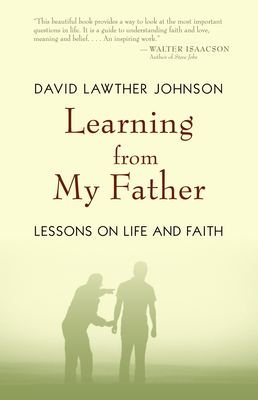
LEARNING FROM MY FATHER
Lessons on Life and FaithBy David Lawther JohnsonWilliam B. Eerdmans Publishing Company
Copyright © 2012 David Lawther Johnson
All right reserved.ISBN: 978-0-8028-6708-7Contents
A First Word The Last Lesson..............................................1The First Lesson Beginning with Belief....................................12The Second Lesson Leaping to Faith........................................35The Third Lesson Love to the Limits.......................................51The Fourth Lesson Self-Indulgence to the Point of Sin.....................70The Fifth Lesson Riddled by Evil..........................................81The Sixth Lesson Not Immortal but Eternal.................................97The Seventh Lesson Showing Up for Work....................................113The Eighth Lesson The Need for a Good Witness.............................128The Last Word First Steps, Endless Lessons................................144
Chapter One
A First Word THE LAST LESSON
* * *
His last lesson in life was how to leave it. In this as in all else, I was his student. I thought we'd have three months. That was the estimate his doctor gave me, on a rushed 7 A.M. cell-phone call to announce the suddenly discovered, incurable gallbladder cancer in early spring 2004. That was the time I began to count, and count on. I was scrambling, but at least, being with him was something I could do. I wanted to do it "right." He was in no pain, and under minimal medication. His mind was clear, even if his body had betrayed him. And so I wanted to have chances to reflect with this man — my lifelong friend and teacher — on what it all meant, how he felt, the state of his health and the state of his faith in medicine, family, and, most importantly, God. But as it turned out, we had less than three weeks. And then he was gone.
He knew he was going, long before I did. After all, he was a pastor by vocation, having spent a career of nearly fifty years in hospitals, nursing homes, and hospices ministering to the sick and the dying. During his own admission and preliminary tests at the hospital, he studied the concerned expressions of the medical residents examining him, and quickly confirmed the hopelessness of his condition. The doctor then arrived, reviewed the charts, and made the bad news official. The patient was uncharacteristically withdrawn for about two hours, clearly desiring to be left alone. When we rejoined him, he was sobered and sad. Even at this tough moment, however, he declared himself ready for whatever came next.
What came immediately next was yet another exhausting change of setting, with a move from hospital to hospice. Finally allowed to rest more comfortably in quieter surroundings, he began to get busy. He made it clear he had people to see, and good-byes to say. True to his intellect and his integrity, he didn't try to hide the fact that he was not ready to die, and that he believed there to be considerable portions of the world and its people still needing him to put things right. Advice and opinions flowed ever more freely. He even began, rather joyously, to abandon a lifetime's worth of those political skills that are the hallmark of a good pastor — familiar traditions like seeing all comers without hesitation or distinction, expressing and sharing concerns for all, or dispensing advice and good humor to everyone. Now, knowing his time was short, he determined to speak only with those he really cared to see. For the rest, he feigned sleep or confusion. How wonderful it was one morning to watch a pious, pompous fellow clergyman come to his side, hoping for a final and quotable conversation, only to find the afflicted with his eyes stubbornly shut and his breathing heavy. As the unfulfilled pilgrim tiptoed away, the dying man's eyes flickered to become slits, and then fully opened. And then, to me — his son &mdash my father winked.
The next several days, before the onslaught of painkillers in overwhelming doses, were his best. He spent many hours with our then eleven-year-old daughter, with whom he had always had a special, easy relationship and who, like my mother, was now determined never to leave his side. He spoke warmly as a parent with my brother Jerry, who now commuted back and forth from his home in Michigan, bringing both stability and strength to all of us. And he spoke fondly, like a parent, with my wife Anne, whom he had always loved as a daughter, and who continued to supply him with favorite books and favorite food for as long as he could maintain an appetite for either one.
Then usually, toward the end of a long day of tests and conversations, he would turn his attention to me. He was ready to talk. We would discuss the sorry state of world affairs, the sorrier state of domestic politics, the stories of those who had come to see him, and most importantly, how he was holding up. Throughout, he remained fully engaged, neither wistful nor sentimental. He was sad but never visibly scared. He spoke of being "on a new journey," but did not dwell on his emotions surrounding it. From his substantial library assembled over a lifetime, he requested only T. S. Eliot's small volume The Four Quartets — fittingly, first published in the United States in 1943, the year of his ordination to the ministry. He focused on certain verses, especially the affirmation of East Coker that "In my end is my beginning," and the observation in The Dry Salvages that "These are only hints and guesses, / Hints followed by guesses; and the rest / Is prayer, observance, discipline, thought and action." (He concluded that he'd done pretty well in at least four out of those five categories, coming up short only in his demonstrated powers of productive prayer.)
Time accelerated, as my father declined. He slept far more. When he was awake, his attitude was positive. At times he seemed almost excited as to what awaited him next. The final time we spoke, before he lapsed into one last deep sleep, my father asked for my views on a number of subjects, secular and religious. Happily for me, he appeared generally satisfied with my responses. His final advice was to indulge in my — to me, still hidden — sense of humor. He also suggested I might occasionally offer a few lighter notes of evidence of enjoying life more.
His calling and funeral (drawing upon years of pastoral preparations, he had planned the service, down to the hymns, long before) brought out hundreds from all walks of life. Former church members and fellow clergy, of course, as well as community leaders, neighbors, fellow residents from the retirement center — all were there. But there too were the waitresses from favorite restaurants he had counseled over the years, the bank clerks he had befriended, the janitors he had slipped an occasional five-dollar bill to over time, the middle-aged businessmen from the local restaurant who had delighted in seeing him for coffee many mornings and arguing over issues of "God and country" (my father was equally adept at voicing provocative views on both). His touch had extended in all directions, blind to distinctions of age, occupation, or social standing.
This was his life, and this was the quality of his faith. Like the crowd that came to his calling, his presence was diversely rich. He touched people where they lived and as they lived, without platitudes or contrivance. His message was almost always action-focused. He could be counted upon to respond sharply to unloving or bigoted conduct, without coming across as judgmental. And as I saw in my last hours alone with him, his was a faith that started and stayed real — certain and sure, stubbornly unsentimental.
That faith was the work of a lifetime for my father, Gerald R. Johnson. Typical of many in his "Greatest Generation," he was a child of immigrants, in his case Danish, people who left the cold and rocky soil of Scandinavia with high hopes for a new land and a new life in America, only to find themselves (remarkably, without irony) settling in exactly the same type of bankrupt terrain they thought they had left behind: deep into the frigid upper peninsula of Michigan. My grandfather ended up as a section worker for one of the railroads that carried ore and timber across the landscape of this bleak territory. My grandmother raised her children, supervised a large nearby contingent of resettled relatives from home, took in boarders, and prepared meals of homegrown food. My father once observed that there was only one advantage in being as poor as his family was: when the markets fell as the Great Depression of 1929 arrived, no one much noticed — because his family had never been part of the market economy in the first place.
My grandmother knew that education in America could bring an end to the cycles of poverty that marked her family's only true legacy. Early on, my father, as the "caboose" of his siblings and demonstrably the most intellectually curious, was singled out as the one who might ascend into acceptable American society. In the community of Escanaba, Michigan, where he grew up, only one family had (or, arguably, needed) anyone who had achieved a college education: the local clergyman, who superintended a Presbyterian congregation and had a son my father's age. Accordingly, my father was encouraged to follow his classmate's lead. When the boy finished high school, so did my father — the first member of his family, in fact, to advance beyond the fifth grade. When his friend gained admission to Alma College, a small Presbyterian-based school in Michigan's lower peninsula, my father did so as well. And when his friend decided to move to a larger and more cosmopolitan (though still Presbyterian) environment by transferring to the College of Wooster in northern Ohio, my father followed. The fact that his friend Peter was a Presbyterian, or might believe in some particular form of religious teachings, was of no particular consequence to my father. In truth, religion had played no role in his upbringing; my father was fully fifteen years old before he even set foot inside a church. The wonderful biblical stories of Noah, Jonah, arks, floods, loaves, and fishes were all unknown and consequently irrelevant to him. Instead, what mattered was that his best friend was leaving home, sidestepping poverty, and going somewhere. My father determined to do likewise. And thus, when Peter took the ultimate career step of entering Princeton Theological Seminary, Jerry Johnson managed to find his way there too.
At Princeton, my father finally came into his own. He learned the stories and lessons of the Old Testament and the New — for the first time. Also for the first time, as he later told me, he came to feel fully aware. Lacking any exposure to religious thinking in his upbringing, my father had scant need to reconcile a child's faith with an adult's knowledge. In his case, learning had center stage all to itself; faith was an intellectually coherent way of living that flowed from that learning process, rather than challenging it. It all came together for him, there and then: Jerry Johnson graduated first in his seminary class, winning top honors in preaching.
Following graduation, my father progressed through a succession of churches — first in rural Ohio, later in a larger urban congregation in Toledo, and eventually in a significant posting as the senior pastor of an even larger Presbyterian church in Indianapolis. He "retired" from that church in his early sixties, only to find himself immersed well into his late seventies in a series of calls as interim pastor for several congregations across the United States. These opportunities arose as each church worked through the seemingly endless cycle of candidate committee and task-force meetings in which the Presbyterian denomination excels as churches select new pastoral leadership. (In his highly readable 1965 book The Revolution of the Saints: A Study in the Origin of Radical Politics, analyzing the historical intertwining of politics and the Calvinist following upon which Presbyterianism is based, the political scientist Michael Walzer observed of John Calvin, "There have been few men in history who loved meetings more.")
Throughout, my father's intellectual curiosity remained strong, and his talents proved considerable. More than anything else, he was simply grateful. He once confessed that he had met most of his ambitions just by leaving home and getting an education; everything that followed was a bonus.
Yet there is more to his story than that. Somehow along the way, even though — or perhaps because — he came to the subject of faith with truly a blank slate, my father also became a believer in the message of the gospel. He was a steady adherent to the concept that life on earth was not an end in itself, but rather a part and a piece of God's larger plan for the eternal life of his creation, a plan in which people played a significant role through what he always saw as the "relationship of faith." I'm sure that relationship was never easy for him, as it is challenging for us all. Yet this was no gloomy Calvinist, even though he was highly attuned to the frailties of the world and its people. Instead, he was an essential optimist with a spare, solid, but hopeful approach to belief. He frequently questioned the shape of God's plans for the world; he never really doubted God's grace.
This was the man I knew to the end — one who was not changed by life's ending. And that was his last lesson to me, shown rather than said: make sure you develop a type of rugged faith, a religious belief you hold credible and true, because you never know when that faith will need to withstand the limits of life itself. Don't waste time indulging in easy or sentimental, overemotional expressions of religious conviction when those sentiments are bound to fail as you barely have the energy to breathe, and all you can count on is who you are, and those (ideally, including God himself ) who love you for that.
It was great teaching, a fitting, final lesson in life and faith.
It was not, however, his only guidance for me. My father had blessed me with important lessons earlier in my life as well, as I came to recall a few weeks after his death. These arose from a correspondence between us at the time I began college, almost forty years earlier. As a freshman at Harvard University, I had found myself with many predictable questions about life and belief. Like my father's journey east to Princeton Seminary a generation earlier, I was suddenly far away from my Midwestern home, on the "big stage" of a legendary American university for the first time, insecure and very much exposed to a staggering array of sophisticated new people, words and thoughts, academic ideals (and academic cynicism too). All at once I was unsure of many things. I had always been close to both of my parents, and still spoke with them often by telephone. Yet the subject of religion, to me, somehow called for a more structured discussion. Hence, on matters of faith, I usually wrote to my father and hoped for his responsive counsel by return mail.
I was not disappointed. My father readily embraced this opportunity to open what he clearly felt to be a long-overdue discussion. He wrote back, and kept writing — as did I. At the time, the resulting correspondence achieved its desired effect. I eagerly read what he had to say on the subjects of God, Christ, Christianity, faith, and good and evil, and found his words to be both affirming and helpful. Fortunately, despite many moves over many ensuing years, I managed to save our "honest exchange" of letters and thoughts on those several topics of faith I had implored him to address.
I hadn't thought about those letters, however, for a long time. In fact, it was not until I found myself, at my mother's insistence, as the new custodian of my late father's many books and papers (along with his desk, bookcases, church photographs, and virtually all the other contents of his study) that I recalled this particular correspondence. Joyous in my rediscovery, I saw anew how much my father had said — and in a real sense, still had to say — about life and faith.
Much has changed, of course, since we wrote to one another in the early 1970s. In rereading these letters, I was sobered by the realization that I was now older than my father had been when we began this correspondence. Now too, I had my own life experiences to compare to his, and my own encounters with faith to recall and compare to the perspective he provided as I was emerging into adulthood. And now I also had my own child, clearly determined to continue our family tradition of entering college far away from home.
Initially, I determined to take this material and write my father's biography, showing how he had developed an inspirational but highly workable faith in a way that allowed him to deal with life fully and to face death squarely. As I thought more about it, however, I realized my father might actually prefer an active demonstration of his legacy over a more passive recounting of his life. His letters to me on religious faith were the foundation of that legacy, but even more, he had wanted his words to be a foundation for my actions. "It's always important to be clear what we're talking about," he wrote in one of those letters. "And if we're talking about your faith, what that really means is we're talking about your being faithful: how well you have conscientiously, steadfastly tried to pattern your life after what you have accepted from and seen in the teacher." Well, he was certainly my teacher. So how well had I heard what that teacher was saying? How credible — and now, how teachable to my own daughter — were the beliefs he described to me?
(Continues...)
Excerpted from LEARNING FROM MY FATHERby David Lawther Johnson Copyright © 2012 by David Lawther Johnson. Excerpted by permission of William B. Eerdmans Publishing Company. All rights reserved. No part of this excerpt may be reproduced or reprinted without permission in writing from the publisher.
Excerpts are provided by Dial-A-Book Inc. solely for the personal use of visitors to this web site.