

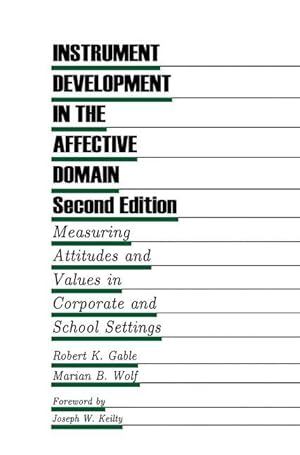
Instrument Development in the Affective Domain
Robert K. Gable|Marian B. Wolf
ISBN 10: 940104614X ISBN 13: 9789401046145
Editorial: Springer Netherlands, 2012
Nuevos
Encuadernación de tapa blanda
Librería:
moluna, Greven, Alemania
Calificación del vendedor: 5 de 5 estrellas

Vendedor de AbeBooks desde 9 de julio de 2020
Este artículo en concreto ya no está disponible.
Descripción
Descripción:
There has been longstanding interest in affective characteristics in both educational and corporate environments. While each domain has produced its own set of theorists and researchers, the work of some, such as Bandura, has found a place in the literature. N° de ref. del artículo 5831397
Sinopsis:
There has been longstanding interest in affective characteristics in both educational and corporate environments. While each domain has produced its own set of theorists and researchers, the work of some, such as Bandura, has found a place in the literature of both areas. In each of these settings, theorists and researchers have agreed on the causal connections between such constructs as self-efficacy and perceived satisfaction and success, whether that success is measured by academic achievement or corporate quality and performance resulting in profitability. Along with this interest, comes the need for the development of valid and reliable instruments to assess affective characteristics. It is clear that no matter whether your interest lies in the relationship between self-efficacy and academic success or employee satisfaction and corporate success, it is essential that the instruments used be carefully designed and tested to assure that they are measuring what they are intended to measure in a consistent manner. This work offers the theoretical perspective, modern psychometric techniques, real examples, and data needed to enable the instrument developer to produce such valid and reliable instruments.
Reseña del editor: This text was prepared for a graduate level course in affective instrument development with a focus on the school-educational environment. A major change in this second edition is the inclusion of research on attitudes and values from the corporate domain. Self-efficacy has also been included as a major affective variable with implications for both educational and corporate worlds. The following methodological techniques have also been included in this edition: confirmatory factor analysis, causal modeling, Rasch latent trait techniques and generalizability theory. The techniques described, and the school and corporate environment data sets included, represent attempts over several years to prepare materials that would illustrate appropriate instrument development techniques in the affective domain. The need for this text became apparent after witnessing several large-scale research projects that were hindered by inadequately prepared instruments. Researchers in these projects were often not aware of the need to use appropriate procedures in developing affective instruments; furthermore, there were few comprehensive and readable texts that could help. The text was developed to meet this important need.
"Sobre este título" puede pertenecer a otra edición de este libro.
Detalles bibliográficos
Título: Instrument Development in the Affective ...
Editorial: Springer Netherlands
Año de publicación: 2012
Encuadernación: Encuadernación de tapa blanda
Condición: New
Edición: 2ª Edición