
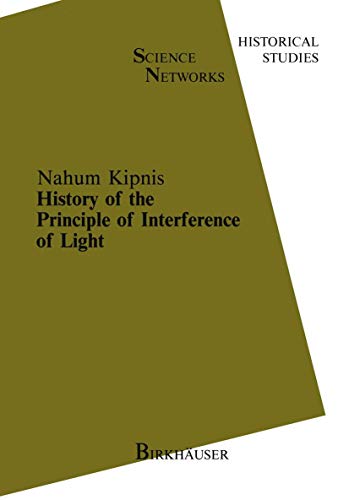
History of the Principle of Interference of Light
Kipnis, N.
ISBN 10: 3034897170 ISBN 13: 9783034897174
Editorial: Birkhäuser, 2012
Nuevos
Encuadernación de tapa blanda
Librería:
Basi6 International, Irving, TX, Estados Unidos de America
Calificación del vendedor: 5 de 5 estrellas

Vendedor de AbeBooks desde 24 de junio de 2016
Este artículo en concreto ya no está disponible.
Descripción
Descripción:
New. Delivery takes 25-30 days. Excellent Customer Service. N° de ref. del artículo POD-113585
Sinopsis:
The controversy between the wave theory and the emission theory of light early in the nineteenth century has been a subject of numerous studies. Yet many is sues remain unclear, in particular, the reasons for rejecting Young’s theory of light. It appears that further progress in the field requires a better grasp of the overall situation in optics and related subjects at the time and a more thorough study of every factor suggested to be of importance for the dispute. This book is intended to be a step in this direction. It examines the impact of the concept of interference of light on the development of the early nineteenth century optics in general, and the theory of light, in particular. This is not a his tory of the wave theory of light, nor is it a history of the debate on the nature of light in general: it covers only that part of the controversy which involved the concept of interference. Although the book deals with a number of scientists, scientific institutions, and journals, its main character is a scientific concept, the principle of interference. While discussing the reasons for accepting or rejecting this concept I have primarily focused on scientific factors, although in some cases the human factor is examined as well. The book is a revised Ph. D. dissertation (University of Minnesota, 1984) writ ten under Alan E. Shapiro.
Reseña del editor: The controversy between the wave theory and the emission theory of light early in the nineteenth century has been a subject of numerous studies. Yet many is sues remain unclear, in particular, the reasons for rejecting Young's theory of light. It appears that further progress in the field requires a better grasp of the overall situation in optics and related subjects at the time and a more thorough study of every factor suggested to be of importance for the dispute. This book is intended to be a step in this direction. It examines the impact of the concept of interference of light on the development of the early nineteenth century optics in general, and the theory of light, in particular. This is not a his tory of the wave theory of light, nor is it a history of the debate on the nature of light in general: it covers only that part of the controversy which involved the concept of interference. Although the book deals with a number of scientists, scientific institutions, and journals, its main character is a scientific concept, the principle of interference. While discussing the reasons for accepting or rejecting this concept I have primarily focused on scientific factors, although in some cases the human factor is examined as well. The book is a revised Ph. D. dissertation (University of Minnesota, 1984) writ ten under Alan E. Shapiro.
"Sobre este título" puede pertenecer a otra edición de este libro.
Detalles bibliográficos
Título: History of the Principle of Interference of ...
Editorial: Birkhäuser
Año de publicación: 2012
Encuadernación: Encuadernación de tapa blanda
Condición: Brand New