
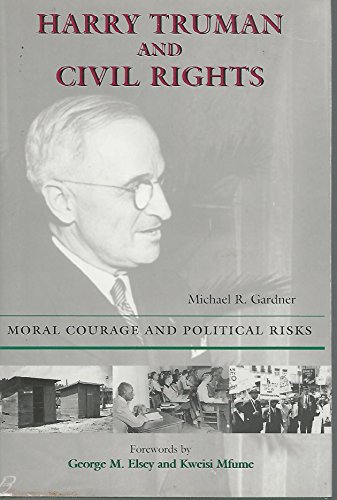
Harry Truman and Civil Rights: Moral Courage and Political Risks
Gardner, Adjunct Professor Michael
ISBN 10: 0809324253 ISBN 13: 9780809324255
Editorial: Southern Illinois University Press, 2002
Usado
Encuadernación de tapa dura
Librería:
World of Books (was SecondSale), Montgomery, IL, Estados Unidos de America
Calificación del vendedor: 5 de 5 estrellas

Vendedor de AbeBooks desde 20 de diciembre de 2007
Este artículo en concreto ya no está disponible.
Descripción
Descripción:
Item in good condition. Textbooks may not include supplemental items i.e. CDs, access codes etc. N° de ref. del artículo 00087648991
Sinopsis:
Given his background, President Truman was an unlikely champion of civil rights. Where he grew up - the border state of Missouri - segregation was accepted and largely unquestioned. Both his maternal and paternal grandparents had owned slaves, and his mother, victimized by Yankee forces, railed against Abraham Lincoln for the remainder of her ninety-four years. When Truman assumed the presidency on April 12, 1945, Michael R. Gardner points out, Washington, D.C., in many ways resembled Cape Town, South Africa, under apartheid rule circa 1985. Truman's background notwithstanding, Gardner shows that it was Harry Truman - not Franklin D. Roosevelt, Dwight D. Eisenhower, or John F. Kennedy - who energized the modern civil rights movement, a movement that basically had stalled since Abraham Lincoln had freed the slaves. Gardner analyzes Truman's speeches, private conversations with colleagues, the executive orders that shattered federal segregation policies, and the appointments of like-minded civil rights activists to important positions. Among those appointments was the first black federal judge in the continental United States. One of Gardner's essential and provocative points is that the Frederick Moore Vinson Supreme Court - a court significantly shaped by Truman - provided the legal basis for the nationwide integration that Truman could not get through the Congress. Challenging the myth that the civil rights movement began with Brown vs. Board of Education under Chief Justice Earl Warren, Gardner contends that the life-altering civil rights rulings by the Vinson Court desegregating higher education, housing, and interstate travel provided the necessary legal framework for the landmark Brown v. Board of Education decision. Gardner characterizes Truman's evolution from a man who grew up in a racist household into a president willing to put his political career at mortal risk by actively supporting the interests of black Americans.
Acerca del autor: Michael R. Gardner is a communications policy attorney in Washington, D.C. He also serves as the pro bono chairman of the United States Telecommunications Training Institute, a nonprofit international training initiative he founded in 1982 while serving as the U.S. ambassador to the ITU Plenipotentiary Conference in Nairobi, Kenya. A graduate of the College at Georgetown University and of the Georgetown University Law School, Gardner is currently an adjunct professor at Georgetown University and has also served on four presidential commissions under Presidents Nixon, Ford, Reagan, and Bush senior.
"Sobre este título" puede pertenecer a otra edición de este libro.
Detalles bibliográficos
Título: Harry Truman and Civil Rights: Moral Courage...
Editorial: Southern Illinois University Press
Año de publicación: 2002
Encuadernación: Encuadernación de tapa dura
Condición: Good