
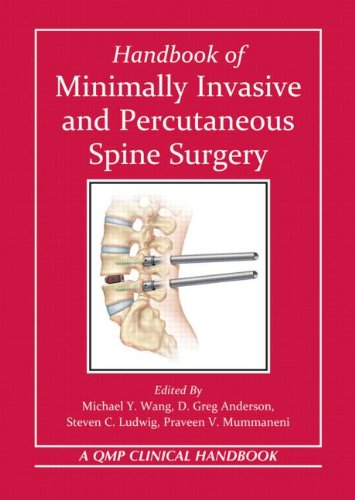

Handbook of Minimally Invasive and Percutaneous Spine Surgery
ISBN 10: 1576262995 ISBN 13: 9781576262993
Editorial: CRC Press, 2011
Usado
Encuadernación de tapa blanda
Librería:
Goodwill Books, Hillsboro, OR, Estados Unidos de America
Calificación del vendedor: 5 de 5 estrellas

Honoris Librarius
Miembro de AbeBooks desde 1996
Este ejemplar en concreto ya no está disponible. Estas algunas de las coincidencias similares para Handbook of Minimally Invasive and Percutaneous Spine Surgery.
Descripción
Descripción:
Signs of wear and consistent use. N° de ref. del artículo 3IIT4Q004YRV_ns
Sinopsis:
Handbook of Minimally Invasive and Percutaneous Spine Surgery, edited by Drs. Wang, Anderson, Ludwig, and Mummaneni, is destined to become a favorite with all students of spine surgery, whether residents in training or experienced practitioners. Small enough to fit in a lab coat pocket, this exceptional manual is just the resource you need. It will prove invaluable as a quick reference in daily practice or simply as a refresher when confronting a difficult clinical problem.
This fully illustrated fundamental guide focuses on procedures and techniques that require minimal exposure. Presented in a concise and readable format, this text delivers the basics for those new to minimally invasive surgery as well as pointers and tips for more advanced surgeons. It is destined to become a favorite with all students of spine surgery.
Composed of 11 chapters, this practical manual begins with the true foundation of minimally invasive surgery―imaging. Safe and effective surgery performed through minimal exposures demands a thorough mind’s-eye understanding of anatomy without visualization. Moreover, it requires a keen ability to mentally translate two-dimensional imaging into three-dimensional anatomy. Next, the most common techniques of cannulation are covered in a logical step-by-step fashion, just as it is taught in the operating room. Minimally invasive options for pedicle screw placement are completed with a chapter describing the mini-open technique. The second half of this book focuses on fusion and pedicle screw insertion. Finally, this handbook does not ignore the endpoint of all these techniques―achieving successful fusion. Techniques to enhance the success of this outcome are discussed in Chapter 9, whereas potential complications and methods to avoid them are outlined in Chapter 8.
Each chapter concludes with "Surgical Pearls and Pitfalls," which provide summaries of the salient points discussed in the chapter. Unique to this text are highlighted boxes outlining "Bailouts/Alternative Strategies" for completing the task when classic techniques fail. Furthermore, each chapter is well illustrated, with step-by-step images that clearly demonstrate the points being made.
Written by world-recognized minimally invasive spine surgeons, this handbook provides essential coverage of key topics.
Reseña del editor:
Handbook of Minimally Invasive and Percutaneous Spine Surgery, edited by Drs. Wang, Anderson, Ludwig, and Mummaneni, is destined to become a favorite with all students of spine surgery, whether residents in training or experienced practitioners. Small enough to fit in a lab coat pocket, this exceptional manual is just the resource you need. It will prove invaluable as a quick reference in daily practice or simply as a refresher when confronting a difficult clinical problem.
This fully illustrated fundamental guide focuses on procedures and techniques that require minimal exposure. Presented in a concise and readable format, this text delivers the basics for those new to minimally invasive surgery as well as pointers and tips for more advanced surgeons. It is destined to become a favorite with all students of spine surgery.
Composed of 11 chapters, this practical manual begins with the true foundation of minimally invasive surgery―imaging. Safe and effective surgery performed through minimal exposures demands a thorough mind’s-eye understanding of anatomy without visualization. Moreover, it requires a keen ability to mentally translate two-dimensional imaging into three-dimensional anatomy. Next, the most common techniques of cannulation are covered in a logical step-by-step fashion, just as it is taught in the operating room. Minimally invasive options for pedicle screw placement are completed with a chapter describing the mini-open technique. The second half of this book focuses on fusion and pedicle screw insertion. Finally, this handbook does not ignore the endpoint of all these techniques―achieving successful fusion. Techniques to enhance the success of this outcome are discussed in Chapter 9, whereas potential complications and methods to avoid them are outlined in Chapter 8.
Each chapter concludes with "Surgical Pearls and Pitfalls," which provide summaries of the salient points discussed in the chapter. Unique to this text are highlighted boxes outlining "Bailouts/Alternative Strategies" for completing the task when classic techniques fail. Furthermore, each chapter is well illustrated, with step-by-step images that clearly demonstrate the points being made.
Written by world-recognized minimally invasive spine surgeons, this handbook provides essential coverage of key topics.
"Sobre este título" puede pertenecer a otra edición de este libro.
Detalles bibliográficos
Título: Handbook of Minimally Invasive and ...
Editorial: CRC Press
Año de publicación: 2011
Encuadernación: Encuadernación de tapa blanda
Condición: good