
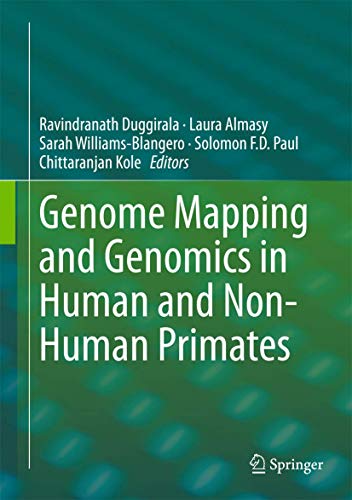
Genome Mapping and Genomics in Human and Non-Human Primates
Duggirala, Ravindranath (EDT); Almasy, Laura (EDT); Williams-blangero, Sarah (EDT); Paul, Solomon F. D. (EDT); Kole, Chittaranjan (EDT)
ISBN 10: 3662463059 ISBN 13: 9783662463055
Editorial: Springer, 2015
Nuevos
Encuadernación de tapa dura
Librería:
GreatBookPrices, Columbia, MD, Estados Unidos de America
Calificación del vendedor: 5 de 5 estrellas

Vendedor de AbeBooks desde 6 de abril de 2009
Este artículo en concreto ya no está disponible.
Descripción
Descripción:
N° de ref. del artículo 23175315-n
Sinopsis:
This book provides an introduction to the latest gene mapping techniques and their applications in biomedical research and evolutionary biology. It especially highlights the advances made in large-scale genomic sequencing. Results of studies that illustrate how the new approaches have improved our understanding of the genetic basis of complex phenotypes including multifactorial diseases (e.g., cardiovascular disease, type 2 diabetes, and obesity), anatomic characteristics (e.g., the craniofacial complex), and neurological and behavioral phenotypes (e.g., human brain structure and nonhuman primate behavior) are presented.
Topics covered include linkage and association methods, gene expression, copy number variation, next-generation sequencing, comparative genomics, population structure, and a discussion of the Human Genome Project. Further included are discussions of the use of statistical genetic and genetic epidemiologic techniques to decipher the genetic architecture of normal and disease-related complex phenotypes using data from both humans and non-human primates.
De la contraportada:
This book provides an introduction to the latest gene mapping techniques and their applications in biomedical research and evolutionary biology. It especially highlights the advances made in large-scale genomic sequencing. Results of studies that illustrate how the new approaches have improved our understanding of the genetic basis of complex phenotypes including multifactorial diseases (e.g., cardiovascular disease, type 2 diabetes, and obesity), anatomic characteristics (e.g., the craniofacial complex), and neurological and behavioral phenotypes (e.g., human brain structure and nonhuman primate behavior) are presented.
Topics covered include linkage and association methods, gene expression, copy number variation, next-generation sequencing, comparative genomics, population structure, and a discussion of the Human Genome Project. Further included are discussions of the use of statistical genetic and genetic epidemiologic techniques to decipher the genetic architecture of normal and disease-related complex phenotypes using data from both humans and non-human primates.
"Sobre este título" puede pertenecer a otra edición de este libro.
Detalles bibliográficos
Título: Genome Mapping and Genomics in Human and ...
Editorial: Springer
Año de publicación: 2015
Encuadernación: Encuadernación de tapa dura
Condición: New