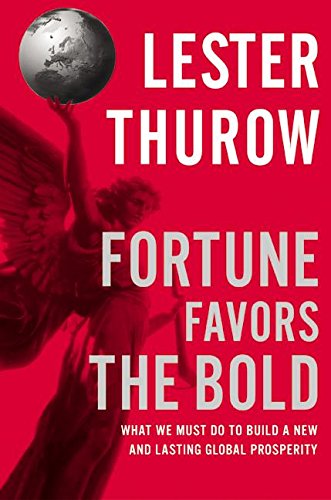
Bestselling author and renowned economist Lester Thurow argues forcefully that globalization is not a done deal and we must seize the moment now if we are to create a new global economy in which all can prosper.
In this new book, Thurow examines the newly–forming global economy, with a special focus on the role of the US and the dangers to our own national well–being. He examines such questions as: What's at stake for us in the global economy? Why is it important that the system be equitable and that other countries prosper along with us? What should our goals as a nation be – long term and short term? What are the tough choices that need to be made in our relationship with other countries and world regulatory bodies? What role should we be playing globally? What are the political, economic, social choices / tradeoffs we will have to confront?
Thurow contends that the huge and growing US trade deficit poses grave dangers to the value of the dollar and is putting our own economy in jeopardy.
As the world economy leaps national boundaries, its hallmark seems to be a rising instability and a growing inequality between the first and third worlds. Financial crises in the third world come ever more frequently and seem to be ever more severe. The first world economies seem to be in ever more frantic boom and bust cycles. Globalization causes riots throughout the world and is one factor in the rise of terrorism against the West.
Thurow shows how some nations, including Ireland and China, have embraced the concept of globalization and placed themselves into a position to prosper with growing and productive national economies. He contrasts their positive actions with Japan, whose leaders have allowed the nation to drift into stagnation and have destroyed its prosperity.
He argues that this is the time to choose globalization or be left behind, the time to "build a global economy that eliminates the defects," and he provides plenty of ideas for corporations, governments, economists, and citizens to act upon.
In this insightful and forward-looking study, MIT economist Thurow draws uncompromising conclusions: only a bold embrace of globalization will bring prosperity, and nations that fail to engage in global economics will fall behind the world’s dominant powers.
“Thurow deserves credit for spotlighting some unconventional but increasingly compelling explanations for America’s international deficits, like the little-noticed recent transformation of U.S. multinational companies from superstar exporters to superstar importers from all the factories they have moved abroad. He also usefully reminds readers that the imbalances result significantly from public-sector decisions, not simply from the impersonal workings of technological progress or free markets. Globalization’s course, in other words, can be usefully shaped by policy.”
-The Washington Post
Excerpt
Chapter One
A Global Economic Tower of Babel
Globalization is much like the biblical Tower of Babel. The construction of a global economy has begun. Someare for it! Some are against it. Neither group knowsexactly what "it" is.
This economic Tower of Babel is being built without a set ofconstruction plans. The neessary architectural drawings aren'teven in the proess of being drafted. Governments aren't thinkingabout the appropriate designs, since the tower is being privatelybuilt. National governments would, in fact, rather not think aboutglobalization because it diminishes their role and their powers tocontrol economic events. The actual builders, private firms that aremoving their economic activities around the world, don't thinkabout the design and construction of the global economy sinceeach is small relative to what is being built. For those who are truebelievers in the efficiency of private markets, there is no need tothink about the institutions and rules of globalization. Whatever isnecessary will simply evolve in the marketplace without private thought or government action. Markets will automatically set thenecessary construction standards!
As in the biblical Tower of Babel those involved in constructingthe global economy are speaking many different languages. Globalization means many different things to many different people. Arguments for and against it are often self-contradictory. Perhapsthese different languages and the associated disputes will stop aglobal economy from being built - just as they stopped the biblicaltower design to go to heaven from being built. If so, is that a goodthing or a bad thing? Have we prevented ourselves from getting toan economic heaven? Or have we prevented ourselves from over-reaching, trying to play God, and ending up in what will surely bean economic hell?
Anxieties are high. The violent antiglobalization demonstrations that have occurred at both public (WTO, IMF, World Bank, Seattle, Goteborg, Bologna)and private (Davos) global meetings inthe last few years have delivered that message. Although the number of actual demonstrators is few, I suspect that if every newspaperin the world tomorrow were to have the headline "Globalization Ends," far more than half of humanity would feel relieved. Inglobal public opinion surveys less than 20 percent of the population thinks the world is doing well.
What do the protestors dislike? What would they like to seehappen? Beneath the noise and babble what is their real message?What are they trying to tell us about globalization? They predictdisaster! But which of the predicted disasters are possible andwhich are impossible? For those that are possible, what are the realcauses?
Real disasters are almost never caused by a single factor alone. Investigators start with a jumble of possible causes that have to besorted out to find the sequence of individual causes that togetherproduced a particular disaster. The same procedure has to be followed when trying to understand the predictions of disaster bythose who are against globalization. The nature of the predicted disasters and their potential causes are all jumbled together. Theyhave to be sorted out.
In the conflicting babble generated by the construction of ourglobal economic tower, the problem is to distinguish noise frominformation - truth from fiction. The investigator begins by tryingto separate out what is true and false in the different arguments. Only when truth has been separated from fiction is it possible toadd up the pluses and the minuses to determine whether we shouldaccept or reject globalization.
But there is a third choice. The third choice is to build a globaleconomy that eliminates some of the minuses that have beenfound. Even if the initial summation indicates the benefits farexceed the minuses, the minuses can be further reduced. Theglobal economy will partially evolve in response to foreseen andunforeseen uncontrollable forces, but in the end it is a human, notgeological, construction and an be built to different specifications. Globalization can be shaped.
But to do so it is necessary to understand the dynamics of globalization so the for es of globalization can be used to change thecourse of globalization. There are actions to be taken that anenhance the positive effects of globalization and minimize its negative effects. These possibilities are outlined and discussed near theend of the book, since an in-depth understanding of the full rangeof the forces of globalization is necessary to evaluate the variouspossibilities. What seem like disconnected problems are often connected problems.
In separating the facts from the fiction in all the babble aboutglobalization, it is important to understand that the economicTower of Babel looks different depending upon where you stand. The rich and successful at the top of the tower see something quitedifferent than do the poor just starting to climb the stairs at thebottom. Those standing far away, outside of the global economy, see a tower with very different contours than what are seen bythose working inside the tower. Not surprisingly, the economically,militarily, and politically large and powerful fear the constructionof the tower much less than do those who are small and weak.
It is not that one of these perspectives is right and the others arewrong. Each focuses on different elements of the tower. All reflectsome aspects of the truth. No one an have all these perspectivessimultaneously because no one can see the entire tower or theentire truth. That is why those who are rich and successful, largeand powerful, and inside the building of the tower have to listen tothe views of those who are poor, unsuccessful, small, powerless, andoutside of the global economy. The first group cannot see what thesecond group sees, but the first group can listen to what the secondgroup has to say ...
(Continues...)
Excerpted from Fortune Favors the Boldby Lester Thurow Copyright © 2003 by Lester Thurow. Excerpted by permission.
All rights reserved. No part of this excerpt may be reproduced or reprinted without permission in writing from the publisher.
Excerpts are provided by Dial-A-Book Inc. solely for the personal use of visitors to this web site.Copyright © 2003 Lester Thurow
All right reserved.