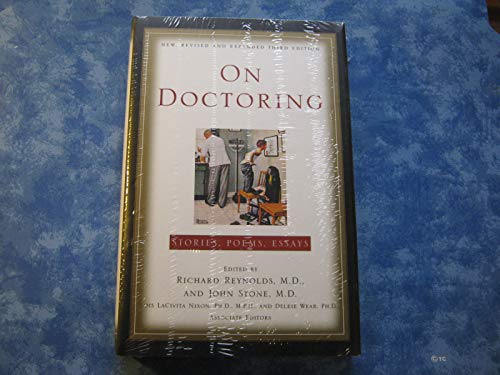
Few subjects hold more universal appeal than that of medicine, and surely few books have evoked medicine's drama and magic more powerfully than
On Doctoring. In its many forms, from age-old ritual to the cutting edge of modern science, medicine concerns us all. It is a human profession, practiced by people who have dedicated their lives not only to science but also to humanity. In the words of the great physician-writer Sir William Osler, "The physician needs a clear head and a kind heart; his work is arduous and complex, requiring the exercise of the very highest faculties of the mind, while constantly appealing to the emotions and higher feelings." It is the humanity in medicine that has inspired the pens of countless writers, and that has now been captured in this remarkable anthology of medical literature.
This newly expanded edition of On Doctoring is an extraordinary collection of stories, poems, and essays written by physicians and non-physicians alike -- works that eloquently record what it is like to be sick, to be cured, to lose, or to triumph. Drawing on the full spectrum of human emotions, the editors have included selections from such important and diverse writers as Anton Chekhov, W. H. Auden, William Carlos Williams, John Keats, John Donne, Robert Coles, Pablo Neruda, Ernest Hemingway, Raymond Carver, Alice Walker, Kurt Vonnegut, and Abraham Verghese. Among the new authors included in this edition are Rainer Maria Rilke, Lisel Mueller, and May Sarton.
In this era of managed healthcare, when medicine is becoming more institutionalized and impersonal, this book recaptures the breadth and the wonder of the medical profession. Presenting the issues, concerns, and challenges facing doctors and patients alike, On Doctoring is at once illuminating and provocative, a compelling record of the human spirit.
Introduction
It's the humdrum, day-in, day-out, everyday work that is the real satisfaction of the practice of medicine; the million and a half patients a man has seen on his daily visits over a forty-year period of weekdays and Sundays that make up his life. I have never had a money practice; it would have been impossible for me. But the actual calling on people, at all times and under all conditions, the coming to grips with the intimate conditions of their lives, when they were being born, when they were dying, watching them die, watching them get well when they were ill, has always absorbed me.
In these few sentences from William Carlos Williams's autobiography, he has captured very well the human splendor of medicine. We have tried to do the same in compiling this anthology, which contains stories, poems, essays, excerpts, and memoirs. In the process of caring for their patients, physicians have a unique -- and privileged -- window on the full range of human emotions. Literature, too, is rich in its descriptions of individual illnesses and plagues, in its capacity to reveal patients' reactions to illness and doctors' dilemmas in providing care. In its own way, literature defines the medical profession and fits into the larger society. Legacies and traditions, which are an important part of medicine, are often best manifested in the literature of a given period of history. Many of our selections were written by physicians. Williams and Anton Chekhov, W. Somerset Maugham and Lewis Thomas are only a few of the physician-writers who have relied on their medical backgrounds to help them understand better the frailties and strengths, the wonderment of the human condition. Some carried on a lifelong practice of medicine while simultaneously achieving literary recognition. Dr. Williams is a fine example -- his work, it seems fair to say, changed the face of American poetry, even as he carried on a large medical practice (he delivered over three thousand babies, for example). Somerset Maugham, although he discontinued his medical practice after internship, gave full credit to the experience in his autobiographical The Summing Up: "I do not know a better training for a writer than to spend some years in the medical profession." Others, so well known for their writing, were also trained in the medicine of their day. It is not generally known, for example, that the Romantic poet John Keats did a five-year apprenticeship with a surgeon. During those years he delivered so many babies that he was not required to take obstetrics and gynecology during the hospital phase of his training.
Of course, one need not be trained in medicine in order to make cogent and crucial observations about what it is like to be sick, hence vulnerable; to witness and record the isolation and alienation that comes eventually to all of us -- finally, we are all patients. Consider the poems of the late Jane Kenyon and her husband, Donald Hall. Their writings poignantly describe the time before their ultimate separation by her death, in 1995. Their poems are human documents without parallel. In his compelling short story "The Immortals," Jorge Luis Borges (also not a physician) comments trenchantly and presciently on some of the major ethical dilemmas of our time, those centering on organ transplants and utilization of scarce medical resources.
We have included many poems in this anthology. Poems recommend themselves to the editors of such a work because of their economy of form: in a few words a poem can communicate a complete experience. Read aloud Margaret Atwood's "The Woman Who Could Not Live with Her Faulty Heart." In its rhythms one can hear the heart, first regular, then skipping. Or listen to the courage embodied in James Dickey's "The Cancer Match." Read Emily Dickinson's short poems, which transcend time and place to speak to us in completely modern -- and human -- terms. And share with Patricia Goedicke (in "One More Time") the universal experience of having an X ray taken: "When the technician says breathe / I breathe."
Nor have we neglected the wisdom gathered in essays from major clinical figures and teachers over the years; hence, Lewis Thomas's "House Calls" is included. We begin this book, in fact, with just such an essay, one that impressed us from the first time we encountered it in the pages of the New England Journal of Medicine: Carola Eisenberg's "It Is Still a Privilege to Be a Doctor." The reader will find his or her own favorites among the many others we have included.
This third edition of On Doctoring provided us with the chance to add other voices to those previously included: remarkable writing from physician-writers Mikhail Bulgakov and Susan Onthank Mates, for example. Many writers new to this anthology are well known and widely published: Rainer Maria Rilke, Mary Oliver, Paul Zimmer, Donald Justice, Derek Mahon, and Jenny Joseph. We note with pride that our youngest author ever is included in these pages: Gregory Edwards was ten years old when he wrote his insightful -- and humorous -- poem called "The Shot."
Each one of us, of course, has a vast and vested interest in what goes on in the myriad arenas of medicine -- and in the nature of the individual doctor-patient encounters explored within the pages of this book. This is all to the good: physicians and patients must continue to talk and listen together -- and literature can help in that exchange. As editors, we are pleased to have had some part in this dialogue: prior editions of On Doctoring have had a combined readership of two hundred thousand.
Henry David Thoreau wrote, "To affect the quality of the day -- that is the highest of arts." Both medicine and literature have the capacity to affect the quality of the human day. Resonances between these two disciplines offer us a unique view of the human condition that neither one alone can provide. Read. And enjoy.
The Editors
Copyright © 1991, 1995, 2001 by The Robert Wood Johnson Foundation