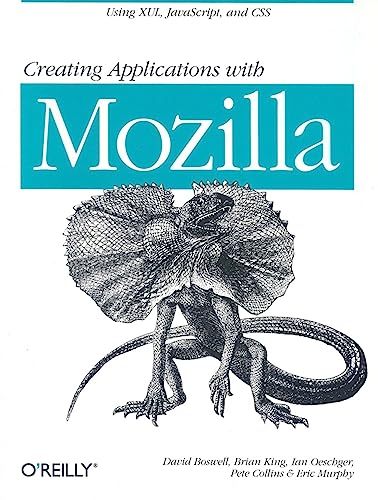
Creating Applications with Mozilla
David Boswell, Brian King, Ian Oeschger, Pete Collins, Eric Murphy
Idioma: inglés
Editorial: O'Reilly Media, 2002
- Tapa blanda
- Nuevo

Librería: The Media Foundation, BEAVERTON, OR, Estados Unidos de AmericaThe Media Foundation
Vendedor de AbeBooks desde 22 de mayo de 2020
Condición: Nuevo
EUR 31,90
Cantidad disponible: 1 disponibles
Añadir al carritoDescripción del artículo del vendedor
N° de ref. del artículo mon0000085517
- Título
- Creating Applications with Mozilla
- Autor
- David Boswell, Brian King, Ian Oeschger, Pete Collins, Eric Murphy
- Editorial
- O'Reilly Media
- Año de publicación
- 2002
- Estado
- New
- Encuadernación
- Paperback
- Idioma
- inglés
- ISBN 10
- 0596000529
- ISBN 13
- 9780596000523
Mozilla is not just a browser. Mozilla is also a framework that allows developers to create cross-platform applications. This framework is made up of JavaScript, CSS (Cascading Style Sheets), and Mozilla's XUL (XML-based User-interface Language) as well as the Gecko rendering engine, XBL (eXtensible Binding Language), XPCOM (Mozilla's component model), and several other components.Creating Applications with Mozilla explains how applications are created with Mozilla and provides step-by-step information about how you can create your own programs using Mozilla's powerful cross-platform development framework. This book also shows examples of many different types of existing applications to demonstrate some of the possibilities of Mozilla application development. One of Mozilla's biggest advantages for a developer is that Mozilla-based applications are cross-platform, meaning programs work the same on Windows as they do on Linux or the Mac OS.Working through the book, you are introduced to the Mozilla development environment and after installing Mozilla, you quickly learn to create simple applications. After the initial satisfaction of developing your own portable applications, the book branches into topics on modular development and packaging your application. In order to build more complex applications, coverage of XUL, JavaScript, and CSS allow you to discover how to customize and build out your application shell. The second half of the book explores more advanced topics including UI enhancement, localization, and remote distribution.Mozilla 1.0 was released on June 5th, 2002, after more than four years of development as an open source project. This book has been written so that all of the information and examples will work with this release and any of the 1.0.x maintenance releases. In addition to Netscape's Mozilla-based browsers (Netscape 6.x and 7.x), the Mozilla framework has been used to create other browsers such as Galeon and Chimera, and chat clients such as ChatZilla and JabberZilla. Developers have also used Mozilla to create games, development tools, browser enhancements, as well as all sorts of other types of applications.
“Sinopsis” puede pertenecer a otra edición de este título.
Acerca del autor
David has been involved in the Mozilla community for more than three years. He started the Mozilla development effort at Alphanumerica and set up the first two Mozilla Developer Meetings. At Alphanumerica David worked with Pete Collins on a number of Mozilla application including Aphrodite, Total Recall, and Chameleon. Pete and David also founded mozdev.org, a site offering free hosting for Mozilla applications. There are currently over 70 development projects hosted on the site. David has also written a number of articles about Mozilla including 'Getting Your Work Into Mozilla' and a series of articles discussing how to use Mozilla technologies to create a Pacman-like video game.
Brian has been hacking on Mozilla and related projects since early 1999. It began with a European funded project called Fabula to create software for children with the aim of learning minority languages like Basque, Catalan, Frisian, Irish, Welsh. This was built using Mozilla. Interest bloomed and he started contributing to the Mozilla Editor, and exploring the rest of the vast body of code. He moved on to work at ActiveState where he was heavily involved in the Komodo project, a scripting language IDE that uses the Mozilla application framework. Previously, Brian spent his time as a C++ applications developer, interspersed with some Perl development and XML consultancy. His technical interests include observing and participating in the re-shaping of the web environment brought about by XML. Other languages he dabbles in are PHP, Python, and JavaScript. Brian is now working as a Web technologies consultant.
Ian Oeschger is Senior Principal Writer at Netscape Communications, where mozilla.org was started over three years ago. His abiding interest in language is the basis for some of his more recent infatuations with Python, XML, web application development, and linguistics. He maintains a number of the XPFE documents on mozilla.org, including the XUL and DOM References. Ian published several articles about XML and mozilla application development for O'Reilly, and also wrote the themes documentation for Netscape, the XPInstall API Reference, and others. Before getting involved with Mozilla and Netscape, he worked at Oceania, a startup doing XML-based electronic medical records and charting software.
Pete got involved with the Mozilla project in April 1999 as a contributor to the editor module. He was also the first external developer to start documenting xul. His initial efforts were a remote, web enabled script editor and a community driven rewrite of the existing Mozilla UI. The project was later named Aphrodite. In January 2000, he joined with David Boswell and the Alphanumerica team. Together they evangelized Mozilla as a viable application platform through the many projects they created and Mozilla developer meetings they organized. Currently a software engineer employed by WorldGate, Pete is working on customizing Mozilla for their TV Internet Client Software. He is the co-founder of mozdev.org a site dedicated to Mozilla based projects. He is a regular Mozilla comitter and owner of various Mozdev projects including jslib and Chameleon.
Eric has been doing Mozilla development since Spring 2000, starting off with an instant-messenger client called Jabberzilla. He enjoys exploring opportunities of Jabber and Mozilla working together with new implementations, such as a collaborative whiteboard and real-time web content demonstrations. In 2002, Eric is looking forward to joining the workforce with a recent computer science degree from the University of Northern Iowa. Working on Mozilla projects has been a great resume-builder for him, and will always be an important part of his life to reflect on.
“Acerca de” puede pertenecer a otra edición de este título.
The Media Foundation
BEAVERTON, OR, Estados Unidos de America
Vendedor de AbeBooks desde 22 de mayo de 2020
Tarifas de envío en Estados Unidos de America
| Artículo | De 5 a 14 días hábiles | De 3 a 6 días hábiles |
|---|---|---|
| Primer artículo | EUR 3,87 | EUR 7,74 |
Métodos de pago
Especialidad
and Collections, Antiquarian, Reference, TextInformación empresarial del vendedor
THE MEDIA FOUNDATION INC
16131 SW SUMAC ST
BEAVERTON, OR Estados Unidos de America 97007
Derecho al desistimiento
Si es un consumidor, puede rescindir el contrato de acuerdo con lo siguiente. Por consumidor se entiende cualquier persona física que actúe con fines ajenos a su actividad comercial, empresarial, oficio o profesión.
Información sobre el derecho de desistimiento
Derecho legal de desistimiento
Tiene derecho a rescindir este contrato en un plazo de 14 días sin dar ningún motivo.
El periodo de desistimiento vencerá a los 14 días desde que usted, o un tercero que no sea el transportista e indicado por usted, adquiera la posesión física del último bien o del último lote o pieza.
Para ejercer el derecho de desistimiento, complete de forma electrónica y envíe una declaración clara en nuestro sitio web, desde "Mis compras" en "Mi cuenta". Le enviaremos sin demora un acuse de recibo de dicho desistimiento a través de un soporte duradero (por ejemplo, por correo electrónico).
Para cumplir con el plazo de desistimiento, basta con que envíe su comunicación relativa al ejercicio del derecho de desistimiento antes de que venza el periodo de desistimiento.
Efectos del desistimiento
Si rescinde este contrato, le reembolsaremos todos los pagos que hayamos recibido de usted, incluidos los gastos de envío (excepto los gastos adicionales que surjan si elige un tipo de envío que no sea el tipo de envío estándar más económico que ofrecemos).
Podemos hacer una deducción del reembolso por la pérdida de valor de cualquier bien suministrado, si la pérdida es el resultado de una manipulación innecesaria por su parte.
Efectuaremos el reembolso sin demoras indebidas y, a más tardar, 14 días después de que se nos informe de su decisión de rescindir este contrato.
Efectuaremos el reembolso utilizando el mismo medio de pago que utilizó para la transacción inicial, a menos que haya acordado expresamente lo contrario; en cualquier caso, no incurrirá en ningún cargo como resultado de dicho reembolso.
Podremos retener el reembolso hasta que hayamos recibido los bienes o hasta que nos haya presentado una prueba de que los ha devuelto, lo que ocurra primero.
Deberá devolver los bienes o entregarlos a The Media Foundation, BEAVERTON, Oregon, U.S.A., +1 (503) 649-0134, sin demoras indebidas y, en cualquier caso, en un plazo máximo de 14 días a partir del día en que nos comunique su desistimiento del presente contrato. El plazo se cumple si devuelve la mercancía antes de que venza el periodo de 14 días. Tendrá que asumir los gastos directos de devolución de los bienes. Usted solo es responsable de la disminución del valor de los bienes como resultado de una manipulación distinta a la necesaria para establecer la naturaleza, las características y el funcionamiento de los bienes.
Excepciones al derecho de desistimiento
El derecho de desistimiento no se aplica a lo siguiente:
- La entrega de periódicos, diarios o revistas, con la excepción de los contratos de suscripción; y
- El suministro de contenido digital que no se proporcione en un soporte tangible (por ejemplo, en un CD o DVD) si, al hacer el pedido, aceptó que podíamos empezar a entregarlo y que no podría desistir una vez iniciada la entrega.