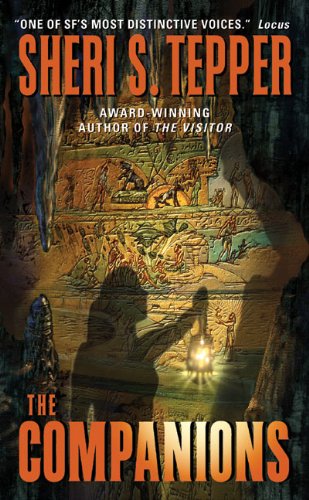
Three planets in deep space were named by their humandiscoverers to reflect their environments: lush andforeboding Jungle, which swallowed up an exploratoryteam; Stone, phenomenally rich in rare ore; and Moss,the most enigmatic -- and dangerous -- of the trio.
Joining her half-brother Paul, the famed linguist, on a two-person scientific expedition, Jewel Delis has come to Moss to observe the phenomenon of dancing light and to help decipher the strange musical "language" that accompanies it. But there are other mysteries alive on this exotic world covered in ever-shifting vegetation -- and something more than illuminations has enticed her away from a disastrously overpopulated homeworld to seek answers at the universe's unexplored edge. For Jewel herself is a question mark with a radical agenda that will put her at perilous odds with her planet's ruling powers -- and with the inscrutable alien races she encounters -- as she risks all for justice for the endangered beasts of the Earth.
The Companions
By Sheri S. TepperEos
Copyright © 2004 Sheri S. Tepper
All right reserved.ISBN: 9780060538224Chapter One
The Place
The moss world, so said one XT-ploitation writer who hadreviewed first-contact images of it, was a Victorian parlor of a planet, everywhere padded and bolstered, its cliffs hung with garlands, its crevasses softened with cushions, every cranny silk-woven, every surface napped into velvet. Here were peridot parklands where moss piled itself into caverned outcrops of sapphire shade. There were violet valleys, veiled in lavender and wine across a mat of minuscule, multicolored moss beads. In that clearing the morning light shone on infant parasols, ankle high, that by noon had sprung upward to become umbrellas, guyed with hair-thin fibers, ribs flung wide to hold feather-lightsails that turned softly, softly through the afternoon, shading the sporelings beneath.
Along the canyons were fragrant forests where every footfall released scents that evoked aching nostalgia, as though racial memory held sensations undetected for centuries: Cedar perhaps? Sandalwood? Maybe piñon or frankincense? Maybe something older than any of those? The riversides were endless alleys cushioned in aquamarine and jade, hung with curtains that moved like the waves of a shifting ocean, hiding, then disclosing -- so it was claimed -- the flame-formed inhabitants of this place.
If, that is, the Exploration and Survey Corps really saw them. If the people from Planetary Protection Institute really saw them. After each sighting the men sought confirmation from their complicated devices and found no evidence of the beings they had perceived. The machinesconfirmed small grazing and burrowing creatures, yes; they confirmed tall, gaunt trees that served as scaffolding for the epiphytic fabric of the world, but these others ... these wonders ... Everyone described the same shapes, the same behaviors, the same colors. Formed like flames, endlessly dancing, an evanescent blaze in the morning, a shimmering shadow in the dusk. Rarely seen, unmistakable when seen, but never yet recorded ...
"Along that ridge, shining, a whole line of them ..."
"Right. I saw them. Like huge candles ..."
What had they seen? That was undoubtedly the question.
A Garr'ugh shipclan of the Derac, a race nomadic by nature, had found Moss quite by accident when their clan-ship was sucked into an instability at one arm of the galaxy and spewed out in another. Subsequently, the exploration and survey of the three inner planets -- therock world, the jungle world, the moss world -- were farmed out on shares to Earthian Enterprises. The Derac were accustomed to farming out work to Earthers. Humans prided themselves on their work -- an emotion felt, so far as anyone knew, only by humans, as most other starfaring races considered "work" a sign of serfdom, which among them it invariably was. Earthers felt differently. They had their own Exploration and Survey Corps, ESC, and their own Planetary Protection Institute, PPI, a branch of the Interstellar Planetary Protection Alliance, of which Earth was a member. More importantly, Earthers were a settling type of people who seemed not to mind staying in one place as long as it took to do an adequate job of assessing new planets. Accordingly, Earth Enterprises, on behalf of PPI and ESC, was awarded a contract by the Derac to explore and survey, using, of course, the IPPA guidelines governing such activities on newly discovered worlds.
Accordingly they came. They saw. They were conquered.
Two-thirds of the planet's surface was taken up by the mosslands where the Earthers sought to answer IPPA's primary question: Did a native people exist? Time spun by, a silver web; they felt what they felt and saw what they saw, but they could not prove what they felt or saw was real. They thought, they felt there was a people, peoples upon Moss, but did a people really exist?
Did the men and women of PPI themselves exist? Their days on Moss went by like dreams passed in a chamber of the heart, a systole of morning wind, a throb of noon sun, an anticipatory pulsation of evening cool that was like the onset of apotheosis, a day gone by in a handful of heartbeats as they waited for something marvelous thatwould happen inevitably, if they were simply patient enough.
Patience wasn't enough. IPPA required specific information about newly discovered worlds. Was the ecology pristine or endangered? Were there intelligent inhabitants, and if there were, were they indigenous, immigrants, or conquerors? Did they occupy the entire planet? Were they threatened? Did they consider themselves a part of or theowners of the world on which they lived? Were other races of intelligent creatures native to the world, or had any been imported or rendered extinct? If there were various views on these matters among the inhabitants, might they be amenable to referring the matters to IPPA for resolution? These questions had to be answered! These and a thousandmore!
Moss could not be opened to habitation, trade, or visitation until it was certified by IPPA. Moss could not be certified by IPPA until the information was received. The information could not be received until the blanks in the forms were filled in, but the blanks in the formsremained exactly that.
How could one determine prior claims from creatures that fled like visions? Were they inhabitants? Possibly, though they were as likely to be events. Often, truly, they seemed to be hallucinogenic happenings, light and motion flung together by wind and imagination. Perhaps they were a new kind of creature: ecological animations! Such suggestionsmet with incomprehension back on Earth, where the carbon life-form branch office of IPPA was located.
Where IPPA was all judgment, Earth's own ESC made no judgments at all. The only task of Exploration and Survey was to record everything, to take note of everything, to determine the history of everything and establish not only how one thing related to another, but also whether each thing fit into a category that would be meaningful to intelligent persons of various races.
Continues...Excerpted from The Companionsby Sheri S. Tepper Copyright © 2004 by Sheri S. Tepper. Excerpted by permission.
All rights reserved. No part of this excerpt may be reproduced or reprinted without permission in writing from the publisher.
Excerpts are provided by Dial-A-Book Inc. solely for the personal use of visitors to this web site.