
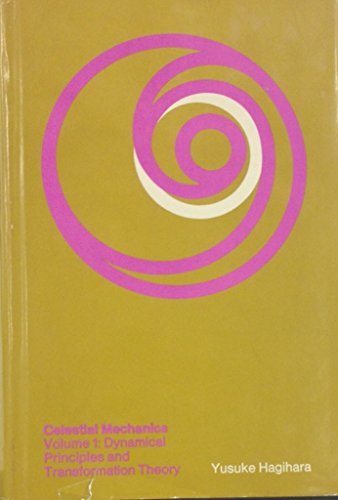
Celestial Mechanics, Volume 1 And 2 Dynamical Principles and Transformation Theory
Hagihara, Yusuke
ISBN 10: 0262080370 ISBN 13: 9780262080378
Editorial: The MIT Press, Cambridge And London, 1970
Usado
Hardcover
Librería:
Willis Monie-Books, ABAA, Cooperstown, NY, Estados Unidos de America
Calificación del vendedor: 5 de 5 estrellas

Honoris Librarius
Miembro de AbeBooks desde 1996
Este artículo en concreto ya no está disponible.
Descripción
Descripción:
Volume 1 has light staining on front and back and light foxing on top and foredge of pages. Volume 2 part 1 has slight fading on back foredge and light foxing on top edge of pages. Volume 2 part 2 has light foxing on top edge of pages. All three have signature of ownership on inside of front cover ; Two volumes in separate books. Volume 2 is split into two volumes. ; v. 1; 9 X 6 X 1 inches. N° de ref. del artículo 266901
Sinopsis:
Book by Hagihara Yusuke
Reseña del editor: The launching of space vehicles has given rise to a broadened interest in the problems of celestial mechanics, and the availability of computers has made practical the solution of some of the more numerically unwieldy of the problems. These circumstances only further enhance the importance of the appearance of "Celestial Mechanics, " to be published in five volumes. This treatise is by far the most extensive of its kind and it rigorously develops the full mathematical theory. The emphasis is on the results obtained during the past hundred years, although the classical mechanics from the time of Laplace is also reviewed.The author writes that "The trend of celestial mechanics at this stage of machine computers should be directed toward studying the general behavior of trajectories on rigorous mathematical foundations, so as to check the results of numerical computation, and at the same time toward estimating the errors involved in using nonconvergent series expansions within the accuracy to be expected from the limited observation time. Thus the science of celestial mechanics is now confronting a new revolutionary era by abruptly moving from reliance on the old weapon of series expansions toward rigorous mathematical discussion of the physical behavior of the trajectories for an unlimited time. The artificial satellites and planets are offering us the more difficult and more general problems of studying motions widely different from those of natural objects hitherto discussed in celestial mechanics. This new aspect completely surpasses the apparent elegance of the old-fashioned celestial mechanics, and its importance cannot be over-emphasized."This first volume is divided into six chapters. The first develops the principles of analytical dynamics. From the variational principle of Hamilton, and using the calculus of variations, Hamilton's canonical form of the differential equations is deduced. As an introduction to the topological study of dynamical trajectories, Riemannian geometry is described as it pertains to the quadratic form of kinetic energy. The second chapter deals with quasi-periodic motions. The third is devoted to particular solutions of the three-body and many-body problems. Euler's and Lagrange's types of particular solutions are obtained for the "n"-body problem in a general manner, and the nature of the motion is fully analyzed. The isosceles-triangular solution is discussed on the basis of the theory of analytic functions. The fourth chapter takes up Lie's theory of continuous groups of transformations, with application to the "n"-body problem. A summary of the modern theory of Lie groups is given with a view to suggesting a new trend of development. In Chapter 5, the differential equations of the "n"-body problem are reduced by using the known integrals. The last chapter concerns Burns's and Poincare's theorems.This work was prepared editorially at NASA's Goddard Space Flight Center.
"Sobre este título" puede pertenecer a otra edición de este libro.
Detalles bibliográficos
Título: Celestial Mechanics, Volume 1 And 2 ...
Editorial: The MIT Press, Cambridge And London
Año de publicación: 1970
Encuadernación: Hardcover
Condición: Very Good-
Condición de la sobrecubierta: No Dust Jacket
Edición: First Edition.