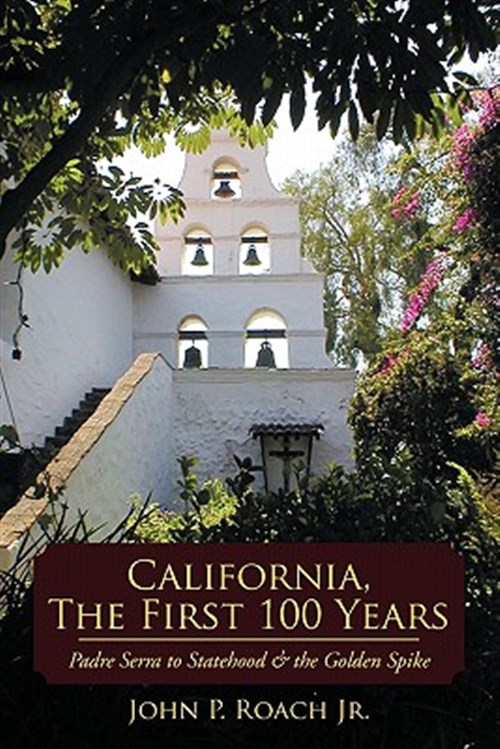
CALIFORNIA, The First 100 Years. 1769 - 1869. Spain wanted a military presence in California to keep out the English, French and Russians all of whom were beginning to pose threats to Spain's expansion to uncivilized California. Four Spanish Exhibitions, left New Spain (today's Mexico) in 1769, two by land and two by sea bound for San Diego. More than one third participating lost their lives on these expeditions due to scurvy and starvation. The survivors were expected to meet in San Diego to create Missions (education centers) and Presidios (Forts) to civilize the Indians at both San Diego and Monterey. Travel to California for the next 100 years by land or by sea was a high risk, dangerous trip for anyone. Indians attacked the settlers who crossed the plains with covered wagons. Weather and the severe elements took many more lives in the hot deserts and freezing High Sierras. California's First 100 Civilized Years were governed by Spain, then Mexico and finally The United States climaxing with Statehood as our Nations 31st State, the Gold Rush and the Golden Spike.
CALIFORNIA, The First 100 Years
Padre Serra to Statehood & the Golden SpikeBy John P. Roach Jr.AuthorHouse
Copyright © 2010 John P. Roach Jr.
All right reserved.ISBN: 978-1-4520-1176-9Contents
Chapter I 1769 Mission San Diego.......................................................11Chapter II 1770–1774 Founding New Missions.......................................17Chapter III 1774 Viceroy Bucareli......................................................23Chapter IV 1774 Juan Batista de Anza...................................................27Chapter V 1775 Padre Luis Jayme........................................................31Chapter VI 1777 Missions San Francisco and Santa Clara.................................33Chapter VII 1782 Padre Juan Crespi.....................................................35Chapter VIII 1782 Governor Felipe de Neve..............................................37Chapter IX 1784 The Apostle of California..............................................41Chapter X 1822 Louis Antonio Arguello..................................................81Chapter XI 1825 Jose Maria Echeandia...................................................85Chapter XII 1826 Jeridah Strong Smith..................................................89Chapter XIII 1830 Kit Carson...........................................................91Chapter XIV 1839 John Sutter...........................................................95Chapter XV 1844 James Polk.............................................................101Chapter XVI 1845 John Fremont..........................................................103Chapter XVII 1846 Mariano Guadalupe Vallejo............................................109Chapter XVIII 1841 Fort Ross, The Russian Settlement in California.....................115Chapter XIX 1846 Pio Pico..............................................................119Chapter XX 1846 The Bear Flag Republic.................................................121Chapter XXI 1846 Andres Pico...........................................................123Chapter XXII 1846-1847 The Donner Party................................................129Chapter XXIII 1848 Secularazation......................................................133Chapter XXIV 1846 Commodore Stockton...................................................135Chapter XXV 1849 The Gold Rush.........................................................139Chapter XXVI 1851 Jesse Benton Fremont.................................................143Chapter XXVII 1849 Constitutional Convention...........................................153Chapter XXVIII 1850 Statehood..........................................................155Chapter XXIX 1867 Alonzo Erastas Horton................................................157Chapter XXX 1861 Transcontinental Railroad.............................................163Chapter XXXI 1869 The Big Four.........................................................165Chapter XXXII 1869 The Golden Spike....................................................173EPILOGUE...............................................................................179BIBLIOGRAPHY...........................................................................183
Chapter One
1769 MISSION SAN DIEGO
At long last father Serra saw the two ships at anchor in San Diego Harbor. The four separate expeditions, two by land and two by sea, had come together in San Diego.
Father Serra remarked to Father Crespi: "What a beautiful place San Diego is, a great place to start my first mission in California."
And Father Crespi replied, "Yes Father, San Diego Bay is a fine harbor. Cabrillo described it well 227 years ago. I am not disappointed, and I am genuinely happy. Vizcaino visited here in 1602, and since then we are the only ships to enter San Diego Harbor in the last 167 years."
"The male natives approach us totally naked, just as if we have entered the Garden of Eden. They are uninhibited and without shame as they stand before us naked while we are fully clothed. I have not seen the women yet," Father Serra answered.
"The women cover themselves with reeds and leaves." said Crespi. "Thank God. The nakedness speaks well for the climate of San Diego."
Governor Portola joined the two padres to ask Father Serra if he likes the site where they are currently encamped.
"Do you like this site?" asked Portola.
"Of course," responded Serra. "There is plenty of water, a substantial native population, fertile soil on the flat land all around us, and it is within canon range of the harbor. It is a perfect site for both a mission and a presidio. Looking far ahead, I can visualize the San Diego pueblo as well, built between here and the bay."
"Ha! I guess you do like it, you are so optimistic. I, for one, never thought that in your condition you could ever make that nine hundred mile trip from Loreto. However, we still have many problems. Of the three hundred that started this trip, we have lost more than one hundred."
"Why so many?" asked Father Crespi.
"Scurvy killed many of those that came by sea, and starvation and desertion decimated our numbers during the Rivera overland expedition. There are so many still sick with scurvy.
"I will bring them back to health." offered Serra.
"Before I leave with an overland expedition for Monterey, I will send the San Antonio with its few remaining sailors back to San Blas for provisions and replacements for the sailors lost."
On July 9, the San Antonio left San Diego harbor containing letters to the guardian of the College of San Fernando in Mexico City and letters to Father Palou at Loreto in Baja Sur on the Sea of Cortez that provide details of the journey thus far.
Less than a week later, on July 15, after a High Mass offered by Father Serra, the twenty-four men were blessed for their expedition to Monterey harbor. Father Crespi was sent as the diarist to record every detail of the expedition for the College of San Fernando. Captain Rivera, who was to lead the first expedition prior to the second overland expedition, departed with him after the blessing.
Father Serra, with the forty men left behind, immediately commenced the construction of the San Diego mission on Presidio Hill. A few shelters were erected, with a larger one to serve as a church until a foundation was laid for the mission.
The next morning on July 16, 1769, the soldiers raised the cross, and Father Serra sang a High Mass founding Mission San Diego de Alcala in honor of Franciscan Saint Didacus, who died at Alcala, Spain in the fifteenth Century.
Father Serra, assisted by Father Perron, started California's first mission, and together they became California's first missionaries. Within the first month there was still a communication problem, as the padres had not yet learned the language of the natives.
When four soldiers left the presidio to accompany Father Perron after he said mass on the ship San Carlos, the natives noticed how shorthanded the mission was and attacked.
When the four remaining soldiers heard the attack, they ran for their muskets and fired. The mission carpenter and blacksmith joined the defense while Fathers Serra and Vizcaino, in one of the huts, prayed that no one on either side would be hurt.
That evening the wailing of women could be heard in the surrounding villages as the natives cremated their dead. The natives' primitive weapons were no match for Spanish muskets, and a new respect was born for the missionaries.
Doctor Prat tended to the wounds of Father Vizcaino, the blacksmith, and a Christian Baja Indian. Another Christian Baja Indian lay dead in front of Father Serra with an arrow through his neck.
A stockade of poles was erected around the mission, and the natives started to visit, hoping their wounded could be healed by Doctor Prat. The natives were becoming more peaceful.
On Jan 24, 1770, the Portola expedition returned to the mission at San Diego with all seventy-four men and no loss of life. They did smell pretty bad, as they had to eat their mules to avoid starvation. Everyone was jubilant with many stories to tell. They never did find Monterey harbor, but were very satisfied with the discovery of the huge San Francisco Bay, deeming it worthy of the name of St. Francis of Assisi, the patron saint of all Franciscans.
Chapter Two
1770–1774 FOUNDING NEW MISSIONS
Mission San Carlos
After surveying the nearby sites for a place to build the mission at Monterey Harbor, Father Serra felt it might be all right for a presidio, but for a mission he believed that the area lacked a most important requirement: a large population of Indians. No one lived at the sight. The nearest population was in nearby Carmel
Carmel also offered plenty of water and land for farming and grazing. Serra had to be patient, as packet ships arrived so rarely, and he had written to Galvez requesting the mission be built at Carmel. Finally, permission was granted to move the mission site from Monterey to Carmel.
On June 3, 1770, the mission and presidio at Monterey were founded. On August 24, 1771, the mission was moved to Carmel. The Carmel mission San Carlos de Borromeo honors the Italian, sixteenth century Franciscan saint. The mission in Carmel is often referred to as Mission San Carlos or Mission Carmel. While construction was underway in Carmel, Serra headed south to start yet another mission.
Mission San Antonio
Father Serra, with a small party, left Monterey in 1771 to find and establish a site to the south in the Santa Lucia mountains where they could establish Mission San Antonio de Padua. The fertile Los Robles Valley was chosen for the site. The mission, named for a thirteenth century Franciscan saint, was chosen because of the hardworking spirit he had during his life. Such inspiration would be needed at this site.
The natives appeared friendly as they approached Father Serra and donated seeds and acorns to the mission. On the priest and his parties' return trip to Carmel, they camped at a beautiful spot near today's Salinas. Father Serra asked the name of a beautiful native woman and she responded, "Soledad," which sounded like the Spanish word that means solitude.
Father Serra took note of this place of smiling natives as a possible site for a future mission.
Mission San Gabriel
In 1771 Father Serra also deployed two padres to begin a fourth mission at what is today known as Los Angeles. They had written instructions that this mission was to honor San Gabriel the Archangel.
Mission San Fernando
Likewise, in 1771 Mission San Fernando Rey de Espana was founded by friars dispatched by Father Serra.
By July of 1772, the first anniversary of the San Carlos mission's establishment in Carmel, construction was moving quite slowly. Father Serra requested that Father Crespi become his assistant, and they both moved from the presidio to the mission.
Spiritual matters were progressing well. Father Serra now had a congregation of thirty Christians.
However, the mission garden produced very little, so times were hard. News arrived that the supply ship from San Blas had to turn back to San Diego due to high winds in the Santa Barbara Channel.
Commander Fages from the presidio and Father Serra conferred and decided that their only hope of avoiding starvation was in taking an overland trip to San Diego to bring back the desperately needed supplies.
Father Serra, Commander Fages and a few soldiers left Monterey on August 24, 1772, to retrace the steps of Portola along the Camino Real (also called the King's Highway). Father Serra had never traveled further south than the Mission San Antonio that he had founded last year. This trip would allow him to look for areas that might be good places for new missions.
On August 27 they stopped at Mission San Antonio and discovered a community of twelve Christians, many of whom requested baptism.
Mission San Luis Obispo
On September 1, 1772, Father Serra founded the Mission San Luis Obispo de Tolosa, named in honor of a French Franciscan saint who lived in 1294. Father Serra raised the cross at this fifth mission and put Father Cavaller in charge. Left behind was a guard of four men and two Baja Indians. Together, they would build the new mission.
As they headed south along the ocean from Santa Barbara to Ventura, Serra noticed the many Indian villages of pagans in need of conversion. On September 11, Father Serra arrived at Mission San Gabriel, the only mission so far that he did not personally establish.
Father Serra was very pleased with what had been accomplished, and he stayed two days. He predicted that someday Mission San Gabriel could produce enough livestock and food to provide for all of the missions.
By the time Father Serra's party arrived in San Diego, he had a much better idea of the vast responsibility that was his as president of the missions. Captain Perez, a fellow Majorcan from the ship San Antonio, was in San Diego. Father Serra pleaded, and he finally persuaded him to re-supply Monterey.
Captain Perez was afraid of the high winds and treacherous seas near Santa Barbara. But Father Serra let him know that he was called upon to do God's work, and so there was nothing to fear.
With provisions and supplies loaded on the San Antonio, Captain Perez left San Diego harbor for Monterey and returned to San Blas, New Spain, without incident.
Chapter Three
1774 VICEROY BUCARELI
Father Serra, in the meantime, left for Mexico City on the San Carlos. The missionaries had all agreed that he should meet the viceroy, the personal representative of the King of Spain, to discuss missionary problems.
There was both a new viceroy, Bucareli, and a new guardian, Verger, at the college, so the time was right for a face-to-face visit in Mexico City. The voyage past the Baja to San Blas on the New Spain mainland would give Father Serra time to prepare his case.
One of the more obvious problems bothering the natives was that they saw no European women, only men and the mules they worked with. This made it difficult to relate to the Spanish military, as they didn't seem family-oriented. The Indian population joked that the military must be descended from the mules. Serra planned to highlight the urgent need for married colonists to be sent to California with their women and children.
After meeting with Guardian Verger and spending a few days at the college, Father Serra sought an appointment with Viceroy Bucareli. Bucareli represented King Carlos III in New Spain. He was very welcoming to this humble Franciscan friar and president of the missions.
Bucareli listened intently and with interest to Father Serra, and he was impressed with his devotion and knowledge about missionary problems. Bucareli asked Father Serra to please put his requests in writing so they could be presented to the court. By doing so, he would establish a court record. Bucareli promised to do what he could to assist in the success of these proposals.
Farther Serra agreed to prepare the documents and stressed the need for immediate attention to the food and supplies in California. Viceroy Bucareli ordered a ship from San Blas to be provisioned with food and supplies for the starving missions and sent out with the most possible haste.
Father Serra, quite pleased with the interest and actions of the vice- roy, returned to the College of San Fernando to report the results to Guardian Verger. Verger suggested that the documents he prepared should be brief, concise, and to the point. He should stick to listing the problems and the proposed solutions and explain how each solution solves a problem.
Father Serra created what was called "the representation." In essence, it is a bill of rights for the Indians that would resolve problems between the military, the missionaries, and the colonists. The thirty-two issues covered in the brief addressed every phase of the mission activity in California. A copy of this first piece of California legislature, written in beautiful calligraphy, may be viewed today at the museum at Mission Santa Barbara.
After his six months of conferences in Mexico City, Father Serra was quite pleased with what he had accomplished:
1. There was the promise of expeditions from Sonora, New Spain that would bring families to settle in California.
2. Doctors, carpenters and blacksmiths were recruited to support the missions of California.
On January 24, 1774, Father Serra, Juan Evangelista, and ninety-six others boarded the Santiago under the command of Captain Perez at San Blas, New Spain to sail to Monterey in Alta California. Included in this party were families of wives and children, some of whom were carpenters and blacksmiths.
After forty days at sea, Captain Perez sought refuge in San Diego harbor rather than continue to Monterey. Mission San Diego had grown somewhat under Father Louis Jayme, who was appointed by Father Serra in 1771.
Chapter Four
1774 JUAN BATISTA DE ANZA
Viceroy Bucareli kept his promise to Father Serra and appointed the explorer Captain Juan Batista de Anza to lead colonists to his missions on the California coast. The first exploration set out from the mainland of New Spain on January 8, 1774, with 34 people, 20 of whom were soldiers; 140 horses; and 65 head of cattle. After fighting Apache raids and crossing the Colorado River, the party entered the Mojave Desert. They were then faced with the difficult task of finding a pass through the high mountain range, but Anza kept moving onward toward the Alta California coast.
When the padres at Mission San Gabriel saw the tired caravan ap- proaching, they rang the mission bells so that everyone could hear the joy of the occasion.
By March 25, Anza sent four soldiers to Mission San Diego for food and supplies. Father Serra was jubilant in the knowledge that this first exploration from the mainland was a success.
On April 6, Father Serra and explorer Father Garces left San Diego for Mission San Gabriel. Father Serra wanted to meet with Anza, but he missed him by one day. Captain Anza had already left for Monterey. Father Serra stayed at Mission San Gabriel for ten days, enjoying the progress that had been made there.
Serra had commissioned some paintings of the saints while in Mexico City. They arrived by ship and were to be placed over the altar of each mission. A picture of St. Gabriel that was taken from a Bible was all they had until the beautiful oil painting arrived to adorn the altar of Mission San Gabriel.
A few days later, while continuing his journey north, Father Serra caught up to Captain Juan Batista de Anza near Point Conception and begged him to camp overnight so that they might compare thoughts on the development of California. Although they had never previously met, the soldier and the friar established an immediate rapport.
On April 30, Father Serra spent three days at Mission San Louis Obispo. He then left for Mission San Antonio and arrived on May 6. The padres there had the oil painting of San Antonio displayed above the altar, and they were pleased to see Father Serra.
Two days later, on May 9, Father Serra and Juan Evangelista began the last leg of their journey on the Camino Real through the Salinas Valley. They arrived in Monterey two days later. Serra spotted the ship Santiago in the harbor and was told it had arrived two days earlier.
An hour's walk through the pines brought him home to Mission San Carlos in Carmel, and standing at the entrance was Father Palou, now stationed at Mission San Carlos, waiting to welcome his dear friend and teacher. They both laughed, remembering their conversation in Loreto: "Goodbye until we meet in Monterey."
On October 23, 1775, Lieutenant Colonel Juan Bautista de Anza commenced his second expedition, the purpose of which was to establish a Spanish colony on San Francisco Bay with his party of families with children. He would also establish a presidio at San Francisco, letting the world know that this land and fantastic harbor had been settled by Spain.
(Continues...)
Excerpted from CALIFORNIA, The First 100 Yearsby John P. Roach Jr. Copyright © 2010 by John P. Roach Jr.. Excerpted by permission of AuthorHouse. All rights reserved. No part of this excerpt may be reproduced or reprinted without permission in writing from the publisher.
Excerpts are provided by Dial-A-Book Inc. solely for the personal use of visitors to this web site.