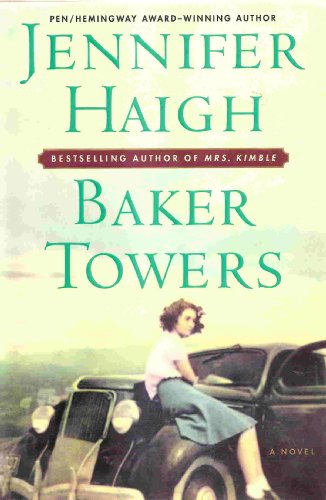
A stunning follow-up to her bestselling debut,
Mrs. Kimble, Jennifer Haigh returns with
Baker Towers, a compelling story of love and loss
in a western Pennsylvania mining town in
the years after World War II
Bakerton is a company town built on coal, a town of church festivals and ethnic neighborhoods, hunters' breakfasts and firemen's parades. Its children are raised in company houses -- three rooms upstairs, three rooms downstairs. Its ball club leads the coal company league. The twelve Baker mines offer good union jobs, and the looming black piles of mine dirt don't bother anyone. Called Baker Towers, they are local landmarks, clear evidence that the mines are booming. Baker Towers mean good wages and meat on the table, two weeks' paid vacation and presents under the Christmas tree.
The mines were not named for Bakerton; Bakerton was named for the mines. This is an important distinction. It explains the order of things.
Born and raised on Bakerton's Polish Hill, the five Novak children come of age during wartime, a thrilling era when the world seems on the verge of changing forever. The oldest, Georgie, serves on a minesweeper in the South Pacific and glimpses life beyond Bakerton, a promising future he is determined to secure at all costs. His sister Dorothy, a fragile beauty, takes a job in Washington, D.C., and finds she is unprepared for city life. Brilliant Joyce longs to devote herself to something of consequence but instead becomes the family's keystone, bitterly aware of the opportunities she might have had elsewhere. Sandy sails through life on looks and charm, and Lucy, the volatile baby, devours the family's attention and develops a bottomless appetite for love.
Baker Towers is a family saga and a love story, a hymn to a time and place long gone, to America's industrial past and the men and women we now call the Greatest Generation. This is a feat of imagination from an extraordinary new voice in American fiction, a writer of enormous power and skill.
Baker Towers
By Haigh, JenniferWilliam Morrow & Company
ISBN: 0060509414Chapter One
Softly the snow falls. In the blue morning light a train winds throughthe hills. The engine pulls a passenger car, brightly lit. Then a dozen blindcoal cars, rumbling dark.
Six mornings a week the train runs westward from Altoona to Pittsburgh,a distance of a hundred miles. The route is indirect, tortuous; theearth is buckled, swollen with what lies beneath. Here and there, thelights of a town: rows of company houses, narrow and square; a main streetof commercial buildings, quickly and cheaply built. Brakes screech; thetrain huffs to a stop. Cars are added. In the passenger compartment, a soldieron furlough clasps his duffel bag, shivers and waits. The whistleblows.Wheezing, the engine leaves the station, slowed by the extra tonsof coal.
The train crosses an iron bridge, the black water of the Susquehanna.Lights cluster in the next valley. The town, Bakerton, is already awake.Coal cars thunder down the mountain. The valley is filled with sound.The valley is deep and sharply featured. Church steeples and mine tipples grow inside it like crystals. At bottom is the town's most famous landmark,known locally as the Towers, two looming piles of mine waste. Theyare forty feet high and growing, graceful slopes of loose coal and sulfurousdirt. The Towers give off an odor like struck matches. On windy days theyglow soft orange, like the embers of a campfire. Scrap coal, spontaneouslycombusting; a million bits of coal bursting into flame.
Bakerton is Saxon County's boomtown. Like the Towers, it is alivewith coal. A life that started in the 1880s, when two English brothers,Chester and Elias Baker, broke ground on Baker One. Attracted by handbills,immigrants came: English and Irish, then Italians and Hungarians;then Poles and Slovaks and Ukrainians and Croats, the "Slavish," as theywere collectively known.With each new wave the town shifted to makeroom. Another church was constructed. A new cluster of company housesappeared at the edge of town.The work -- mine work -- was backbreaking,dangerous and bleak; but at Baker Brothers the union was tolerated. Bythe standards of the time the pay was generous, the housing affordableand clean.
The mines were not named for Bakerton; Bakerton was named for themines. This is an important distinction. It explains the order of things.
Chester Baker was the town's first mayor. During his term Bakertonacquired the first streetcar line in the county, the first public water supply.Its electric street lamps were purchased from Baker's own pocket. Figurethe cost of maintaining them for fifty years, he wrote to the town bosses, andI will pay you the sum in advance. After twenty years Baker ceded his office,but the bosses continued to meet at his house, a rambling yellow-brickmansion on Indian Hill. A hospital was built, the construction crew paidfrom a fund Baker had established. He wouldn't let the building be namedfor him. At his direction, it was called Miners' Hospital.
The hospital was constructed in brick; so were the stores, the dress fac-tory, the churches, the grammar school. After the Commercial Hotelburned to the ground in 1909, an ordinance was passed, urging merchantsto "make every effort to fabricate their establishments of brick."To a travelerarriving on the morning train -- by now an expert on Pennsylvaniacoal towns -- the hat shop and dry-goods store, the pharmacy and mercantile,seem built to last. Their brick facades suggest order, prosperity,permanence.
On the seventeenth of January 1944, a motorcar idled atthe railroad crossing, waiting for the train to pass. In the passengerseat was an elderly undertaker of Sicilian descent, named AntonioBernardi. At the wheel was his great-nephew Gennaro, a handsome,curly-haired youth known in the pool halls as Jerry. Between them sat ablond-haired boy of eight. The car, a black Packard, had been waxed thatmorning. The old man peered anxiously through the windshield, at thesnowflakes melting on the hood.
"These Slavish," he said, as if only a Pole would drop dead in the middleof winter and expect to be buried in a snowstorm.
The train passed, whistle blowing. The Packard crossed the tracks andclimbed a steep road lined with company houses, a part of town known asPolish Hill. The road was loose and rocky; the coarse stones, called reddog, came from bony piles on the outskirts of town. Black smoke rosefrom the chimneys; in the backyards were outhouses, coal heaps, clotheslinesstretched between posts. Here and there, miners' overalls hung out todry, frozen stiff in the January wind.
"These Slavish," Bernardi said again. "They live like animali." At onetime, his own brothers had lived in company houses, but the family had improved itself. His nephews owned property, houses filled with moderncomforts: telephones and flush toilets, gas stoves and carpeted floors.
"Papa," said Jerry, glancing at the boy; but the child seemed not tohear. He stared out the window wide-eyed, having never ridden in a carbefore. His name was Sandy Novak; he'd come knocking at Bernardi'sback door an hour before -- breathless, his nose dripping.His mother hadsent him running all the way from Polish Hill, to tell Bernardi to comeand get his father.
The car climbed the slope, engine racing. Briefly the tires slid on theice. At the top of the hill Jerry braked.
"Well?" said the old man to the boy. "Where do you live?"
"Back there," said Sandy Novak. "We passed it."
Bernardi exhaled loudly. "Cristo. Now we got to turn around."
Jerry turned the car in the middle of the road.
"Pay attention this time," Bernardi told the boy. "We don't got all day."In fact he'd buried nobody that week, but he believed in staying available ...
Continues...Excerpted from Baker Towersby Haigh, Jennifer Excerpted by permission.
All rights reserved. No part of this excerpt may be reproduced or reprinted without permission in writing from the publisher.
Excerpts are provided by Dial-A-Book Inc. solely for the personal use of visitors to this web site.