Librería:
Ria Christie Collections, Uxbridge, Reino Unido
Calificación del vendedor: 5 de 5 estrellas
Vendedor de AbeBooks desde 25 de marzo de 2015
In English. N° de ref. del artículo ria9781461269489_new
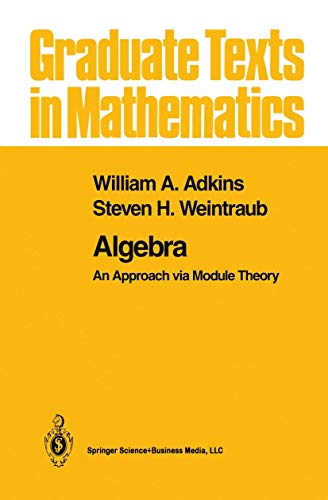
This book is designed as a text for a first-year graduate algebra course. The choice of topics is guided by the underlying theme of modules as a basic unifying concept in mathematics. The book emphasizes proofs with a maximum of insight and a minimum of computation in order to promote understanding. However, extensive material on computation (for example, computation of canonical forms) is provided.
Reseña del editor: This book is designed as a text for a first-year graduate algebra course. As necessary background we would consider a good undergraduate linear algebra course. An undergraduate abstract algebra course, while helpful, is not necessary (and so an adventurous undergraduate might learn some algebra from this book). Perhaps the principal distinguishing feature of this book is its point of view. Many textbooks tend to be encyclopedic. We have tried to write one that is thematic, with a consistent point of view. The theme, as indicated by our title, is that of modules (though our intention has not been to write a textbook purely on module theory). We begin with some group and ring theory, to set the stage, and then, in the heart of the book, develop module theory. Having developed it, we present some of its applications: canonical forms for linear transformations, bilinear forms, and group representations. Why modules? The answer is that they are a basic unifying concept in mathematics. The reader is probably already familiar with the basic role that vector spaces play in mathematics, and modules are a generaliza tion of vector spaces. (To be precise, modules are to rings as vector spaces are to fields.
Título: Algebra: An Approach via Module Theory (...
Editorial: Springer
Año de publicación: 2012
Encuadernación: Encuadernación de tapa blanda
Condición: New
Librería: Books From California, Simi Valley, CA, Estados Unidos de America
paperback. Condición: Very Good. Nº de ref. del artículo: mon0003745273
Cantidad disponible: 1 disponibles
Librería: Textbooks_Source, Columbia, MO, Estados Unidos de America
paperback. Condición: New. Ships in a BOX from Central Missouri! UPS shipping for most packages, (Priority Mail for AK/HI/APO/PO Boxes). Softcover reprint of the original 1st ed. 1992. Nº de ref. del artículo: 002329119N
Cantidad disponible: 3 disponibles
Librería: moluna, Greven, Alemania
Kartoniert / Broschiert. Condición: New. Dieser Artikel ist ein Print on Demand Artikel und wird nach Ihrer Bestellung fuer Sie gedruckt. This book is designed as a text for a first-year graduate algebra course. As necessary background we would consider a good undergraduate linear algebra course. An undergraduate abstract algebra course, while helpful, is not necessary (and so an adventurous . Nº de ref. del artículo: 4189582
Cantidad disponible: Más de 20 disponibles
Librería: preigu, Osnabrück, Alemania
Taschenbuch. Condición: Neu. Algebra | An Approach via Module Theory | William A. Adkins (u. a.) | Taschenbuch | x | Englisch | 2012 | Springer | EAN 9781461269489 | Verantwortliche Person für die EU: Springer Verlag GmbH, Tiergartenstr. 17, 69121 Heidelberg, juergen[dot]hartmann[at]springer[dot]com | Anbieter: preigu Print on Demand. Nº de ref. del artículo: 106118751
Cantidad disponible: 5 disponibles
Librería: Lucky's Textbooks, Dallas, TX, Estados Unidos de America
Condición: New. Nº de ref. del artículo: ABLIING23Mar2716030028411
Cantidad disponible: Más de 20 disponibles
Librería: GreatBookPrices, Columbia, MD, Estados Unidos de America
Condición: New. Nº de ref. del artículo: 19199749-n
Cantidad disponible: Más de 20 disponibles
Librería: Chiron Media, Wallingford, Reino Unido
Paperback. Condición: New. Nº de ref. del artículo: 6666-IUK-9781461269489
Cantidad disponible: 10 disponibles
Librería: buchversandmimpf2000, Emtmannsberg, BAYE, Alemania
Taschenbuch. Condición: Neu. Neuware -This book is designed as a text for a first-year graduate algebra course. As necessary background we would consider a good undergraduate linear algebra course. An undergraduate abstract algebra course, while helpful, is not necessary (and so an adventurous undergraduate might learn some algebra from this book). Perhaps the principal distinguishing feature of this book is its point of view. Many textbooks tend to be encyclopedic. We have tried to write one that is thematic, with a consistent point of view. The theme, as indicated by our title, is that of modules (though our intention has not been to write a textbook purely on module theory). We begin with some group and ring theory, to set the stage, and then, in the heart of the book, develop module theory. Having developed it, we present some of its applications: canonical forms for linear transformations, bilinear forms, and group representations. Why modules The answer is that they are a basic unifying concept in mathematics. The reader is probably already familiar with the basic role that vector spaces play in mathematics, and modules are a generaliza tion of vector spaces. (To be precise, modules are to rings as vector spaces are to fields.Springer Verlag GmbH, Tiergartenstr. 17, 69121 Heidelberg 544 pp. Englisch. Nº de ref. del artículo: 9781461269489
Cantidad disponible: 2 disponibles
Librería: BuchWeltWeit Ludwig Meier e.K., Bergisch Gladbach, Alemania
Taschenbuch. Condición: Neu. This item is printed on demand - it takes 3-4 days longer - Neuware -This book is designed as a text for a first-year graduate algebra course. As necessary background we would consider a good undergraduate linear algebra course. An undergraduate abstract algebra course, while helpful, is not necessary (and so an adventurous undergraduate might learn some algebra from this book). Perhaps the principal distinguishing feature of this book is its point of view. Many textbooks tend to be encyclopedic. We have tried to write one that is thematic, with a consistent point of view. The theme, as indicated by our title, is that of modules (though our intention has not been to write a textbook purely on module theory). We begin with some group and ring theory, to set the stage, and then, in the heart of the book, develop module theory. Having developed it, we present some of its applications: canonical forms for linear transformations, bilinear forms, and group representations. Why modules The answer is that they are a basic unifying concept in mathematics. The reader is probably already familiar with the basic role that vector spaces play in mathematics, and modules are a generaliza tion of vector spaces. (To be precise, modules are to rings as vector spaces are to fields. 544 pp. Englisch. Nº de ref. del artículo: 9781461269489
Cantidad disponible: 2 disponibles
Librería: GreatBookPricesUK, Woodford Green, Reino Unido
Condición: New. Nº de ref. del artículo: 19199749-n
Cantidad disponible: 2 disponibles