
Artículos relacionados a Changing Chinese Cities: The Potentials of Field Urbanism
Sinopsis
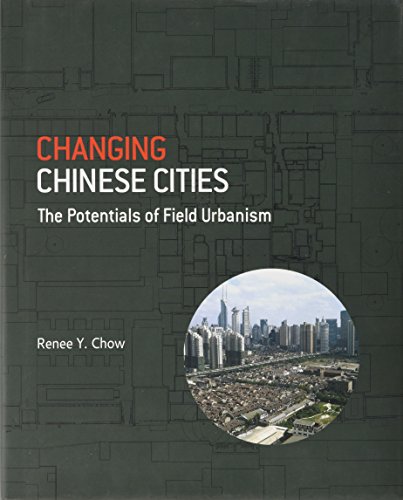
Until the middle of the twentieth century, Chinese urban life revolved around courtyards. Whether for housing or retail, administration or religion, everyday activities took place in a field of pavilions and walls that shaped collective ways of living. Changing Chinese Cities explores the reciprocal relations between compounds and how they inform a distinct and legible urbanism.
Following thirty years of economic and political containment, cities are now showcases whose every component―street, park, or building ―is designed to express distinctiveness. This propensity for the singular is erasing the relational fields that once distinguished each city. In China’s first tier cities, the result is a cacophony of events where the extraordinary is becoming a burden to the ordinary.
Using a lens of urban fields, Renee Y. Chow describes life in neighborhoods of Beijing, Tianjin, Shanghai and its canal environs. Detailed observations from courtyard to city are unlayered to reveal the relations that build extended environments. These attributes are then relayered to integrate the emergence of forms that are rooted to a place, providing a new paradigm for urban design and master planning. Essays, mappings and case studies demonstrate how the design of fields can be made as compelling as figures.
"Sinopsis" puede pertenecer a otra edición de este libro.
Acerca del autor
Renee Y. Chow is Professor of Architecture and Urban Design at University of California Berkeley, USA as well as a founding principal of Studio URBIS.
"Sobre este título" puede pertenecer a otra edición de este libro.
Resultados de la búsqueda para Changing Chinese Cities: The Potentials of Field Urbanism

Imagen del vendedor
Changing Chinese Cities: The Potentials of Field Urbanism.
Publicado por
NUS Press., Singapore., 2015
ISBN 10: 9971698331
ISBN 13: 9789971698331
Antiguo o usado
Tapa dura
Librería: Asia Bookroom ANZAAB/ILAB, Canberra, ACT, Australia
Calificación del vendedor: 5 de 5 estrellas

Maps, plans, colour photographic illustrations, xv + 185pp, notes, bibliography, index, dustjacket. Until the middle of the twentieth century, Chinese urban life revolved around courtyards. Whether for housing or retail, administration or religion, everyday activities took place in a field of pavilions and walls that shaped collective ways of living. Changing Chinese Cities explores the reciprocal relations between compounds and how they inform a distinct and legible urbanism. Following thirty years of economic and political containment, cities are now showcases whose every component street, park, or building is designed to express distinctiveness. This propensity for the singular is erasing the relational fields that once distinguished each city. In China's first tier cities, the result is a cacophony of events where the extraordinary is becoming a burden to the ordinary. Using a lens of urban fields, Renee Y. Chow describes life in neighborhoods of Beijing, Tianjin, Shanghai and its canal environs. Detailed observations from courtyard to city are unlayered to reveal the relations that build extended environments. These attributes are then relayered to integrate the emergence of forms that are rooted to a place, providing a new paradigm for urban design and master planning. Essays, mappings and case studies demonstrate how the design of fields can be made as compelling as figures. Fully illustrated in colour with 82 maps and architectural drawings, and 33 photographs. Renee Y. Chow is Professor of Architecture and Urban Design at University of California Berkeley as well as founding principal of Studio URBIS. Nº de ref. del artículo: 152580
Comprar usado
EUR 35,52
Envío por EUR 18,68
Se envía de Australia a Estados Unidos de America
Se envía de Australia a Estados Unidos de America
Cantidad disponible: 1 disponibles