
Artículos relacionados a Questions and Answers: 1 (Linguistic Calculation, 1)
Sinopsis
In almost all principled accounts of questions questions are related to the corresponding answers. Zellig Harris (Harris 1978:1), for example, maintains that" ... all interrogative sentences can be derived, by means of the independently established transformations of the language, from sentences which assert that someone is asking about a disjunction of statements which are the relevant possible answers to that interroga tive." This amounts to the claim that a yes-no question such as Will John stay? is derived from I ask you whether John will stay and a wh question such as Who came is derived from something like I ask you whether A came or B came or ... or X came .. Though in generative grammar interrogatives are not derived from the corresponding declaratives, the semantic interpretation of questions is akin to the syntactic source of questions posited by Harris. Jerrold J.Katz and Paul M.Postal (Katz-Postal 1964:113-117) state a reading rule for Q, the interrogative constituent, which boils down to (1) in the case of yes-no questions and to (2) in the case of wh-questions. (1) Tell me which of the following is true: John will stay or John will not stay. (2) Tell me which of the following is true: A came or B came or ... or X came. Thus, the semantic interpretation of questions makes reference to the set of possible answers represented here by a disjunction of statements.
"Sinopsis" puede pertenecer a otra edición de este libro.
Reseña del editor
In almost all principled accounts of questions questions are related to the corresponding answers. Zellig Harris (Harris 1978:1), for example, maintains that" ... all interrogative sentences can be derived, by means of the independently established transformations of the language, from sentences which assert that someone is asking about a disjunction of statements which are the relevant possible answers to that interroga tive." This amounts to the claim that a yes-no question such as Will John stay? is derived from I ask you whether John will stay and a wh question such as Who came is derived from something like I ask you whether A came or B came or ... or X came .. Though in generative grammar interrogatives are not derived from the corresponding declaratives, the semantic interpretation of questions is akin to the syntactic source of questions posited by Harris. Jerrold J.Katz and Paul M.Postal (Katz-Postal 1964:113-117) state a reading rule for Q, the interrogative constituent, which boils down to (1) in the case of yes-no questions and to (2) in the case of wh-questions. (1) Tell me which of the following is true: John will stay or John will not stay. (2) Tell me which of the following is true: A came or B came or ... or X came. Thus, the semantic interpretation of questions makes reference to the set of possible answers represented here by a disjunction of statements.
"Sobre este título" puede pertenecer a otra edición de este libro.
Resultados de la búsqueda para Questions and Answers: 1 (Linguistic Calculation, 1)

Imagen del vendedor
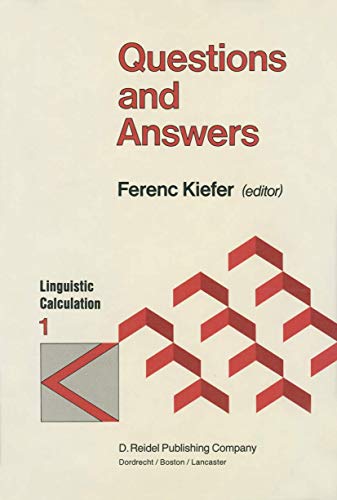
Questions and Answers: Linguistic Calculation Linguistic Calculation, 1
Librería: books4less (Versandantiquariat Petra Gros GmbH & Co. KG), Welling, Alemania
Calificación del vendedor: 5 de 5 estrellas

gebundene Ausgabe. Condición: Gut. 299 Seiten Das hier angebotene Buch stammt aus einer teilaufgelösten Bibliothek und kann die entsprechenden Kennzeichnungen aufweisen (Rückenschild, Instituts-Stempel.); der Buchzustand ist ansonsten ordentlich und dem Alter entsprechend gut. In ENGLISCHER Sprache. Sprache: Englisch Gewicht in Gramm: 585. Nº de ref. del artículo: 2151900
Comprar usado
EUR 49,95
Envío por EUR 15,95
Se envía de Alemania a Estados Unidos de America
Se envía de Alemania a Estados Unidos de America
Cantidad disponible: 1 disponibles
Imagen de archivo
Questions and Answers (Linguistic Calculation, 1)
Librería: Zubal-Books, Since 1961, Cleveland, OH, Estados Unidos de America
Calificación del vendedor: 5 de 5 estrellas
Condición: Very Good. *Price HAS BEEN REDUCED by 10% until Monday, Sept. 28 (weekend SALE item)* First edition, first printing, 306 pp., hardcover, previous owner's name to front free endpaper, several page corners bent else text clean & binding tight. - If you are reading this, this item is actually (physically) in our stock and ready for shipment once ordered. We are not bookjackers. Buyer is responsible for any additional duties, taxes, or fees required by recipient's country. Nº de ref. del artículo: ZB1317611
Comprar usado
EUR 80,99
Envío por EUR 3,95
Se envía dentro de Estados Unidos de America
Se envía dentro de Estados Unidos de America
Cantidad disponible: 1 disponibles
Imagen de archivo
Questions and Answers (Linguistic Calculation, 1)
Librería: California Books, Miami, FL, Estados Unidos de America
Calificación del vendedor: 5 de 5 estrellas
Condición: New. Nº de ref. del artículo: I-9789027715036
Comprar nuevo
EUR 127,49
Gastos de envío gratis
Se envía dentro de Estados Unidos de America
Se envía dentro de Estados Unidos de America
Cantidad disponible: Más de 20 disponibles
Imagen de archivo
Questions and Answers (Linguistic Calculation, 1)
Librería: Ria Christie Collections, Uxbridge, Reino Unido
Calificación del vendedor: 5 de 5 estrellas
Condición: New. In English. Nº de ref. del artículo: ria9789027715036_new
Comprar nuevo
EUR 127,74
Envío por EUR 13,13
Se envía de Reino Unido a Estados Unidos de America
Se envía de Reino Unido a Estados Unidos de America
Cantidad disponible: Más de 20 disponibles
Imagen de archivo
Questions and Answers
Librería: Books Puddle, Woodside, NY, Estados Unidos de America
Calificación del vendedor: 4 de 5 estrellas

Condición: New. pp. 312. Nº de ref. del artículo: 2614920093
Comprar nuevo
EUR 167,56
Envío por EUR 3,50
Se envía dentro de Estados Unidos de America
Se envía dentro de Estados Unidos de America
Cantidad disponible: 4 disponibles
Imagen del vendedor
Questions and Answers
Librería: moluna, Greven, Alemania
Calificación del vendedor: 5 de 5 estrellas
Gebunden. Condición: New. In almost all principled accounts of questions questions are related to the corresponding answers. Zellig Harris (Harris 1978:1), for example, maintains that . all interrogative sentences can be derived, by means of the independently established transfor. Nº de ref. del artículo: 5814775
Comprar nuevo
EUR 128,20
Envío por EUR 48,99
Se envía de Alemania a Estados Unidos de America
Se envía de Alemania a Estados Unidos de America
Cantidad disponible: Más de 20 disponibles
Imagen de archivo
Questions and Answers
Impresión bajo demandaLibrería: Majestic Books, Hounslow, Reino Unido
Calificación del vendedor: 4 de 5 estrellas
Condición: New. Print on Demand pp. 312 52:B&W 6.14 x 9.21in or 234 x 156mm (Royal 8vo) Case Laminate on White w/Gloss Lam. Nº de ref. del artículo: 9705026
Comprar nuevo
EUR 172,31
Envío por EUR 7,56
Se envía de Reino Unido a Estados Unidos de America
Se envía de Reino Unido a Estados Unidos de America
Cantidad disponible: 4 disponibles
Imagen de archivo
Questions and Answers
Impresión bajo demandaLibrería: Biblios, Frankfurt am main, HESSE, Alemania
Calificación del vendedor: 4 de 5 estrellas
Condición: New. PRINT ON DEMAND pp. 312. Nº de ref. del artículo: 1814920087
Comprar nuevo
EUR 172,95
Envío por EUR 9,95
Se envía de Alemania a Estados Unidos de America
Se envía de Alemania a Estados Unidos de America
Cantidad disponible: 4 disponibles
Imagen del vendedor
Questions and Answers
Librería: AHA-BUCH GmbH, Einbeck, Alemania
Calificación del vendedor: 5 de 5 estrellas
Buch. Condición: Neu. Neuware - In almost all principled accounts of questions questions are related to the corresponding answers. Zellig Harris (Harris 1978:1), for example, maintains that' . all interrogative sentences can be derived, by means of the independently established transformations of the language, from sentences which assert that someone is asking about a disjunction of statements which are the relevant possible answers to that interroga tive.' This amounts to the claim that a yes-no question such as Will John stay is derived from I ask you whether John will stay and a wh question such as Who came is derived from something like I ask you whether A came or B came or . or X came . Though in generative grammar interrogatives are not derived from the corresponding declaratives, the semantic interpretation of questions is akin to the syntactic source of questions posited by Harris. Jerrold J.Katz and Paul M.Postal (Katz-Postal 1964:113-117) state a reading rule for Q, the interrogative constituent, which boils down to (1) in the case of yes-no questions and to (2) in the case of wh-questions. (1) Tell me which of the following is true: John will stay or John will not stay. (2) Tell me which of the following is true: A came or B came or . or X came. Thus, the semantic interpretation of questions makes reference to the set of possible answers represented here by a disjunction of statements. Nº de ref. del artículo: 9789027715036
Comprar nuevo
EUR 163,57
Envío por EUR 35,00
Se envía de Alemania a Estados Unidos de America
Se envía de Alemania a Estados Unidos de America
Cantidad disponible: 1 disponibles