
Artículos relacionados a Implementation and Verification of Distributed Control...
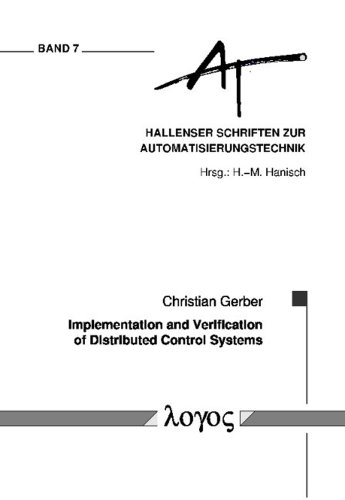
Implementation and Verification of Distributed Control Systems: 7 (Hallenser Schriften Zur Automatisierungstechnik) - Tapa blanda
Sinopsis
There exist certain key issues to modern industrial automation as modularity, reusability, portability, flexibility, extendibility and reconfigurability to create optimally coordinated automation solution for manufacturing plants. This will feature the operating companies to react fast and flexible to changed customer demands. An appropriate way to realize these issues is an object-oriented control implementation, which has been quite common since the late 90s. This work is focused on the upcoming standard IEC 61499, which defines an object-oriented and event-driven software model, which can be realised by any hardware the engineer prefers. Furthermore, the control implementation is application-oriented and all parts are mapped to available control devices later on. Thus, it is possible to replace one device by another by easily remapping the application. But, does this possibility need certain care during the development of the control application and how could a control engineer be supported to prove the correctness of the plant behaviour in any case? To answer this question the formal model discrete timed Net Condition/Event Systems is used in this work to model in a modular manner the control system and the plant. Both models are connected in closed loop to perform a reachability analysis. It is shown, how a control engineer can examine in a graphical manner the system behaviour for all possible cases by selecting interesting trajectories and drawing them as Gantt-Charts. Since the model of the plant incorporates all sensors and actuators, the state of the corresponding places can be included into the Gantt-Chart.Even if the control engineer has no deep knowledge about the used formal model, this systematic and tool supported way ensures the possibility to analyse the system behaviour in any case, if he changes the control application or remaps it. This will reduce downtimes during production changes and new plant can be brought faster into service.
"Sinopsis" puede pertenecer a otra edición de este libro.
Resultados de la búsqueda para Implementation and Verification of Distributed Control...

Imagen de archivo
Implementation and Verification of Distributed Control Systems (Paperback)
Publicado por
Logos Verlag Berlin GmbH, Berlin, 2011
ISBN 10: 3832528490
ISBN 13: 9783832528492
Nuevo
Paperback
Librería: Grand Eagle Retail, Bensenville, IL, Estados Unidos de America
Calificación del vendedor: 5 de 5 estrellas

Paperback. Condición: new. Paperback. There exist certain key issues to modern industrial automation as modularity, reusability, portability, flexibility, extendibility and reconfigurability to create optimally coordinated automation solution for manufacturing plants. This will feature the operating companies to react fast and flexible to changed customer demands. An appropriate way to realize these issues is an object-oriented control implementation, which has been quite common since the late 90s. This work is focused on the upcoming standard IEC 61499, which defines an object-oriented and event-driven software model, which can be realised by any hardware the engineer prefers. Furthermore, the control implementation is application-oriented and all parts are mapped to available control devices later on. Thus, it is possible to replace one device by another by easily remapping the application. But, does this possibility need certain care during the development of the control application and how could a control engineer be supported to prove the correctness of the plant behaviour in any case?To answer this question the formal model discrete timed Net Condition/Event Systems is used in this work to model in a modular manner the control system and the plant. Both models are connected in closed loop to perform a reachability analysis. It is shown, how a control engineer can examine in a graphical manner the system behaviour for all possible cases by selecting interesting trajectories and drawing them as Gantt-Charts. Since the model of the plant incorporates all sensors and actuators, the state of the corresponding places can be included into the Gantt-Chart. Even if the control engineer has no deep knowledge about the used formal model, this systematic and tool supported way ensures the possibility to analyse the system behaviour in any case, if he changes the control application or remaps it. This will reduce downtimes during production changes and new plant can be brought faster into service. Shipping may be from multiple locations in the US or from the UK, depending on stock availability. Nº de ref. del artículo: 9783832528492
Comprar nuevo
EUR 81,11
Gastos de envío gratis
Se envía dentro de Estados Unidos de America
Se envía dentro de Estados Unidos de America
Cantidad disponible: 1 disponibles
Imagen de archivo
Implementation and Verification of Distributed Control Systems
Librería: Revaluation Books, Exeter, Reino Unido
Calificación del vendedor: 5 de 5 estrellas
Paperback. Condición: Brand New. 132 pages. 8.27x5.71 inches. In Stock. Nº de ref. del artículo: x-3832528490
Comprar nuevo
EUR 88,87
Envío por EUR 11,63
Se envía de Reino Unido a Estados Unidos de America
Se envía de Reino Unido a Estados Unidos de America
Cantidad disponible: 1 disponibles
Imagen de archivo
Implementation and Verification of Distributed Control Systems
Publicado por
Logos Verlag Berlin, 2011
ISBN 10: 3832528490
ISBN 13: 9783832528492
Nuevo
Tapa blanda
Librería: Kennys Bookstore, Olney, MD, Estados Unidos de America
Calificación del vendedor: 5 de 5 estrellas
Condición: New. 2011. Paperback. . . . . . Books ship from the US and Ireland. Nº de ref. del artículo: V9783832528492
Comprar nuevo
EUR 134,64
Envío por EUR 9,22
Se envía dentro de Estados Unidos de America
Se envía dentro de Estados Unidos de America
Cantidad disponible: 10 disponibles
Imagen de archivo
Implementation and Verification of Distributed Control Systems
Publicado por
Logos Verlag Berlin, 2011
ISBN 10: 3832528490
ISBN 13: 9783832528492
Nuevo
Tapa blanda
Librería: Kennys Bookshop and Art Galleries Ltd., Galway, GY, Irlanda
Calificación del vendedor: 5 de 5 estrellas
Condición: New. 2011. Paperback. . . . . . Nº de ref. del artículo: V9783832528492
Comprar nuevo
EUR 153,57
Envío por EUR 9,50
Se envía de Irlanda a Estados Unidos de America
Se envía de Irlanda a Estados Unidos de America
Cantidad disponible: 10 disponibles
Imagen del vendedor
Implementation and Verification of Distributed Control Systems
Publicado por
Logos Verlag Berlin GmbH, DE, 2011
ISBN 10: 3832528490
ISBN 13: 9783832528492
Nuevo
Paperback
Librería: Rarewaves.com UK, London, Reino Unido
Calificación del vendedor: 5 de 5 estrellas
Paperback. Condición: New. Nº de ref. del artículo: LU-9783832528492
Comprar nuevo
EUR 94,83
Envío por EUR 75,58
Se envía de Reino Unido a Estados Unidos de America
Se envía de Reino Unido a Estados Unidos de America
Cantidad disponible: 1 disponibles
Imagen de archivo
Implementation and Verification of Distributed Control Systems (Paperback)
Publicado por
Logos Verlag Berlin GmbH, Berlin, 2011
ISBN 10: 3832528490
ISBN 13: 9783832528492
Nuevo
Paperback
Librería: AussieBookSeller, Truganina, VIC, Australia
Calificación del vendedor: 5 de 5 estrellas
Paperback. Condición: new. Paperback. There exist certain key issues to modern industrial automation as modularity, reusability, portability, flexibility, extendibility and reconfigurability to create optimally coordinated automation solution for manufacturing plants. This will feature the operating companies to react fast and flexible to changed customer demands. An appropriate way to realize these issues is an object-oriented control implementation, which has been quite common since the late 90s. This work is focused on the upcoming standard IEC 61499, which defines an object-oriented and event-driven software model, which can be realised by any hardware the engineer prefers. Furthermore, the control implementation is application-oriented and all parts are mapped to available control devices later on. Thus, it is possible to replace one device by another by easily remapping the application. But, does this possibility need certain care during the development of the control application and how could a control engineer be supported to prove the correctness of the plant behaviour in any case?To answer this question the formal model discrete timed Net Condition/Event Systems is used in this work to model in a modular manner the control system and the plant. Both models are connected in closed loop to perform a reachability analysis. It is shown, how a control engineer can examine in a graphical manner the system behaviour for all possible cases by selecting interesting trajectories and drawing them as Gantt-Charts. Since the model of the plant incorporates all sensors and actuators, the state of the corresponding places can be included into the Gantt-Chart. Even if the control engineer has no deep knowledge about the used formal model, this systematic and tool supported way ensures the possibility to analyse the system behaviour in any case, if he changes the control application or remaps it. This will reduce downtimes during production changes and new plant can be brought faster into service. Shipping may be from our Sydney, NSW warehouse or from our UK or US warehouse, depending on stock availability. Nº de ref. del artículo: 9783832528492
Comprar nuevo
EUR 141,82
Envío por EUR 32,48
Se envía de Australia a Estados Unidos de America
Se envía de Australia a Estados Unidos de America
Cantidad disponible: 1 disponibles