
Artículos relacionados a Marcel Duchamp Tu m' - Puzzle upon Puzzle /anglais:...
Sinopsis
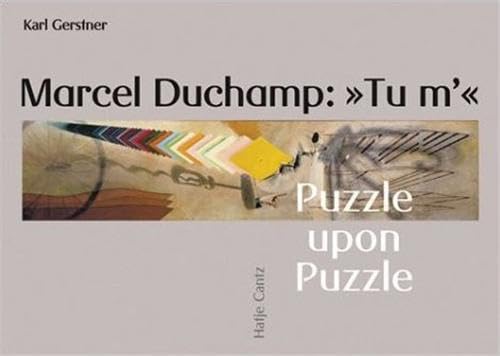
That it was Duchamp who precipitated the Copernican turn-around in art is an opinion long shared, and not only by insiders. The oeuvre Duchamp left us is exceedingly small, but hardly any of his works did not have to undergo multiple interpretations of an art historic, psychological, socio-critical or alchemist kind. Yet Duchamp's last work "in oil and vinegar", "Tu m'" from 1918, has never drawn extensive attention among his exegetes. Already the title poses a riddle: Does it mean "Tu m'aimes" (you love me) or, as most frequently guessed, "Tu m'emb tes" (you bore me), or, more poignantly even, "Tu m'emmerdes" (kiss my ass)? Karl Gerstner, one of the prominent Swiss graphic designers who knew Duchamp personally, was first taken aback by the work - but also fascinated at the same time. He then proceeded to get a picture of the picture himself in order to satisfy his curiosity. And the more deeply he penetrated into the matter the more his surprise abated and his fascination grew. This book has 20 analytical essays on the work.
"Sinopsis" puede pertenecer a otra edición de este libro.
Reseña del editor
The oeuvre Duchamp left us is small and repeatedly subject to multiple interpretations of the art historical, psychological, socio-critical and alchemical persuasion. And yet, how odd: Duchamp's last painting, Tu m' from 1918, has never drawn extensive attention among his exegetes. The title itself poses a riddle: Does it mean "tu m'aimes" (you love me), "tu m'emb'tes" (you bore me) or "tu m'emmerdes" (you can kiss my ass)? Karl Gerstner, a prominent Swiss graphic designer who knew Duchamp personally, was taken aback the first time he saw Tu m', but also intrigued. Having acquired a reproduction of the picture, Gerstner proceeded to penetrate its meanings and surfaces more and more deeply; as his surprise faded, his fascination grew. Enter this book, encouraged by artist Richard Hamilton (perhaps the most intimate of Duchamp connoisseurs), and its 20 analytical essays of riddle-solving.
"Sobre este título" puede pertenecer a otra edición de este libro.
Resultados de la búsqueda para Marcel Duchamp Tu m' - Puzzle upon Puzzle /anglais:...

Imagen de archivo
Marcel Duchamp: >>Tu m?<< Rätsel über Rätsel.
Publicado por
Ostfildern-Ruit., Hatje Cantz Verlag, 2003
ISBN 10: 3775791272
ISBN 13: 9783775791274
Antiguo o usado
Tapa dura
Librería: Rotes Antiquariat Wien, Wien, Austria
Calificación del vendedor: 3 de 5 estrellas

28 S. 4° 400 gr. Nº de ref. del artículo: WIE1036
Comprar usado
EUR 15,00
Envío por EUR 17,55
Se envía de Austria a Estados Unidos de America
Se envía de Austria a Estados Unidos de America
Cantidad disponible: 1 disponibles
Imagen de archivo
Marcel Duchamp, 'Tu m': Puzzle upon Puzzle
Publicado por
Hatje Cantz / Distributed Art Publishers, Ostfildern-Ruit / New York, 2003
ISBN 10: 3775791272
ISBN 13: 9783775791274
Antiguo o usado
Tapa dura
Librería: Mullen Books, ABAA, Marietta, PA, Estados Unidos de America
Calificación del vendedor: 4 de 5 estrellas

Hardcover. Quarto. Hardcover. Plain white paper wraps with white stamped itles. G+. Ex-art museum library with stickers on front and rear panel and plate inside. Tome foxing to boads. Nº de ref. del artículo: 216048
Comprar usado
EUR 27,58
Envío por EUR 11,60
Se envía dentro de Estados Unidos de America
Se envía dentro de Estados Unidos de America
Cantidad disponible: 1 disponibles
Imagen del vendedor
Marcel Duchamp Tu M': Riddles Galore
Publicado por
Hatje Cantz, 2003
ISBN 10: 3775791272
ISBN 13: 9783775791274
Antiguo o usado
Tapa dura
Librería: Walden Books, London, Reino Unido
Calificación del vendedor: 4 de 5 estrellas
Hardback. Condición: Very Good. Estado de la sobrecubierta: Very Good+. Dust jacket is lightly shelf-marked on rear; boards are faintly marked, corners sharp; binding is tight; pages are unmarked with colour plates. ; 8.3 x 0.5 x 11.5 inches; 55 pages. Nº de ref. del artículo: 58353
Comprar usado
EUR 32,25
Envío por EUR 17,72
Se envía de Reino Unido a Estados Unidos de America
Se envía de Reino Unido a Estados Unidos de America
Cantidad disponible: 1 disponibles
Imagen de archivo
Marcel Duchamp: Tu m' Puzzle upon Puzzle
Publicado por
Hatje Cantz, 2003
ISBN 10: 3775791272
ISBN 13: 9783775791274
Antiguo o usado
Tapa dura
Librería: Mooney's bookstore, Den Helder, Holanda
Calificación del vendedor: 4 de 5 estrellas
Condición: Very Good. Nº de ref. del artículo: 15A8262B8950D3E
Comprar usado
EUR 44,52
Envío por EUR 14,95
Se envía de Holanda a Estados Unidos de America
Se envía de Holanda a Estados Unidos de America
Cantidad disponible: 1 disponibles
Imagen del vendedor
Marcel Duchamp: Tu m'. Puzzle upon Puzzle.
Publicado por
Hatje Cantz Publishers, 2003
ISBN 10: 3775791272
ISBN 13: 9783775791274
Antiguo o usado
Tapa dura
Librería: Frans Melk Antiquariaat, HILVERSUM, Holanda
Calificación del vendedor: 5 de 5 estrellas

stfildern, Hatje Cantz Verlag, 2003. 29,5 x 21,5 cm. Hardcover with dustjacket. With 28 illustrations in color and b/w. NEW COPY Still shrinkwrapped [Art / international artist [Buitenlandse Kunstenaars] ]. Nº de ref. del artículo: #69204
Comprar usado
EUR 15,00
Envío por EUR 68,00
Se envía de Holanda a Estados Unidos de America
Se envía de Holanda a Estados Unidos de America
Cantidad disponible: 1 disponibles
Imagen de archivo
Marcel Duchamp: Tu m*: Puzzle Upon Puzzle
Publicado por
Hatje Cantz Publishers, 2003
ISBN 10: 3775791272
ISBN 13: 9783775791274
Antiguo o usado
Tapa dura
Librería: Mispah books, Redhill, SURRE, Reino Unido
Calificación del vendedor: 4 de 5 estrellas
Hardcover. Condición: Very Good. Very Good. Dust Jacket may NOT BE INCLUDED.CDs may be missing. SHIPS FROM MULTIPLE LOCATIONS. book. Nº de ref. del artículo: ERICA82937757912724
Comprar usado
EUR 232,42
Envío por EUR 29,54
Se envía de Reino Unido a Estados Unidos de America
Se envía de Reino Unido a Estados Unidos de America
Cantidad disponible: 1 disponibles