
Artículos relacionados a Systematics and Evolution: Part B (The Mycota)
Sinopsis
Mycology, the study of fungi, originated as a subdiscipline of botany and was a des criptive discipline, largely neglected as an experimental science until the early years of this century. A seminal paper by Blakeslee in 1904 provided evidence for self incompatibility, termed "heterothallism", and stimulated interest in studies related to the control of sexual reproduction in fungi by mating-type specificities. Soon to follow was the demonstration that sexually reproducing fungi exhibit Mendelian inheritance and that it was possible to conduct formal genetic analysis with fungi. The names Burgetf, Kniep and Lindegren are all associated with this early period of fungal genet ics research. These studies and the discovery of penicillin by Fleming, who shared a Nobel Prize in 1945, provided further impetus for experimental research with fungi. Thus began a period of interest in mutation induction and analysis of mutants for biochemical traits. Such fundamental research, conducted largely with Neurospora crassa, led to the one gene: one enzyme hypothesis and to a second Nobel Prize for fungal research awarded to Beadle and Tatum in 1958. Fundamental research in biochemical genetics was extended to other fungi, especially to Saccharomyces cerevisiae, and by the mid-1960s fungal systems were much favored for studies in eukaryotic molecular biology and were soon able to compete with bacterial systems in the molecular arena.
"Sinopsis" puede pertenecer a otra edición de este libro.
Reseña del editor
Mycology, the study of fungi, originated as a subdiscipline of botany and was a des criptive discipline, largely neglected as an experimental science until the early years of this century. A seminal paper by Blakeslee in 1904 provided evidence for self incompatibility, termed "heterothallism", and stimulated interest in studies related to the control of sexual reproduction in fungi by mating-type specificities. Soon to follow was the demonstration that sexually reproducing fungi exhibit Mendelian inheritance and that it was possible to conduct formal genetic analysis with fungi. The names Burgetf, Kniep and Lindegren are all associated with this early period of fungal genet ics research. These studies and the discovery of penicillin by Fleming, who shared a Nobel Prize in 1945, provided further impetus for experimental research with fungi. Thus began a period of interest in mutation induction and analysis of mutants for biochemical traits. Such fundamental research, conducted largely with Neurospora crassa, led to the one gene: one enzyme hypothesis and to a second Nobel Prize for fungal research awarded to Beadle and Tatum in 1958. Fundamental research in biochemical genetics was extended to other fungi, especially to Saccharomyces cerevisiae, and by the mid-1960s fungal systems were much favored for studies in eukaryotic molecular biology and were soon able to compete with bacterial systems in the molecular arena.
Reseña del editor
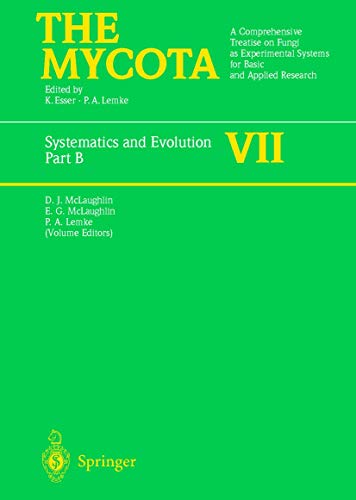
This is an exciting time to produce an overview of the systematics and evolution of the fungi. Molecular and subcellular characters have given us our first view of the true phylogeny of the fungi. The systematic chapters present detailed illustrated treatments of specific fungal groups with the authors' interpretation of the systematics of that group as well as a survey of specific economic, ecological, morphological, ultrastructural, molecular and cultural data. Other chapters, in addition to treating techniques useful in modern mycology, provide the reader with views of the place of the fungi among the Eukaryotes and relationships within the Mycota. Volume VII, Part A, includes an overview of the fungal hierarchy, Pseudomycota, Chytridiomycota, Zygomycota, Ascomycota and their yeasts, and anamorphic states. Volume VII, Part B, includes the Basidiomycota and their yeasts, and chapters on speciation, molecular evolution, preservation, computer techniques, and nomenclature.
"Sobre este título" puede pertenecer a otra edición de este libro.
Resultados de la búsqueda para Systematics and Evolution: Part B (The Mycota)

Imagen de archivo
The Mycota - Systematics and Evolution. Part B VII. A Comprehensive Treatise on Fungi as Experimental Systems for Basic and Applied Research.
Publicado por
Berlin, Springer., 2001
ISBN 10: 3540664939
ISBN 13: 9783540664932
Antiguo o usado
Tapa dura
Librería: Universitätsbuchhandlung Herta Hold GmbH, Berlin, Alemania
Calificación del vendedor: 4 de 5 estrellas

XX, 259 S. , Ill. Hardcover. Versand aus Deutschland / We dispatch from Germany via Air Mail. Einband bestoßen, daher Mängelexemplar gestempelt, sonst sehr guter Zustand. Imperfect copy due to slightly bumped cover, apart from this in very good condition. Stamped. Stamped. The Mycota; Vol. VII. Sprache: Englisch. Nº de ref. del artículo: 2675BB
Comprar usado
EUR 25,00
Envío por EUR 30,00
Se envía de Alemania a Estados Unidos de America
Se envía de Alemania a Estados Unidos de America
Cantidad disponible: 1 disponibles
Imagen de archivo
Systematics and Evolution (The Mycota)
Librería: Mispah books, Redhill, SURRE, Reino Unido
Calificación del vendedor: 4 de 5 estrellas
Hardcover. Condición: Very Good. Very Good. Dust Jacket may NOT BE INCLUDED.CDs may be missing. SHIPS FROM MULTIPLE LOCATIONS. book. Nº de ref. del artículo: ERICA82935406649394
Comprar usado
EUR 355,70
Envío por EUR 29,17
Se envía de Reino Unido a Estados Unidos de America
Se envía de Reino Unido a Estados Unidos de America
Cantidad disponible: 1 disponibles