
Artículos relacionados a SDL 2005: Model Driven: 12th International SDL Forum,...
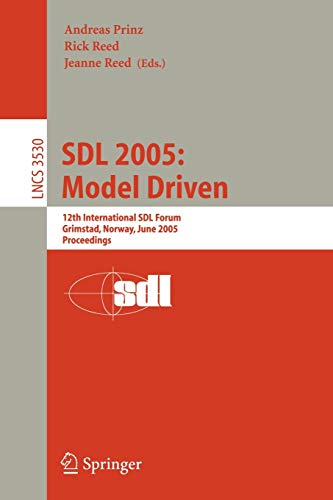
SDL 2005: Model Driven: 12th International SDL Forum, Grimstad, Norway, June 20-23, 2005, Proceedings: 3530 (Lecture Notes in Computer Science, 3530) - Tapa blanda
Sinopsis
This volume contains the papers presented at the 12th SDL Forum, Grimstad, Norway. The SDL Forum was ?rst held in 1982, and then every two years from 1985. Initially the Forum was concerned only with the Speci?cation and Description Language that was ?rst standardized in the 1976 Orange Book of the Inter- tional Telecommunication Union (ITU). Since then, many developments took place and the language has undergone several changes. However, the main underlying paradigm has survived, and it is the reason for the success of the Speci?cation and Description Language in many projects. This paradigm is based on the following important principles of distributed - plications: Communication: large systems tend to be described using smaller parts that communicate with each other; State: the systems are described on the basis of an explicit notion of state; State change: the behavior of the system is described in terms of (local) changes of the state. The original language is not the only representative for this kind of paradigm, so the scope of the SDL Forum was extended quite soon after the ?rst few events to also include other ITU standardized languages of the same family, such as MSC, ASN.1 and TTCN. This led to the current scope of System Design Languages coveringallstagesofthedevelopmentprocessincludinginparticularSDL,MSC, UML, ASN.1, eODL, TTCN, and URN. The focus is clearly on the advantages to users, and how to get from these languages the same advantage given by the ITU Speci?cation and Description Language: code generation from high-level speci?cations.
"Sinopsis" puede pertenecer a otra edición de este libro.
Reseña del editor
This volume contains the papers presented at the 12th SDL Forum, Grimstad, Norway. The SDL Forum was ?rst held in 1982, and then every two years from 1985. Initially the Forum was concerned only with the Speci?cation and Description Language that was ?rst standardized in the 1976 Orange Book of the Inter- tional Telecommunication Union (ITU). Since then, many developments took place and the language has undergone several changes. However, the main underlying paradigm has survived, and it is the reason for the success of the Speci?cation and Description Language in many projects. This paradigm is based on the following important principles of distributed - plications: Communication: large systems tend to be described using smaller parts that communicate with each other; State: the systems are described on the basis of an explicit notion of state; State change: the behavior of the system is described in terms of (local) changes of the state. The original language is not the only representative for this kind of paradigm, so the scope of the SDL Forum was extended quite soon after the ?rst few events to also include other ITU standardized languages of the same family, such as MSC, ASN.1 and TTCN. This led to the current scope of System Design Languages coveringallstagesofthedevelopmentprocessincludinginparticularSDL,MSC, UML, ASN.1, eODL, TTCN, and URN. The focus is clearly on the advantages to users, and how to get from these languages the same advantage given by the ITU Speci?cation and Description Language: code generation from high-level speci?cations.
Reseña del editor
This book constitutes the refereed proceedings of the 12th International SDL Forum, SDL 2005, held in Grimstad, Norway. The 16 revised full and 8 short papers presented were carefully reviewed and selected for inclusion in the book. The papers are organized in topical sections on language issues, engineering issues, message sequence charts, applications and tools, model driven architecture, test and validation, and code generation. Thus all aspects of system design using system design languages are addressed.
"Sobre este título" puede pertenecer a otra edición de este libro.
Resultados de la búsqueda para SDL 2005: Model Driven: 12th International SDL Forum,...

Imagen de archivo
SDL 2005: Model Driven: 12th International SDL Forum, Grimstad, Norway, June 20-23, 2005, Proceedings (Lecture Notes in Computer Science)
Librería: GuthrieBooks, Spring Branch, TX, Estados Unidos de America
Calificación del vendedor: 5 de 5 estrellas

Paperback. Condición: Very Good. Sorry, No international shipping on this item.Ex-library paperback in very nice condition with the usual markings and attachments. Except for library markings, interior clean and unmarked. Tight binding. Nº de ref. del artículo: UTD1419906
Comprar usado
EUR 38,55
Envío por EUR 6,09
Se envía dentro de Estados Unidos de America
Se envía dentro de Estados Unidos de America
Cantidad disponible: 1 disponibles
Imagen de archivo
SDL 2005: Model Driven : 12th International SDL Forum, Grimstad, Norway, June 20-23, 2005, Proceedings
Librería: GreatBookPrices, Columbia, MD, Estados Unidos de America
Calificación del vendedor: 5 de 5 estrellas
Condición: New. Nº de ref. del artículo: 3518336-n
Comprar nuevo
EUR 58,60
Envío por EUR 2,30
Se envía dentro de Estados Unidos de America
Se envía dentro de Estados Unidos de America
Cantidad disponible: Más de 20 disponibles
Imagen de archivo
SDL 2005: Model Driven: 12th International SDL Forum, Grimstad, Norway, June 20-23, 2005, Proceedings (Lecture Notes in Computer Science, 3530)
Librería: California Books, Miami, FL, Estados Unidos de America
Calificación del vendedor: 4 de 5 estrellas

Condición: New. Nº de ref. del artículo: I-9783540266129
Comprar nuevo
EUR 60,98
Gastos de envío gratis
Se envía dentro de Estados Unidos de America
Se envía dentro de Estados Unidos de America
Cantidad disponible: Más de 20 disponibles
Imagen de archivo
Sdl 2005: Model Driven
Librería: Basi6 International, Irving, TX, Estados Unidos de America
Calificación del vendedor: 5 de 5 estrellas
Condición: Brand New. New. US edition. Expediting shipping for all USA and Europe orders excluding PO Box. Excellent Customer Service. Nº de ref. del artículo: ABEOCT25-239717
Comprar nuevo
EUR 61,82
Gastos de envío gratis
Se envía dentro de Estados Unidos de America
Se envía dentro de Estados Unidos de America
Cantidad disponible: 1 disponibles
Imagen de archivo
Sdl 2005: Model Driven
Librería: Romtrade Corp., STERLING HEIGHTS, MI, Estados Unidos de America
Calificación del vendedor: 5 de 5 estrellas
Condición: New. This is a Brand-new US Edition. This Item may be shipped from US or any other country as we have multiple locations worldwide. Nº de ref. del artículo: ABBB-166351
Comprar nuevo
EUR 61,82
Gastos de envío gratis
Se envía dentro de Estados Unidos de America
Se envía dentro de Estados Unidos de America
Cantidad disponible: 1 disponibles
Imagen de archivo
SDL 2005: Model Driven: 12th International SDL Forum, Grimstad, Norway, June 20-23, 2005, Proceedings (Lecture Notes in Computer Science, 3530)
Librería: Ria Christie Collections, Uxbridge, Reino Unido
Calificación del vendedor: 5 de 5 estrellas
Condición: New. In English. Nº de ref. del artículo: ria9783540266129_new
Comprar nuevo
EUR 61,01
Envío por EUR 13,17
Se envía de Reino Unido a Estados Unidos de America
Se envía de Reino Unido a Estados Unidos de America
Cantidad disponible: Más de 20 disponibles
Imagen de archivo
SDL 2005: Model Driven: 12th International SDL Forum, Grimstad, Norway, June 20-23, 2005, Proceedings (Lecture Notes in Computer Science)
Librería: Chiron Media, Wallingford, Reino Unido
Calificación del vendedor: 5 de 5 estrellas
Paperback. Condición: New. Nº de ref. del artículo: 6666-IUK-9783540266129
Comprar nuevo
EUR 57,41
Envío por EUR 18,06
Se envía de Reino Unido a Estados Unidos de America
Se envía de Reino Unido a Estados Unidos de America
Cantidad disponible: 10 disponibles
Imagen del vendedor
SDL 2005: Model Driven
Publicado por
Springer Berlin Heidelberg Jun 2005, 2005
ISBN 10: 3540266127
ISBN 13: 9783540266129
Nuevo
Taschenbuch
Librería: BuchWeltWeit Ludwig Meier e.K., Bergisch Gladbach, Alemania
Calificación del vendedor: 5 de 5 estrellas
Taschenbuch. Condición: Neu. This item is printed on demand - it takes 3-4 days longer - Neuware -This volume contains the papers presented at the 12th SDL Forum, Grimstad, Norway. The SDL Forum was rst held in 1982, and then every two years from 1985. Initially the Forum was concerned only with the Speci cation and Description Language that was rst standardized in the 1976 Orange Book of the Inter- tional Telecommunication Union (ITU). Since then, many developments took place and the language has undergone several changes. However, the main underlying paradigm has survived, and it is the reason for the success of the Speci cation and Description Language in many projects. This paradigm is based on the following important principles of distributed - plications: Communication: large systems tend to be described using smaller parts that communicate with each other; State: the systems are described on the basis of an explicit notion of state; State change: the behavior of the system is described in terms of (local) changes of the state. The original language is not the only representative for this kind of paradigm, so the scope of the SDL Forum was extended quite soon after the rst few events to also include other ITU standardized languages of the same family, such as MSC, ASN.1 and TTCN. This led to the current scope of System Design Languages coveringallstagesofthedevelopmentprocessincludinginparticularSDL,MSC, UML, ASN.1, eODL, TTCN, and URN. The focus is clearly on the advantages to users, and how to get from these languages the same advantage given by the ITU Speci cation and Description Language: code generation from high-level speci cations. 380 pp. Englisch. Nº de ref. del artículo: 9783540266129
Comprar nuevo
EUR 53,49
Envío por EUR 23,00
Se envía de Alemania a Estados Unidos de America
Se envía de Alemania a Estados Unidos de America
Cantidad disponible: 2 disponibles
Imagen de archivo
SDL 2005
Librería: Books Puddle, New York, NY, Estados Unidos de America
Calificación del vendedor: 4 de 5 estrellas
Condición: Used. pp. 380. Nº de ref. del artículo: 263105796
Comprar usado
EUR 73,84
Envío por EUR 3,47
Se envía dentro de Estados Unidos de America
Se envía dentro de Estados Unidos de America
Cantidad disponible: 1 disponibles
Imagen del vendedor
SDL 2005: Model Driven : 12th International SDL Forum, Grimstad, Norway, June 20-23, 2005, Proceedings
Librería: GreatBookPricesUK, Woodford Green, Reino Unido
Calificación del vendedor: 5 de 5 estrellas
Condición: New. Nº de ref. del artículo: 3518336-n
Comprar nuevo
EUR 60,40
Envío por EUR 17,49
Se envía de Reino Unido a Estados Unidos de America
Se envía de Reino Unido a Estados Unidos de America
Cantidad disponible: Más de 20 disponibles