
Artículos relacionados a Cold Plasma in Nano-Matter Synthesis: Basic Principles...
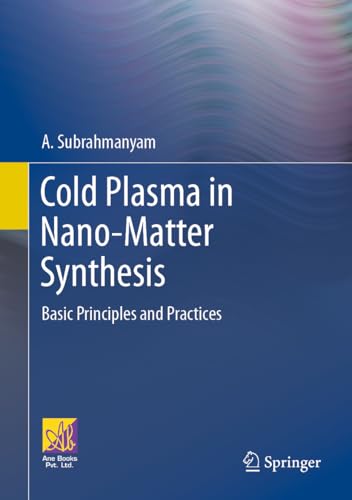
Sinopsis
This book describes the basic principles and techniques of cold plasma to synthesize nanomaterials, emphasizing the fundamentals.
Nanotechnology has matured enough to make inroads into the industry. “Quantum size effects” is the basis of the exotic properties of nanomaterials. The shapes and the size distribution dictate the properties of the nano-matter. The demands of the synthesis technique are to produce nano-matter with uniform size, repeatable shapes, uniform size distribution, stability of the nanostructures (reaching thermodynamic equilibrium), reproducibility of the particle sizes, and reliability of the process. These demands can be met when the synthesis technique has precise control over the process parameters. Cold plasma techniques possess all the requirements of the needs of nanomaterial synthesis. The cold plasma, an evolving field, has been established to be the most powerful tool not only for micro-electronics (both in the deposition and etching) but in many areas like health care, medicine, agriculture, food processing, etc.
The book’s primary emphasis is to explain the basic principles and concepts of cold plasma in nanomaterial synthesis. The target audience is undergraduate and graduate students learning nanomaterial synthesis and plasma technology. It is hoped that this book also is a good source of reference for practicing scientists and engineers involved in synthesizing nanomaterials and nanostructures in the industry.
"Sinopsis" puede pertenecer a otra edición de este libro.
Acerca del autor
Dr. Subrahmanyam has teaching and research experience spanning over 38 years in Indian Institute of Technology Madras, Chennai. Presently, he is Senior Professor (retired). His main area of research is in thin films and surface engineering, basics of plasma, and bio-medical engineering. He has established a thin-film laboratory equipped with electron beam evaporation, DC and RF magnetron sputtering, pulsed laser deposition (PLD), and sol-gel techniques. His main area is on metal oxide thin films (ITO, ZnO, WO3, VO2) spanning the industrial applications of transparent conducting oxides (TCO) and electrochromics (WO3) for smart windows. He has designed and developed a non-contact and non-destructive surface analytical tool: Kelvin Probe; presently, this machine is being commercialized. He is Author (along with Dr. Suresh) of the first book on Kelvin Probe: The Kelvin Probe for Surface Engineering: Fundamentals and Design (ISBN 9781420080773) published by Ane Books, India, and CRC Press, USA (in 2010).
De la contraportada
This book describes the basic principles and techniques of cold plasma to synthesize nanomaterials, emphasizing the fundamentals.
Nanotechnology has matured enough to make inroads into the industry. "Quantum size effects" is the basis of the exotic properties of nanomaterials. The shapes and the size distribution dictate the properties of the nano-matter. The demands of the synthesis technique are to produce nano-matter with uniform size, repeatable shapes, uniform size distribution, stability of the nanostructures (reaching thermodynamic equilibrium), reproducibility of the particle sizes, and reliability of the process. These demands can be met when the synthesis technique has precise control over the process parameters. Cold plasma techniques possess all the requirements of the needs of nanomaterial synthesis. The cold plasma, an evolving field, has been established to be the most powerful tool not only for micro-electronics (both in the deposition and etching) but in many areas like health care, medicine, agriculture, food processing, etc.
The book's primary emphasis is to explain the basic principles and concepts of cold plasma in nanomaterial synthesis. The target audience is undergraduate and graduate students learning nanomaterial synthesis and plasma technology. It is hoped that this book also is a good source of reference for practicing scientists and engineers involved in synthesizing nanomaterials and nanostructures in the industry.
"Sobre este título" puede pertenecer a otra edición de este libro.
Resultados de la búsqueda para Cold Plasma in Nano-Matter Synthesis: Basic Principles...

Imagen de archivo
Cold Plasma in Nano-Matter Synthesis (eng)
Impresión bajo demandaLibrería: Brook Bookstore On Demand, Napoli, NA, Italia
Calificación del vendedor: 5 de 5 estrellas

Condición: new. Questo è un articolo print on demand. Nº de ref. del artículo: BDOYKV46HU
Comprar nuevo
EUR 142,27
Envío por EUR 8,00
Se envía de Italia a Estados Unidos de America
Se envía de Italia a Estados Unidos de America
Cantidad disponible: Más de 20 disponibles
Imagen de archivo
Cold Plasma in Nano-matter Synthesis : Basic Principles and Practices
Librería: GreatBookPrices, Columbia, MD, Estados Unidos de America
Calificación del vendedor: 5 de 5 estrellas
Condición: New. Nº de ref. del artículo: 49368041-n
Comprar nuevo
EUR 156,76
Envío por EUR 2,37
Se envía dentro de Estados Unidos de America
Se envía dentro de Estados Unidos de America
Cantidad disponible: 1 disponibles
Imagen de archivo
Cold Plasma in Nano-Matter Synthesis
Librería: PBShop.store UK, Fairford, GLOS, Reino Unido
Calificación del vendedor: 5 de 5 estrellas
HRD. Condición: New. New Book. Shipped from UK. Established seller since 2000. Nº de ref. del artículo: GB-9783031640407
Comprar nuevo
EUR 156,59
Envío por EUR 7,04
Se envía de Reino Unido a Estados Unidos de America
Se envía de Reino Unido a Estados Unidos de America
Cantidad disponible: 1 disponibles
Imagen de archivo
Cold Plasma in Nano-matter Synthesis : Basic Principles and Practices
Librería: GreatBookPrices, Columbia, MD, Estados Unidos de America
Calificación del vendedor: 5 de 5 estrellas
Condición: As New. Unread book in perfect condition. Nº de ref. del artículo: 49368041
Comprar usado
EUR 177,42
Envío por EUR 2,37
Se envía dentro de Estados Unidos de America
Se envía dentro de Estados Unidos de America
Cantidad disponible: 1 disponibles
Imagen de archivo
COLD PLASMA IN NANOMATTER SYNTHESIS
Librería: Speedyhen, Hertfordshire, Reino Unido
Calificación del vendedor: 5 de 5 estrellas
Condición: NEW. Nº de ref. del artículo: NW9783031640407
Comprar nuevo
EUR 138,68
Envío por EUR 49,19
Se envía de Reino Unido a Estados Unidos de America
Se envía de Reino Unido a Estados Unidos de America
Cantidad disponible: 1 disponibles
Imagen del vendedor
Cold Plasma in Nano-Matter Synthesis
Publicado por
Springer, Berlin, Springer Nature Switzerland, Ane Books Pvt. Ltd., Springer, 2024
ISBN 10: 3031640403
ISBN 13: 9783031640407
Nuevo
Tapa dura
Librería: BuchWeltWeit Ludwig Meier e.K., Bergisch Gladbach, Alemania
Calificación del vendedor: 5 de 5 estrellas
Buch. Condición: Neu. This item is printed on demand - it takes 3-4 days longer - Neuware -This book describes the basic principles and techniques of cold plasma to synthesize nanomaterials, emphasizing the fundamentals.Nanotechnology has matured enough to make inroads into the industry. 'Quantum size effects' is the basis of the exotic properties of nanomaterials. The shapes and the size distribution dictate the properties of the nano-matter. The demands of the synthesis technique are to produce nano-matter with uniform size, repeatable shapes, uniform size distribution, stability of the nanostructures (reaching thermodynamic equilibrium), reproducibility of the particle sizes, and reliability of the process. These demands can be met when the synthesis technique has precise control over the process parameters. Cold plasma techniques possess all the requirements of the needs of nanomaterial synthesis. The cold plasma, an evolving field, has been established to be the most powerful tool not only for micro-electronics (both in the deposition and etching) but in many areas like health care, medicine, agriculture, food processing, etc.The book's primary emphasis is to explain the basic principles and concepts of cold plasma in nanomaterial synthesis. The target audience is undergraduate and graduate students learning nanomaterial synthesis and plasma technology. It is hoped that this book also is a good source of reference for practicing scientists and engineers involved in synthesizing nanomaterials and nanostructures in the industry. 372 pp. Englisch. Nº de ref. del artículo: 9783031640407
Comprar nuevo
EUR 181,89
Envío por EUR 23,00
Se envía de Alemania a Estados Unidos de America
Se envía de Alemania a Estados Unidos de America
Cantidad disponible: 2 disponibles
Imagen de archivo
Cold Plasma in Nano-matter Synthesis: Basic Principles and Practices
Librería: Revaluation Books, Exeter, Reino Unido
Calificación del vendedor: 5 de 5 estrellas
Hardcover. Condición: Brand New. 391 pages. 9.44x6.61x9.69 inches. In Stock. Nº de ref. del artículo: __3031640403
Comprar nuevo
EUR 204,75
Envío por EUR 15,00
Se envía de Reino Unido a Estados Unidos de America
Se envía de Reino Unido a Estados Unidos de America
Cantidad disponible: 1 disponibles
Imagen del vendedor
Cold Plasma in Nano-matter Synthesis
Publicado por
Springer, Berlin|Springer Nature Switzerland|Ane Books Pvt. Ltd.|Springer, 2024
ISBN 10: 3031640403
ISBN 13: 9783031640407
Nuevo
Tapa dura
Librería: moluna, Greven, Alemania
Calificación del vendedor: 5 de 5 estrellas
Condición: New. This book describes the basic principles and techniques of cold plasma to synthesize nanomaterials, emphasizing the fundamentals.Nanotechnology has matured enough to make inroads into the industry. Quantum size effects is the basis of the exotic. Nº de ref. del artículo: 1680674094
Comprar nuevo
EUR 172,61
Envío por EUR 48,99
Se envía de Alemania a Estados Unidos de America
Se envía de Alemania a Estados Unidos de America
Cantidad disponible: 1 disponibles
Imagen del vendedor
Cold Plasma in Nano-Matter Synthesis | Basic Principles and Practices
Impresión bajo demandaLibrería: preigu, Osnabrück, Alemania
Calificación del vendedor: 5 de 5 estrellas
Buch. Condición: Neu. Cold Plasma in Nano-Matter Synthesis | Basic Principles and Practices | A. Subrahmanyam | Buch | xix | Englisch | 2024 | Springer | EAN 9783031640407 | Verantwortliche Person für die EU: Springer Verlag GmbH, Tiergartenstr. 17, 69121 Heidelberg, juergen[dot]hartmann[at]springer[dot]com | Anbieter: preigu Print on Demand. Nº de ref. del artículo: 129299428
Comprar nuevo
EUR 159,60
Envío por EUR 70,00
Se envía de Alemania a Estados Unidos de America
Se envía de Alemania a Estados Unidos de America
Cantidad disponible: 5 disponibles
Imagen de archivo
Cold Plasma in Nano-Matter Synthesis (Hardcover)
Publicado por
Springer International Publishing AG, Cham, 2024
ISBN 10: 3031640403
ISBN 13: 9783031640407
Nuevo
Tapa dura
Librería: Grand Eagle Retail, Bensenville, IL, Estados Unidos de America
Calificación del vendedor: 5 de 5 estrellas
Hardcover. Condición: new. Hardcover. This book describes the basic principles and techniques of cold plasma to synthesize nanomaterials, emphasizing the fundamentals.Nanotechnology has matured enough to make inroads into the industry. Quantum size effects is the basis of the exotic properties of nanomaterials. The shapes and the size distribution dictate the properties of the nano-matter. The demands of the synthesis technique are to produce nano-matter with uniform size, repeatable shapes, uniform size distribution, stability of the nanostructures (reaching thermodynamic equilibrium), reproducibility of the particle sizes, and reliability of the process. These demands can be met when the synthesis technique has precise control over the process parameters. Cold plasma techniques possess all the requirements of the needs of nanomaterial synthesis. The cold plasma, an evolving field, has been established to be the most powerful tool not only for micro-electronics (both in the deposition and etching) but in many areas like health care, medicine, agriculture, food processing, etc.The books primary emphasis is to explain the basic principles and concepts of cold plasma in nanomaterial synthesis. The target audience is undergraduate and graduate students learning nanomaterial synthesis and plasma technology. It is hoped that this book also is a good source of reference for practicing scientists and engineers involved in synthesizing nanomaterials and nanostructures in the industry. This book describes the basic principles and techniques of cold plasma to synthesize nanomaterials, emphasizing the fundamentals.Nanotechnology has matured enough to make inroads into the industry. Shipping may be from multiple locations in the US or from the UK, depending on stock availability. Nº de ref. del artículo: 9783031640407
Comprar nuevo
EUR 234,28
Gastos de envío gratis
Se envía dentro de Estados Unidos de America
Se envía dentro de Estados Unidos de America
Cantidad disponible: 1 disponibles