
Artículos relacionados a The Myth of Multitasking: How "Doing It All"...
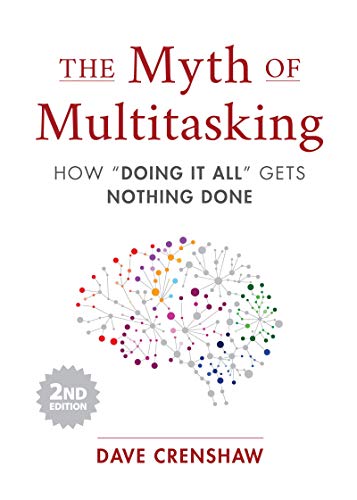
The Myth of Multitasking: How "Doing It All" Gets Nothing Done (2nd Edition) (Project Management and Time Management Skills) - Tapa dura
Sinopsis
The Myth of Multitasking takes a popular business superstition and confronts it head-on. Multitasking doesn’t save us time. The reality is that multitasking damages productivity and relationships, both at work and at home. This simple, powerful book shows precisely why multitasking is, in fact, a lie that wastes time and resources-and helps the reader come up with their own personalized game plan for a life with less multitasking.
"Sinopsis" puede pertenecer a otra edición de este libro.
Acerca del autor
As an author, speaker, and online trainer, Dave Crenshaw is a master of building productive leaders.
The irony of Dave’s productive mission is his inherently chaotic and unfocused nature. When he was clinically diagnosed as “off-the-charts” ADHD he took this as a personal challenge and developed simple systems to be organized and productive despite himself. Now, hundreds of thousands of high-performers worldwide utilize Dave’s training to improve focus, productivity, and profitability.
Dave has decades of experience training leaders in Fortune 500 companies, universities, and organizations of every size. His humorous and engaging approach always hits the mark with audiences. His speeches are described as dynamic and life-changing.
Dave’s courses on LinkedIn Learning―such as Time Management Fundamentals and Improving Your Focus―are consistently among the most popular in the world and have received tens of millions of views.
He also frequently appears in the news worldwide, including TIME Magazine, FastCompany, USA Today and the BBC News. However, Dave is most proud of being cited by Chuck Norris in The Official Chuck Norris Fact Book.
He is the founder and CEO of Invaluable Inc., a coaching and training corporation that promotes productive leadership on both the personal and organizational level.
Dave lives in the shadow of Utah’s Rocky Mountains with his wife and children.
Fragmento. © Reproducción autorizada. Todos los derechos reservados.
From the book:
While collecting her thoughts after Phil’s multitasking exercise, something caught Sally’s attention outside. “I think I’m witnessing a perfect example of what you’re talking about right now. Look out the window.”
Helen and Phil turned to look where Sally was staring. Through Helen’s second-story office window, they had a perfect view of the first-floor office area.
A young man wearing a T-shirt from a local college was standing next to a seated female co-worker. To Phil, it looked as if he was trying to share something very important with his coworker.
“Look at Tracy,” Sally said, pointing out of the window. Tracy the coworker was attempting to focus on her computer monitor—probably a company report—while attempting to give half an ear to the man standing next to her. “Is she even listening to Jason?”
“Jason’s one of our interns,” Helen explained to Phil. “He does good work, but he can be a little overeager sometimes. Tracy is his supervisor.”
Jason continued to speak enthusiastically, and Tracy nodded in response without ever turning away from her computer screen.
“Oh! Look!” Sally said excitedly. “Now she’s walking away to take a call on her cell!”
Jason stood there, hovering in mid-sentence, as he watched Tracy walk away. He dropped his arms in discouragement, shook his head, and shuffled away.
“Poor Jason-the-intern,” Sally said sympathetically. Helen glanced at Sally, and Phil caught the look of doubt on her face.
As the scene downstairs finished, Phil spoke softly. “It’s bad enough losing efficiency and effectiveness when we try to multitask. But when multitasking—switchtasking—involves another person, the costs are deeper.
“People deserve our full attention, whether at home or at work. When we give them only partial, piecemeal attention, the switching costs extend to damaging relationships.
“Moments like you just saw make people feel unimportant. They tell me this all the time.”
“I want people at GreenGarb to feel like they matter,” Helen offered.
Phil nodded. “I can tell you do. And when you focus on them, they feel that. But when you don’t focus on them, it’s the equivalent of seeing someone and saying, ‘Hi, you’re unimportant.’”
Sally chortled. “We’d never do that!”
“Of course not,” Phil replied. “But—”
“But we do that, don’t we?” Helen said. “All the time.”
Phil paused. Both women looked very deep in thought, and he gave them space to take in the moment.
Sally was the first to break the silence. “I have to admit, I need to work on this. I have a tough time giving people my undivided attention.”
Phil smiled encouragingly. “We’ve all done it, Sally. And we’ll continue doing it as long as multitasking—switchtasking—is seen as acceptable.
“The message is this: when someone says they’re ‘good at multitasking,’ they’re really saying they’re inefficient. It’s like publicly admitting you’re going to make it a habit to screw up multiple things at the same time.
“And, ironically, people who consider themselves great at multitasking are statistically more likely to be the worst at it.
“It doesn’t matter how effective you think you are at switchtasking. When you do it, you will take longer getting things done and hurt relationships in the process. Whenever possible, it’s better to focus on one activity—and one person—at a time.”
"Sobre este título" puede pertenecer a otra edición de este libro.
Resultados de la búsqueda para The Myth of Multitasking: How "Doing It All"...

Imagen de archivo
The Myth of Multitasking, Second Edition: How doing It All Gets Nothing Done
Publicado por
Mango Media, 2021
ISBN 10: 1642505056
ISBN 13: 9781642505054
Antiguo o usado
Tapa dura
Librería: World of Books (was SecondSale), Montgomery, IL, Estados Unidos de America
Calificación del vendedor: 5 de 5 estrellas

Hardback. Condición: Good. Multitasking Doesn?t Work?Learn What Does!??multitasking is, in fact, a lie that actually wastes time, energy, and money. Most of all, it robs us of life and our relationships with others.? ?Chuck Norris, world-renowned actor and martial artist Through anecdotal and real-world examples, The Myth of Multitasking proves that multitasking hurts your focus and productivity. Instead, learn how to be more effective by doing one thing at a time.Productivity and effective time management end with multitasking. The false idea that multitasking is productive has become even more prevalent and damaging to our productivity and well-being since the first edition of The Myth of Multitasking was published in 2008. In this revised and updated second edition, author and productivity expert Dave Crenshaw provides a solution for the chaos of distraction that multitasking creates?and a way to combat the temptation to constantly switch between tasks.Learn how to actually get things done. Dave Crenshaw takes the idea of multitasking as a productivity tool and smashes it to smithereens. But rather than leaving you with the burden of wading through the wreckage all by yourself, he shows you how to focus, move forward, and free up more time for what you value the most.In this new edition of The Myth of Multitasking, discover:Updated research on how and why multitasking doesn?t workWorksheets to help you figure out how to manage your day effectivelyEasy, actionable steps to manage your life well and accomplish your dreams and goalsReaders of self-improvement books and time management books like Indistractable, Free to Focus, or It Doesn't Have to Be Crazy at Work will love increasing productivity and personal success with The Myth of Multitasking. Nº de ref. del artículo: 00106290745
Comprar usado
EUR 3,47
Gastos de envío gratis
Se envía dentro de Estados Unidos de America
Se envía dentro de Estados Unidos de America
Cantidad disponible: 1 disponibles
Imagen de archivo
The Myth of Multitasking, Second Edition: How doing It All Gets Nothing Done
Publicado por
Mango Media, 2021
ISBN 10: 1642505056
ISBN 13: 9781642505054
Antiguo o usado
Tapa dura
Librería: World of Books Inc, Montgomery, IL, Estados Unidos de America
Calificación del vendedor: 4 de 5 estrellas

Hardback. Condición: Good. Multitasking Doesn?t Work?Learn What Does!??multitasking is, in fact, a lie that actually wastes time, energy, and money. Most of all, it robs us of life and our relationships with others.? ?Chuck Norris, world-renowned actor and martial artist Through anecdotal and real-world examples, The Myth of Multitasking proves that multitasking hurts your focus and productivity. Instead, learn how to be more effective by doing one thing at a time.Productivity and effective time management end with multitasking. The false idea that multitasking is productive has become even more prevalent and damaging to our productivity and well-being since the first edition of The Myth of Multitasking was published in 2008. In this revised and updated second edition, author and productivity expert Dave Crenshaw provides a solution for the chaos of distraction that multitasking creates?and a way to combat the temptation to constantly switch between tasks.Learn how to actually get things done. Dave Crenshaw takes the idea of multitasking as a productivity tool and smashes it to smithereens. But rather than leaving you with the burden of wading through the wreckage all by yourself, he shows you how to focus, move forward, and free up more time for what you value the most.In this new edition of The Myth of Multitasking, discover:Updated research on how and why multitasking doesn?t workWorksheets to help you figure out how to manage your day effectivelyEasy, actionable steps to manage your life well and accomplish your dreams and goalsReaders of self-improvement books and time management books like Indistractable, Free to Focus, or It Doesn't Have to Be Crazy at Work will love increasing productivity and personal success with The Myth of Multitasking. Nº de ref. del artículo: CIN1642505056G
Comprar usado
EUR 5,31
Gastos de envío gratis
Se envía dentro de Estados Unidos de America
Se envía dentro de Estados Unidos de America
Cantidad disponible: 1 disponibles
Imagen del vendedor
The Myth of Multitasking: How âDoing It Allâ Gets Nothing Done (2nd Edition) (Project Management and Time Management Skills)
Librería: Books for Life, LAUREL, MD, Estados Unidos de America
Calificación del vendedor: 5 de 5 estrellas
Condición: very_good. Book is in very good condition. Clean with little to no signs of wear or markings highlights. Nº de ref. del artículo: LFM.9LO3
Comprar usado
EUR 5,51
Gastos de envío gratis
Se envía dentro de Estados Unidos de America
Se envía dentro de Estados Unidos de America
Cantidad disponible: 1 disponibles
Imagen del vendedor
The Myth of Multitasking: How âDoing It Allâ Gets Nothing Done (2nd Edition) (Project Management and Time Management Skills)
Librería: Books for Life, LAUREL, MD, Estados Unidos de America
Calificación del vendedor: 5 de 5 estrellas
Condición: very_good. Book is in very good condition. Clean with little to no signs of wear or markings highlights. Nº de ref. del artículo: LFM.96JU
Comprar usado
EUR 5,51
Gastos de envío gratis
Se envía dentro de Estados Unidos de America
Se envía dentro de Estados Unidos de America
Cantidad disponible: 1 disponibles
Imagen de archivo
The Myth of Multitasking: How âDoing It Allâ Gets Nothing Done (2nd Edition) (Project Management and Time Management Skills)
Publicado por
TMA Press (edition 2), 2021
ISBN 10: 1642505056
ISBN 13: 9781642505054
Antiguo o usado
Tapa dura
Librería: BooksRun, Philadelphia, PA, Estados Unidos de America
Calificación del vendedor: 5 de 5 estrellas
Hardcover. Condición: Fair. 2. The item might be beaten up but readable. May contain markings or highlighting, as well as stains, bent corners, or any other major defect, but the text is not obscured in any way. Nº de ref. del artículo: 1642505056-7-1-13
Comprar usado
EUR 6,00
Gastos de envío gratis
Se envía dentro de Estados Unidos de America
Se envía dentro de Estados Unidos de America
Cantidad disponible: 1 disponibles
Imagen del vendedor
The Myth of Multitasking: How âDoing It Allâ Gets Nothing Done (2nd Edition) (Project Management and Time Management Skills)
Librería: Greenworld Books, Arlington, TX, Estados Unidos de America
Calificación del vendedor: 5 de 5 estrellas
Condición: good. Fast Free Shipping â" Good condition. It may show normal signs of use, such as light writing, highlighting, or library markings, but all pages are intact and the book is fully readable. A solid, complete copy that's ready to enjoy. Nº de ref. del artículo: GWV.1642505056.G
Comprar usado
EUR 6,00
Gastos de envío gratis
Se envía dentro de Estados Unidos de America
Se envía dentro de Estados Unidos de America
Cantidad disponible: 1 disponibles
Imagen del vendedor
The Myth of Multitasking: How âDoing It Allâ Gets Nothing Done (2nd Edition) (Project Management and Time Management Skills)
Librería: Greenworld Books, Arlington, TX, Estados Unidos de America
Calificación del vendedor: 5 de 5 estrellas
Condición: very_good. Fast Free Shipping â" Very Good condition book with a firm cover and clean pages. Shows normal use and some light wear or limited notes markings. A solid, nice copy to enjoy. Nº de ref. del artículo: GWV.1642505056.VG
Comprar usado
EUR 6,00
Gastos de envío gratis
Se envía dentro de Estados Unidos de America
Se envía dentro de Estados Unidos de America
Cantidad disponible: 2 disponibles
Imagen de archivo
The Myth of Multitasking: How ââ¬Å"Doing It Allââ¬Â Gets Nothing Don
Librería: Hawking Books, Edgewood, TX, Estados Unidos de America
Calificación del vendedor: 4 de 5 estrellas
Condición: Very Good. Very Good Condition. Five star seller - Buy with confidence! Nº de ref. del artículo: X1642505056X2
Comprar usado
EUR 6,52
Gastos de envío gratis
Se envía dentro de Estados Unidos de America
Se envía dentro de Estados Unidos de America
Cantidad disponible: 1 disponibles
Imagen de archivo
The Myth of Multitasking: How âDoing It Allâ Gets Nothing Done (2nd Edition) (Project Management and Time Management Skills)
Librería: Books-FYI, Inc., Cadiz, KY, Estados Unidos de America
Calificación del vendedor: 5 de 5 estrellas
hardcover. Condición: Good. Classification to import inventory to be deleted.MonsoonOP, SKU, and Classification are the three headers. place"a" in MonsoonOP column, the sku in the 2nd, and fill down RemovedQuanitity fo rthe classification. Nº de ref. del artículo: mon0000002499
Comprar usado
EUR 3,01
Envío por EUR 3,56
Se envía dentro de Estados Unidos de America
Se envía dentro de Estados Unidos de America
Cantidad disponible: 6 disponibles
Imagen de archivo
The Myth of Multitasking : How Doing It All Gets Nothing Done (2nd Edition) (Project Management and Time Management Skills)
Publicado por
Mango Media, 2021
ISBN 10: 1642505056
ISBN 13: 9781642505054
Antiguo o usado
Tapa dura
Librería: Better World Books, Mishawaka, IN, Estados Unidos de America
Calificación del vendedor: 5 de 5 estrellas
Condición: Good. Former library copy. Pages intact with minimal writing/highlighting. The binding may be loose and creased. Dust jackets/supplements are not included. Includes library markings. Stock photo provided. Product includes identifying sticker. Better World Books: Buy Books. Do Good. Nº de ref. del artículo: 41147244-6
Comprar usado
EUR 6,57
Gastos de envío gratis
Se envía dentro de Estados Unidos de America
Se envía dentro de Estados Unidos de America
Cantidad disponible: 2 disponibles