
Artículos relacionados a Numbers Don't Lie: Mets: The Biggest Numbers in...
Sinopsis
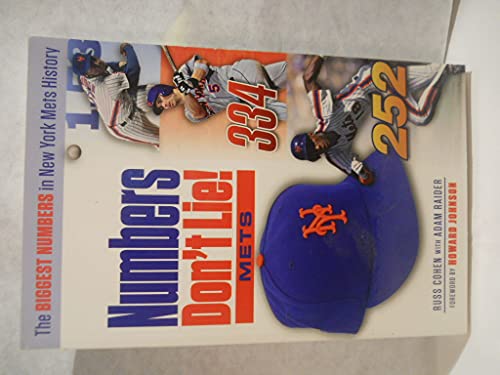
Numbers Don't Lie: Behind the Biggest Numbers in Mets History details the numbers every Mets fan should know by heart. Authors Russ Cohen and Adam Raider tell the stories behind the most memorable moments and achievements in Mets history, including 6: the number of Gold Gloves Keith Hernandez earned in his career; 480: the distance in feet Tommy Agee's home run traveled on April 10, 1969; and 696: the record number of at bats Jose Reyes had in in 2005 to set a franchise record. With over 50 entries that span more than a half-century of Mets magic, this resource is an engaging, unique look back at the history of one of baseball's most entertaining franchises.
"Sinopsis" puede pertenecer a otra edición de este libro.
Acerca del autor
Russ Cohen is an accomplished writer for www.sportsology.com and radio host for the Sportsology Radio Network and covers multiple sports. He has numerous articles published on NHL.com and other team websites as well as Slam, CSNPhilly.com and FoxSports.com. Some of his articles have appeared in Canadian Sports Collector, Goalie News, New England Hockey Journal, The Hockey News, Beckett Hockey, Blueshirt Bulletin, NHL Publications and he has a monthly column in Center Ice Magazine. Russ has been asked to be a guest on several radio shows as a respected and valued expert on sports and has extensive AM radio experience including Hockey Prospect Radio on NHL Network Radio for the last 12 years, plus TSN radio and Sportstalkny WLIE 540 AM.
Fragmento. © Reproducción autorizada. Todos los derechos reservados.
Numbers Don't Lie
The Biggest Numbers in New York Mets History
By Russ Cohen, Adam RaiderTriumph Books
Copyright © 2015 Russ Cohen and Adam Raider
All rights reserved.
ISBN: 978-1-62937-084-2All rights reserved.
Contents
Foreword by Howard Johnson,
Introduction,
1: First Overall Pick Plays 0 Major League Games,
2: Patient Olerud Bats .354,
3: Fonzie Bats a Fantastic .444,
4: Wally Backman's .989 Fielding Percentage,
5. There's Only 1 David Wright,
6: 1.2%: The Strawberry Snub,
7: Swoboda's 2 Home Runs Trump Carlton's 19 Strikeouts,
8: 2 Years at the Polo Grounds,
9: Tom Seaver Wins 3 Cy Young Awards,
10: Not a Typo: Rey Ordonez Made Only 4 Errors in '99,
11: Hometown Hero Baxter Draws 5 Walks,
12: Keith Hernandez Wins 5 Gold Gloves,
13: Mets Blow 7-Game Lead and Glavine Surrenders 7,
14: Delgado Drives in 9,
15: Tom Terrific Strikes Out 10 in a Row, 19 Overall,
16: Gary Carter's 11 Postseason RBI,
17: Matt Harvey's 11-Strikeout Debut,
18: The Year Felix Millan Struck Out Only 14 Times,
19: Ventura's 15th Inning "Grand Slam Single",
20: Mets Sign 17-Year-Old Dominican Phenom Juan Lagares,
21: Marvelous Marv's 17 Errors at First,
22: Amazin' for 18 Seasons: Ed Kranepool,
23: Doc Wins 24,
24: No. 24 Was a 24-Time All-Star,
25: Mets Lose 25-Inning Game,
26: Anthony Young's 27-Game Losing Streak,
27: Dickey's Scoreless Streak Reaches 32.2 Innings,
28: Workhorse Fisher First Met to Start 36 Games,
29: Todd Hundley's Record-Breaking 41 Home Runs,
30: Bob Murphy: 42 Years Behind the Mike,
31: Reviled Benitez Earns 43 Saves,
32: New York's First Subway World Series in 44 Years,
33: 45 Seasons at Shea,
34: 45 Things We'll Never Forget About Shea Stadium,
35: 63 Plunks and 0 Regrets for Al Leiter,
36: Despite 82 Wins, "Ya Gotta Believe!",
37: 90 Percent of the Game is Mental. The Other Half is Physical.,
38: Overworked Feliciano Takes the Mound 92 Times,
39: Piersall's 100th Career Home Run,
40: Nolan Ryan Walks 116 Batters,
41: deGrom Strikes Out 144, Wins Rookie of the Year,
42: 145 Whiffs: Mo Vaughn Strikes Out as a Met,
43: Dave Kingman's 156 Strikeouts,
44: Sidd Finch's 168 MPH Fastball,
45: "Hitman" Lance Johnson Bags 227,
46: John Franco's 276 Saves,
47: Piazza Becomes Home Run King Among Catchers with No. 352,
48: Tommie Agee's 480-Foot Blast,
49: Jose Reyes: Mets Record 696 At-Bats,
50: Omar Minaya Flies 2,800 Miles to Fire Willie Randolph,
51: Roberto Clemente, Jon Matlack, and Hit No. 3,000,
52: 4,800 Pounds. That's a Big Apple.,
53: Bobby V Fined $5,000 for Dugout Disguise,
54: 8,019 Games Without a No-Hitter,
55: 56,188 See First Mets-Yankees Interleague Game,
56: 42,000,000 Reasons You Can't Forget Bobby Bonilla,
Sources,
Acknowledgments,
CHAPTER 1
First Overall Pick Plays
0
Major League Games
In 1976, the Mets came under fire for not outbidding the Yankees for the services of free agent superstar Reggie Jackson. It wasn't the first time they blew an opportunity to get the home run-hitting outfielder. Years earlier, the Mets passed on Jackson to use the first overall pick in the 1966 draft to select Steve Chilcott, a lefty-hitting catcher who would never play baseball in the major leagues.
Jackson, for his part, alleged in his 2013 autobiography Becoming Mr. October that he was told the Mets didn't draft him because he was a black man dating a Mexican woman and the team didn't want to deal with the potential backlash. It's not a completely outrageous assertion, given the ultra-conservative state of baseball at the time.
Scouted by Casey Stengel, Chilcott was envisioned by the Mets to be their catcher for the next decade. But first, they dispatched the 17-year-old to the minor leagues, where he played with future Mets like Tug McGraw and Ron Swoboda.
In 1967, Chilcott was leading Winter Haven of the Florida State League in virtually every offensive category — he was also leading the league with 20 doubles — before suffering the freak shoulder injury on July 23 that would eventually derail his baseball career.
Chilcott was on first when there was a force at second. He slid into the bag and, believing he'd been called out, got up and started to jog off the field. Once he realized he had actually been called safe, he dove awkwardly back to the base. The infielder fell onto Chilcott's right shoulder — his throwing shoulder. It was never the same.
Over the next three seasons, Chilcott suffered over a dozen semi-dislocations. He often took cortisone shots to reduce inflammation before finally going under the knife to repair the shoulder permanently. Sports medicine wasn't what it is today, and Chilcott never regained his throwing and hitting strength.
Sometime later, he suffered a split kneecap when he fell on a sprinkler head.
Despite a series of heartbreaking setbacks, Chilcott refused to give up his dream of playing major league baseball. Eventually, he was traded to the Yankees, but his injury woes continued. In 1972, a broken right hand in spring training ruined his chances of making the team as Thurman Munson's backup.
Steve Chilcott is one of three first overall picks who never played in the majors.
Matt Bush San Diego Padres 2004
Brien Taylor New York Yankees 1991
Steve Chilcott New York Mets 1966
It wasn't easy to walk away from baseball, which Chilcott did at age 24. But he used a portion of his signing bonus to invest in real estate, worked as a carpenter, and built a new life for himself in relative anonymity.
Reggie, as is his fashion, took the opposite approach. In his brutally candid memoir, he referenced all the teams he wished he'd played for throughout his career and how much better off those teams would have been with him in the lineup. That included the Mets, who he believed would have won the 1973 World Series with him on their side instead of Oakland's.
"I think about that sometimes," he wrote. "I would've been coming up just as that team was finally improving. They had all those great arms: Tom Seaver, Jerry Koosman, Jon Matlack, Nolan Ryan, Tug McGraw. Oh boy!"
CHAPTER 2Patient Olerud Bats
.354
In his prime, John Olerud was one of the best line-drive hitters in the game. In 1998, his second year with the Mets, Olerud hit a club-record .354 in 160 games.
Olerud won back-to-back World Series championships with the Blue Jays in 1992 and 1993. Despite putting up solid numbers over the next several years, he failed to replicate the gaudy statistics of his breakout performance in 1993 when he led the league with a .363 batting average, a .473 on-base percentage that was tops in the majors, and career-highs in hits (200), runs (109), home runs (24), doubles (54), and RBI (107).
After the 1996 season, Olerud was battling veteran Joe Carter and up-and-comer Carlos Delgado for a spot at either first base or designated hitter. Delgado was younger and less expensive, making the veteran Olerud expendable. In a deal that set a baseball record for cash changing hands, the Blue Jays traded Olerud to the Mets for pitcher Robert Person and gave the Mets $5 million of the first baseman's $6.5 million salary. Toronto fans are still crying over that one. Person went 8–13 with a 6.18 ERA in two-plus seasons with the Jays.
With the Mets on the hook for just $1.5 million of his salary, Olerud had to be the best bargain in baseball. Coming off a disappointing final season in Toronto where he batted .274, he saw his average jump to .294 with 22 homers and 102 RBI. The Mets went 88–74 and missed the playoffs, but fans were finally excited to come to Shea again after six straight losing seasons.
Olerud was a two-position star (first base and pitcher) at Washington State University. His coach, Bobo Brayton, thought the world of him. "When I made up the lineup," Brayton once said, "I always put Ole in the third spot — where you want your best all-around player — and filled in around him. He led the world in everything."
Olerud had an unusual practice of wearing his batting helmet at all times — even while playing the field. In college, he suffered a brain hemorrhage and an aneurysm during a morning workout. Though he recovered, doctors advised him to wear a protective batting helmet while playing first base or pitching in order to protect against line drives and collisions with baserunners that might result in contact with the skull. That he still wore his helmet as a pro probably had less to do with excessive caution than with habit and superstition.
BIG MAN ON CAMPUS
John Olerud was one of the best all-around college baseball players ever. As a freshman in 1987, he batted .414 and finished 8–2 with a 3.00 ERA on the mound. He exploded as a sophomore, hitting .464 with 21 home runs and 81 RBI while compiling a 15–0 record with a 2.49 ERA, easily winning National Player of the Year. Even while recovering from that scary aneurysm, he hit .359 with five homers and 30 RBI in 78 plate appearances. There's even an award named after him: the John Olerud Two-Way Player of the Year Award, given to the best two-way player of the season. In 2007, John was inducted into the College Baseball Hall of Fame.
At 6'5", 205 pounds, Olerud reminded some of the Splendid Splinter himself, Ted Williams. Both were tall and lanky lefties with power and a great eye at the plate. Olerud wasn't flashy — he could lull an opponent to sleep by running up pitch counts — but fans really took to him. The Seattle native took to the Big Apple, too. By the end of April 1998, he was hitting a cool .359. A month later, his average was up to .371 and never fell below .339. Thanks to a 23-game hitting streak, he finished the season at .354, a Mets record that stands today. His on-base percentage of .447 is also a team record. For the second consecutive season, the Mets finished 88–74. Olerud again had 22 home runs and 93 RBI and yet he was only 12 in MVP voting.
In 1999, he also set the team record for most walks (125) and joined Robin Ventura, Edgardo Alfonzo, and Rey Ordonez on the cover of Sports Illustrated with a caption reading, "Best Infield Ever?" It might have been. The starting foursome was incredibly efficient, accounting for only 27 errors on the season.
After the Mets fell to Atlanta in the NLCS, Olerud — who hit .296 and led the Mets with two homers and six RBI in the series — became a free agent. Although he enjoyed his time in New York, and at times seemed to be leaning toward staying, the opportunity to return to his native Washington and play for his hometown Mariners proved too hard to resist.
Olerud's time with the Mets might have been brief, but its impact was great.
GREATEST EVER?
They weren't together for very long, but the infield of Olerud, Alfonzo, Ordonez, and Ventura was a joy to watch. Their sharp defensive play is a big reason why New York's pitching staff allowed only 20 unearned runs in 1999, the fewest since 1912 (not counting seasons shortened due to war or labor disputes).
CHAPTER 3Fonzie Bats a Fantastic
.444
Edgardo Alfonzo wasn't named MVP of the 2000 NLCS. That honor went to Mike Hampton. But in batting 8-for-18 with five runs scored and four RBI against St. Louis, "Fonzie" was the Mets' best hitter. His consistency made it easy for his teammates to drive him in. His postseason series average of .444 was the highest in Mets history.
Alfonzo was an undrafted free agent signed out of his native Venezuela in 1991 and he made his major league debut with the Mets four years later. His breakout campaign came in 1997 when he batted .315 with 163 hits in 151 games — the first of nine consecutive seasons with 100 or more hits.
A versatile infielder, Alfonzo spent much of his time in New York moving back and forth between shortstop, second, and third, depending on the organization's needs at any given time. In 1999, the Mets signed free agent third baseman Robin Ventura, prompting Fonzie to shift from third to second.
At second base, his defensive abilities really flourished. In turning 98 double plays and boasting a .993 fielding percentage, he was finally recognized as one of the best defensive players in the game. He took his offense up a notch that season, too, batting .304 with a career-high 27 home runs and 108 RBI. On August 30, he put on one of the great single-game performances ever by a Met, tying a record with six hits (including three homers) in a 17–1 rout of the Houston Astros. In the playoffs, he hit three home runs in the NLDS to help lead the Mets past Arizona.
By now, Alfonzo was really becoming a fan favorite in Queens. He had not only developed into one of the Mets' best all-around players, winning a Silver Slugger award and finishing eighth in National League MVP voting, but he also had a friendliness and approachability that made him seem doubly deserving of all the accolades he was receiving.
In a 2000 season that opened with a 5–3 loss to the Cubs at Japan's Tokyodome, Alfonzo delivered more of the same: 25 home runs, 94 runs batted in, his second consecutive year of 40 or more doubles, and career-bests in batting average (.324) and OPS (.967). Those are eye-popping numbers for a second baseman. He was an All-Star for the only time in his career and the 94–68 Mets had their mojo working for them heading into the playoffs.
The Mets made quick work of the San Francisco Giants and their allegedly chemically enhanced slugger, Barry Bonds, in the NLDS. Superb Giants pitching held the Mets to a paltry team average of .210 in the series, which New York won in four games. Alfonzo led the way batting .278 with a dinger and five RBI.
Next up for the Mets were the dreaded Cardinals. Mark McGwire, another heavy hitter whose reputation was ravaged by baseball's steroid scandal, only pinch-hit in the series because of patellar tendinitis in his knee. St. Louis was facing a Mets team playing its best baseball of the season.
Against the Cards, the Mets scored at least six runs in each of their four victories. Alfonzo, hitting second behind Timo Perez, went 1-for-3 with an RBI in Game 1. The late Darryl Kile pitched a solid seven innings for the Cardinals but Hampton didn't yield an earned run. Alfonzo got two more hits in Game 2, including a triple, and he helped pace the Mets to a 6–5 win behind the arm of Al Leiter. He went 2-for-4 in a Game 3 loss. In Game 4, St. Louis manager Tony La Russa raised some eyebrows by going back to Kile on three days' rest. The move backfired. Kile had nothing left in the tank, blowing a 2–0 lead as the Mets stormed back to win 10–6. Hampton pitched a complete-game shutout and Alfonzo went 2-for-4 as the Mets eliminated the Cardinals in Game 5 to advance to the World Series.
Alfonzo not only batted .444 in the NLCS but also had an OBP of .565, meaning he was on base more than 56 percent of the time in that series. Mike Piazza hit .412, Todd Zeile hit .368 with eight runs batted in, Robin Ventura had only three hits but knocked in five runs, and Perez crossed home plate eight times.
Like so many Mets of that era, reaching the 2000 World Series was the crowning achievement of Fonzie's career. In eight years with the club, he amassed a career .292/.367/.445 line in 4,449 plate appearances. He left as a free agent in 2002, signing a four-year deal with the Giants worth $26 million. But he never returned to the heights he enjoyed as a Met. He retired in 2006 following a forgettable season split between the Angels and Blue Jays.
In 2014, Alfonzo was named a minor league coach in the Mets' system.
CHAPTER 4Wally Backman's
.989
Fielding Percentage
Never the fastest or most talented player, Wally Backman became one of the most popular (if underrated) Mets of his era by playing a throwback-style of baseball. In 1985, the scrappy, hard-nosed second baseman set a Mets franchise mark for fielding proficiency.
Selected 16th overall by the Mets in 1977, Backman moved up quickly though quietly through the minor league ranks. Most fans had never heard of him by the time he got his September call-up in 1980. He singled and got an RBI in his first major league at-bat.
In his first few seasons, he was nothing more than a part-time infielder. Playing mostly second base, he also spent some time at shortstop and third base, but didn't really distinguish himself at either position. Even though it was clear that he belonged at second, there always seemed to be others ahead of him on the depth chart, like Gold Glove-winner Doug Flynn, or Brian Giles, a darling of the organization who offered a bit more offense and speed.
Opportunity knocked in 1984 when the Mets left Giles unprotected in the Rule V draft and he was claimed by the Milwaukee Brewers. That seemed to be the break the 24-year-old Backman was waiting for. He appeared in 128 games, batting .280 with 32 stolen bases. He was a spark plug on an up-and-coming team and new skipper Davey Johnson loved him. Johnson had managed Wally in the minors when they won an International League title with the Triple-A Tidewater Tides. Backman had so impressed Johnson that when he became the Mets manager in 1984, he brought Backman with him.
When you think Wally Backman, you think about a player full of piss and vinegar who always made the play in the hole between first and second base. He was the guy whose uniform always looked like it had been dragged through the dirt. With a dive or an outstretched glove, he got the most out of his 5'9", 160-pound frame, and Mets fans adored him for it.
In 1985, Backman's only year as a regular, he led NL second basemen (and set a Mets record for that position) with a .989 fielding percentage to go along with 272 putouts and only seven errors. He also turned 76 double plays. At the plate, he was the two-hole hitter in a very potent lineup, churning out a career-high 142 hits and a league-leading 14 sacrifice bunts.
The following season, the Mets were tabbed as a World Series contender. Backman and leadoff hitter Lenny Dykstra were dubbed "the Wild Boys." They were a dynamic 1–2 punch and they had similar styles: balls-to-the-wall baseball. Shortly after the Mets' magical season ended, the team put out a video called A Season to Remember and Duran Duran's hit single "Wild Boys" was featured during the segment on Dykstra and Backman.
Backman didn't have enough at-bats to win a batting title in 1986 but his .320 average was impressive nonetheless. He did head into the 1987 campaign as a regular, but he — and the team — had an off year, and the Mets missed the playoffs.
While the '88 Mets were back to being a contending team, their second baseman was back to being platooned. He managed to hit .303 in a reduced role and tied his career-best fielding percentage of .989. Tim Teufel, New York's other second baseman, was attracting more and more attention as his play improved. After the Mets lost in the NLCS to the Los Angeles Dodgers, they decided to make some changes.
That December, Backman was traded to the Minnesota Twins for a trio of minor leaguers. He kicked around the league for five more years before hanging up his spikes.
(Continues...)
Excerpted from Numbers Don't Lie by Russ Cohen, Adam Raider. Copyright © 2015 Russ Cohen and Adam Raider. Excerpted by permission of Triumph Books.
All rights reserved. No part of this excerpt may be reproduced or reprinted without permission in writing from the publisher.
Excerpts are provided by Dial-A-Book Inc. solely for the personal use of visitors to this web site.
"Sobre este título" puede pertenecer a otra edición de este libro.
Resultados de la búsqueda para Numbers Don't Lie: Mets: The Biggest Numbers in...

Imagen del vendedor
Numbers Don't Lie: Mets: The Biggest Numbers in Mets History (Paperback or Softback)
Publicado por
Triumph Books (IL) 6/1/2015, 2015
ISBN 10: 1629370843
ISBN 13: 9781629370842
Nuevo
Paperback or Softback
Librería: BargainBookStores, Grand Rapids, MI, Estados Unidos de America
Calificación del vendedor: 5 de 5 estrellas

Paperback or Softback. Condición: New. Numbers Don't Lie: Mets: The Biggest Numbers in Mets History. Book. Nº de ref. del artículo: BBS-9781629370842
Comprar nuevo
EUR 7,62
Gastos de envío gratis
Se envía dentro de Estados Unidos de America
Se envía dentro de Estados Unidos de America
Cantidad disponible: 5 disponibles
Imagen de archivo
Numbers Don't Lie: Mets: The Biggest Numbers in Mets History
Librería: Running Numbers, Grand Rapids, MI, Estados Unidos de America
Calificación del vendedor: 5 de 5 estrellas
paperback. Condición: New. Nº de ref. del artículo: 79190
Comprar nuevo
EUR 8,91
Envío por EUR 4,33
Se envía dentro de Estados Unidos de America
Se envía dentro de Estados Unidos de America
Cantidad disponible: Más de 20 disponibles
Imagen del vendedor
Numbers Don't Lie : The Biggest Numbers in New York Mets History
Librería: GreatBookPrices, Columbia, MD, Estados Unidos de America
Calificación del vendedor: 5 de 5 estrellas
Condición: New. Nº de ref. del artículo: 23401724-n
Comprar nuevo
EUR 12,90
Envío por EUR 2,29
Se envía dentro de Estados Unidos de America
Se envía dentro de Estados Unidos de America
Cantidad disponible: Más de 20 disponibles
Imagen del vendedor
Numbers Don't Lie: Mets
Librería: Rarewaves USA, OSWEGO, IL, Estados Unidos de America
Calificación del vendedor: 5 de 5 estrellas
Paperback. Condición: New. Numbers Don't Lie: Behind the Biggest Numbers in Mets History details the numbers every Mets fan should know by heart. Authors Russ Cohen and Adam Raider tell the stories behind the most memorable moments and achievements in Mets history, including 6: the number of Gold Gloves Keith Hernandez earned in his career; 480: the distance in feet Tommy Agee's home run traveled on April 10, 1969; and 696: the record number of at bats Jose Reyes had in in 2005 to set a franchise record. With over 50 entries that span more than a half-century of Mets magic, this resource is an engaging, unique look back at the history of one of baseball's most entertaining franchises. Nº de ref. del artículo: LU-9781629370842
Comprar nuevo
EUR 15,27
Gastos de envío gratis
Se envía dentro de Estados Unidos de America
Se envía dentro de Estados Unidos de America
Cantidad disponible: Más de 20 disponibles
Imagen de archivo
Numbers Don't Lie Format: Paperback
Librería: INDOO, Avenel, NJ, Estados Unidos de America
Calificación del vendedor: 5 de 5 estrellas
Condición: New. Brand New. Nº de ref. del artículo: 9781629370842
Comprar nuevo
EUR 15,36
Gastos de envío gratis
Se envía dentro de Estados Unidos de America
Se envía dentro de Estados Unidos de America
Cantidad disponible: Más de 20 disponibles
Imagen del vendedor
Numbers Don't Lie : The Biggest Numbers in New York Mets History
Publicado por
Triumph Books, 2015
ISBN 10: 1629370843
ISBN 13: 9781629370842
Antiguo o usado
Tapa blanda
Librería: GreatBookPrices, Columbia, MD, Estados Unidos de America
Calificación del vendedor: 5 de 5 estrellas
Condición: As New. Unread book in perfect condition. Nº de ref. del artículo: 23401724
Comprar usado
EUR 13,58
Envío por EUR 2,29
Se envía dentro de Estados Unidos de America
Se envía dentro de Estados Unidos de America
Cantidad disponible: Más de 20 disponibles
Imagen de archivo
Numbers Don't Lie: Mets (Paperback)
Publicado por
Triumph Books, Chicago, 2015
ISBN 10: 1629370843
ISBN 13: 9781629370842
Nuevo
Paperback
Librería: Grand Eagle Retail, Bensenville, IL, Estados Unidos de America
Calificación del vendedor: 5 de 5 estrellas
Paperback. Condición: new. Paperback. Numbers Don't Lie: Behind the Biggest Numbers in Mets History details the numbers every Mets fan should know by heart. Authors Russ Cohen and Adam Raider tell the stories behind the most memorable moments and achievements in Mets history, including 6: the number of Gold Gloves Keith Hernandez earned in his career; 480: the distance in feet Tommy Agee's home run traveled on April 10, 1969; and 696: the record number of at bats Jose Reyes had in in 2005 to set a franchise record. With over 50 entries that span more than a half-century of Mets magic, this resource is an engaging, unique look back at the history of one of baseball's most entertaining franchises. Shipping may be from multiple locations in the US or from the UK, depending on stock availability. Nº de ref. del artículo: 9781629370842
Comprar nuevo
EUR 17,83
Gastos de envío gratis
Se envía dentro de Estados Unidos de America
Se envía dentro de Estados Unidos de America
Cantidad disponible: 1 disponibles
Imagen del vendedor
Numbers Don't Lie: Mets
Librería: Rarewaves.com USA, London, LONDO, Reino Unido
Calificación del vendedor: 5 de 5 estrellas
Paperback. Condición: New. Numbers Don't Lie: Behind the Biggest Numbers in Mets History details the numbers every Mets fan should know by heart. Authors Russ Cohen and Adam Raider tell the stories behind the most memorable moments and achievements in Mets history, including 6: the number of Gold Gloves Keith Hernandez earned in his career; 480: the distance in feet Tommy Agee's home run traveled on April 10, 1969; and 696: the record number of at bats Jose Reyes had in in 2005 to set a franchise record. With over 50 entries that span more than a half-century of Mets magic, this resource is an engaging, unique look back at the history of one of baseball's most entertaining franchises. Nº de ref. del artículo: LU-9781629370842
Comprar nuevo
EUR 20,86
Gastos de envío gratis
Se envía de Reino Unido a Estados Unidos de America
Se envía de Reino Unido a Estados Unidos de America
Cantidad disponible: Más de 20 disponibles
Imagen de archivo
Numbers Don't Lie: Mets: The Biggest Numbers in Mets History
Librería: Kennys Bookshop and Art Galleries Ltd., Galway, GY, Irlanda
Calificación del vendedor: 5 de 5 estrellas
Condición: New. Nº de ref. del artículo: V9781629370842
Comprar nuevo
EUR 20,70
Envío por EUR 9,50
Se envía de Irlanda a Estados Unidos de America
Se envía de Irlanda a Estados Unidos de America
Cantidad disponible: Más de 20 disponibles
Imagen de archivo
Numbers Don't Lie: Mets: The Biggest Numbers in Mets History
Librería: Kennys Bookstore, Olney, MD, Estados Unidos de America
Calificación del vendedor: 5 de 5 estrellas
Condición: New. Nº de ref. del artículo: V9781629370842
Comprar nuevo
EUR 24,99
Envío por EUR 9,09
Se envía dentro de Estados Unidos de America
Se envía dentro de Estados Unidos de America
Cantidad disponible: Más de 20 disponibles