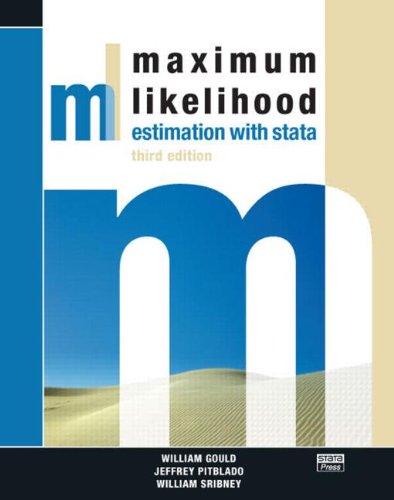
Sinopsis
Written by the creators of Stata's likelihood maximization features, Maximum Likelihood Estimation with Stata, Third Edition continues the pioneering work of the previous editions. Emphasizing practical implications for applied work, the first chapter provides an overview of maximum likelihood estimation theory and numerical optimization methods. With step-by-step instructions, the next several chapters detail the use of Stata to maximize user-written likelihood functions. Various examples include logit, probit, linear, Weibull, and random-effects linear regression as well as the Cox proportional hazards model. The final chapters describe how to add a new estimation command to Stata. Assuming a familiarity with Stata, this reference is ideal for researchers who need to maximize their own likelihood functions.
New ml commands and their functions:
"Sinopsis" puede pertenecer a otra edición de este libro.
Reseña del editor
Written by the creators of Stata's likelihood maximization features, Maximum Likelihood Estimation with Stata, Third Edition continues the pioneering work of the previous editions. Emphasizing practical implications for applied work, the first chapter provides an overview of maximum likelihood estimation theory and numerical optimization methods. With step-by-step instructions, the next several chapters detail the use of Stata to maximize user-written likelihood functions. Various examples include logit, probit, linear, Weibull, and random-effects linear regression as well as the Cox proportional hazards model. The final chapters describe how to add a new estimation command to Stata. Assuming a familiarity with Stata, this reference is ideal for researchers who need to maximize their own likelihood functions.
New ml commands and their functions:
"Sobre este título" puede pertenecer a otra edición de este libro.
Resultados de la búsqueda para Maximum Likelihood Estimation with Stata, Third Edition

Imagen de archivo
Maximum Likelihood Estimation with Stata
Publicado por
Taylor & Francis Group, 2005
ISBN 10: 1597180122
ISBN 13: 9781597180122
Antiguo o usado
Tapa blanda
Librería: Better World Books Ltd, Dunfermline, Reino Unido
Calificación del vendedor: 5 de 5 estrellas

Condición: Very Good. Ships from the UK. Used book that is in excellent condition. May show signs of wear or have minor defects. Nº de ref. del artículo: 6241386-75
Comprar usado
EUR 13,00
Gastos de envío:
EUR 9,17
De Reino Unido a Estados Unidos de America
Cantidad disponible: 1 disponibles
Imagen de archivo
Maximum Likelihood Estimation with Stata, Third Edition
Publicado por
Stata Press, 2006
ISBN 10: 1597180122
ISBN 13: 9781597180122
Antiguo o usado
Softcover
Librería: Ammareal, Morangis, Francia
Calificación del vendedor: 5 de 5 estrellas
Softcover. Condición: Très bon. Ancien livre de bibliothèque avec équipements. Edition 2006. Ammareal reverse jusqu'à 15% du prix net de cet article à des organisations caritatives. ENGLISH DESCRIPTION Book Condition: Used, Very good. Former library book. Edition 2006. Ammareal gives back up to 15% of this item's net price to charity organizations. Nº de ref. del artículo: G-600-554
Comprar usado
EUR 5,15
Gastos de envío:
EUR 20,50
De Francia a Estados Unidos de America
Cantidad disponible: 1 disponibles