
Artículos relacionados a Shaolin Qi Gong: Energy in Motion
Sinopsis
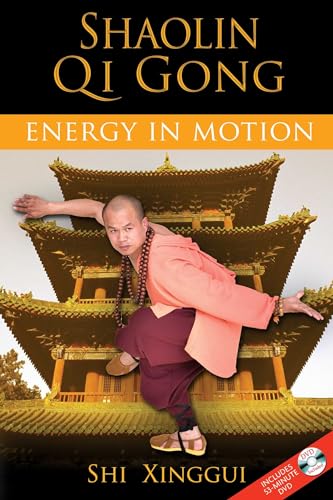
Authentic qi gong as practiced in the Shaolin Temple where this discipline originated centuries ago
• Reveals the fundamental spiritual principles and includes both a short and long form of the daily exercises
• Explains the benefits of mastering energy in the body, such as organ strengthening
• Includes a 53-minute DVD of exercises performed by the author, a Shaolin monk
The great teacher Bodhidharma is credited with the creation of Shaolin Temple qi gong and kung fu in the 6th century CE. Motivated by the terrible physical condition of the monks who spent all their time meditating or copying scrolls, his two-part system promoted physical as well as spiritual fitness and became the basis for all the martial and meditative arts taught in the Shaolin Temple. These ancient practices increase physical health and vitality, enhance creativity, and can be practiced well into old age.
Author Shi Xinggui, a Shaolin monk, explains the fundamental principle of qi gong--the art of mastering energy (qi) and moving it through the body--and provides clear demonstrations of all the positions and movements. In order to develop qi attentively, it is necessary to cultivate the art of slowness in both movement and breathwork. Shi Xinggui provides both a short form and a long form of the daily exercises, with lessons on heart centering, organ strengthening, and balancing the energy using the three dantians--the three energy centers of the body. A 53-minute DVD of the exercises performed by the author is also included.
"Sinopsis" puede pertenecer a otra edición de este libro.
Acerca del autor
Shi Xinggui became a student at the Shaolin Monastery at the age of eight. His teachers there included Masters Shi De Shin, Shi Xu Xi, Shi De Su, and Shi De Duzan. In 1988 the author won the National Championship title for kung fu (70 kg class) in Shaolin and again in 1993 and 1994 in Zheng Zou. He received his Shaolin diploma in 1989 from Master Shi De Yuan. He now lives and teaches in Goldegg, Austria.
De la contraportada
MARTIAL ARTS / HEALTH
The great teacher Bodhidharma is credited with the creation of Shaolin Temple Qi Gong and kung fu in the 6th century CE. Motivated by the terrible physical condition of the monks who spent all their time meditating or copying scrolls, his two-part system promoted physical as well as spiritual fitness and became the basis for all the martial and meditative arts taught in the Temple. These ancient practices increase physical health and vitality, enhance creativity, and can be practiced well into old age.
Author Shi Xinggui, a Shaolin monk, explains the fundamental principle of Qi Gong--the art of mastering energy (qi) and moving it through the body--and provides clear demonstrations of all the positions and movements. In order to develop qi attentively, it is necessary to cultivate the art of slowness in both movement and breathwork. Xinggui provides both a short form and a long form of the daily exercises, with lessons on heart centering, organ strengthening, and balancing the energy using the three dantians--the three energy centers of the body. A 53-minute DVD of the exercises performed by the author is included.
SHI XINGGUI became a student at the Shaolin Monastery at the age of eight. His teachers there included Masters Shi De Shin, Xu Xi, De Su, and De Duzan. In 1988 the author won the National Championship title for kung fu (70-kg class) in Shaolin and again in 1993 and 1994 in Zheng Zou. He received his diploma in 1989 from Master Shi De Yuan. He now lives and teaches in Goldegg, Austria.
Fragmento. © Reproducción autorizada. Todos los derechos reservados.
FROM PART 1
The Eternal Lightness of Being The Essence of Qi Gong
The concept “Qi Gong” (pronounced Chi Gung) is expressed by two Chinese characters:
Qi = life energy
Gong = work
Qi Gong therefore logically means work with life energy, which is known as Qi in China, Prana in India, Odem in some areas of the West, and often simply “energy” in modern language.
According to the Chinese conception, there is a cosmic intelligence living in the Qi. It lives in all things that exist naturally--humans, animals, plants, and minerals. Only its form of vibration changes depending on the form of manifestation.
According to the Chinese masters, every person is therefore born with a certain potential for life energy, with a certain initial capital of Qi. Everyday stress, unhealthy lifestyles, injuries, and major operations exhaust the human life energy capital to the extreme. Qi Gong is a simple technique for regaining the lost energy, reversing the deficit, and making normal life possible again.
Shi Xinggui Qi Gong
A few years ago, a physician who was taking Shi Xinggui’s course asked him how he might imagine an “internal morning shower” as a complement to external morning bathing. Shi Xinggui answered with the following combination of movements and intensive abdominal breathing.
This series of exercises is a good morning program for waking up in body and spirit and going into your day well prepared. It can also be done at other times of the day. But because of its energy potential, it should not be done right before going to bed, or it will certainly be two to three hours before you can sleep.
In Qi Gong, only a minimum of muscular force is used. But in these exercises, it is very important to work with spiritual force. This spiritual force is called Yi in Chinese. Yi means not thinking of oneself; it might be better expressed as awareness, as an intuitive understanding. It means turning all your attention to the doing, and practicing the exercises with intuitive attentiveness.
The more consciously we go through the exercises with our focus and attentiveness, the more quickly and effectively our energy reserves will be filled.
At first, go through each exercise 2 or 3 times. Once you have become more familiar with the breathing technique, you can do it more often.
Breathing Energy
This is one of the oldest Chinese breathing techniques to be mentioned in writing. Its original name is Tûná or Tugú náxîn, which could be literally translated as “giving up the old and taking in the new.”
- From the starting position, bend your knees down a bit more and form an imaginary energy ball in front of your body with both hands, about 20-30 centimeters in diameter. Between the two energy surfaces of your palms, an energetic contact emerges.
- Breathe in calmly and slowly, bringing this energy ball slowly up in front of your body to the neck area. You can also imagine that you are gently drawing energy upward from below. In doing this, stand up straight again. (Your knees remain loose.)
- Turn the palms of your hands down toward the earth. The energy is still there in your palms.
- Breathe out calmly and slowly, gently pressing the energy down with the palms of your hands. In doing this, bend your knees again, a bit more deeply. The fresh energy flows into your reservoir, your Dantian, and the used energy automatically flows out through your feet. Then repeat this succession of movements.
In order to be better able to take in energy, you can curl your toes a bit each time you breathe in, then spread them again as you breathe out. This curling makes a dimple appear in the front third of the sole (this is the location of the acupuncture point Kidney 1). Used energy is let out through this point, and fresh energy taken in. This movement is also good for the energy flow of the legs.
Note: Be especially attentive when breathing out, so that the energy can really sink downward. If you become lightheaded, immediately turn your attention to your feet, root yourself deeply in the earth, and breathe in. You will feel better right away.
Effect:
Your lungs are filled with fresh Qi, which can spread from there throughout the whole body.
Connecting
- Continue standing with your legs shoulder width apart. Check again to make sure all your joints are supple and relaxed, your pelvis slightly forward, and your tongue touching your palate. Tense your pelvic floor muscles a bit.
- Breathe in and go into a light crouch. As in the previous exercise, form an energy ball with your hands. Again, lift up the energy and your hands level with the base of your neck in front of your body, straightening up.
- Breathe out while bringing your hands around to the back of your neck, without moving the rest of your body, until your hands touch the “great vertebra point” (Chinese: Daz Hui). This is at the often prominent vertebra that marks the transition between the neck vertebrae and the thoracic vertebrae. Without interrupting the movement, bring up your hands, behind your head, until they are above your head.
- Make brief contact with the energy point at the top of your head, “heaven’s gate” or Bai Hui.
- Now your hands, above your head, grasp a ball of heavenly energy. Bend your knees slightly and breathe in.
- Now, as you breathe out, bring down this energy slowly in front of your body. Your palms face the floor and your legs slowly straighten up again.
Effect:
In order to boost the energy cycle, it is important to create a connection between the “great vertebra point” (Daz Hui) and the base of the skull. This supports the energy flow to “heaven’s gate” (Bai Hui).
"Sobre este título" puede pertenecer a otra edición de este libro.
Resultados de la búsqueda para Shaolin Qi Gong: Energy in Motion

Imagen de archivo
Shaolin Qi Gong: Energy in Motion [With DVD]
Publicado por
Destiny Books, 2008
ISBN 10: 1594772649
ISBN 13: 9781594772641
Antiguo o usado
Paperback
Librería: ThriftBooks-Atlanta, AUSTELL, GA, Estados Unidos de America
Calificación del vendedor: 5 de 5 estrellas

Paperback. Condición: Good. No Jacket. Pages can have notes/highlighting. Spine may show signs of wear. ~ ThriftBooks: Read More, Spend Less. Nº de ref. del artículo: G1594772649I3N00
Comprar usado
EUR 7,33
Gastos de envío gratis
Se envía dentro de Estados Unidos de America
Se envía dentro de Estados Unidos de America
Cantidad disponible: 1 disponibles
Imagen de archivo
Shaolin Qi Gong: Energy in Motion
Publicado por
Inner Traditions Bear and Company, 2008
ISBN 10: 1594772649
ISBN 13: 9781594772641
Antiguo o usado
Paperback
Librería: World of Books (was SecondSale), Montgomery, IL, Estados Unidos de America
Calificación del vendedor: 5 de 5 estrellas
Paperback. Condición: Very Good. The great teacher Bodhidharma is credited with the creation of Shaolin Temple qi gong and kung fu in the 6th century CE. Motivated by the terrible physical condition of the monks who spent all their time meditating or copying scrolls, his two-part system promoted physical as well as spiritual fitness and became the basis for all the martial and meditative arts taught in the Shaolin Temple. These ancient practices increase physical health and vitality, enhance creativity, and can be practiced well into old age. Author Shi Xinggui, a Shaolin monk, explains the fundamental principle of qi gong--the art of mastering energy (qi) and moving it through the body--and provides clear demonstrations of all the positions and movements. In order to develop qi attentively, it is necessary to cultivate the art of slowness in both movement and breathwork. Shi Xinggui provides both a short form and a long form of the daily exercises, with lessons on heart centering, organ strengthening, and balancing the energy using the three dantians--the three energy centers of the body. A 53-minute DVD of the exercises performed by the author is also included. Nº de ref. del artículo: CIN1594772649VG
Comprar usado
EUR 7,39
Gastos de envío gratis
Se envía dentro de Estados Unidos de America
Se envía dentro de Estados Unidos de America
Cantidad disponible: 1 disponibles
Imagen de archivo
Shaolin Qi Gong: Energy in Motion
Publicado por
Destiny Books, 2008
ISBN 10: 1594772649
ISBN 13: 9781594772641
Antiguo o usado
paperback
Librería: Book Alley, Pasadena, CA, Estados Unidos de America
Calificación del vendedor: 4 de 5 estrellas

paperback. Condición: Good. Gently used with limited markings. Includes DVD which is unmarked. Nº de ref. del artículo: mon0000786021
Comprar usado
EUR 2,81
Envío por EUR 5,46
Se envía dentro de Estados Unidos de America
Se envía dentro de Estados Unidos de America
Cantidad disponible: 1 disponibles
Imagen de archivo
Shaolin Qi Gong : Energy in Motion
Publicado por
Inner Traditions International, Limited, 2008
ISBN 10: 1594772649
ISBN 13: 9781594772641
Antiguo o usado
Tapa blanda
Librería: Better World Books, Mishawaka, IN, Estados Unidos de America
Calificación del vendedor: 5 de 5 estrellas
Condición: Good. Pages intact with minimal writing/highlighting. The binding may be loose and creased. Dust jackets/supplements are not included. Stock photo provided. Product includes identifying sticker. Better World Books: Buy Books. Do Good. Nº de ref. del artículo: 18959732-6
Comprar usado
EUR 8,51
Gastos de envío gratis
Se envía dentro de Estados Unidos de America
Se envía dentro de Estados Unidos de America
Cantidad disponible: 3 disponibles
Imagen de archivo
Shaolin Qi Gong: Energy in Motion
Publicado por
Destiny Books, 2008
ISBN 10: 1594772649
ISBN 13: 9781594772641
Antiguo o usado
paperback
Librería: HPB-Diamond, Dallas, TX, Estados Unidos de America
Calificación del vendedor: 5 de 5 estrellas
paperback. Condición: Very Good. Connecting readers with great books since 1972! Used books may not include companion materials, and may have some shelf wear or limited writing. We ship orders daily and Customer Service is our top priority! Nº de ref. del artículo: S_491074422
Comprar usado
EUR 7,49
Envío por EUR 3,41
Se envía dentro de Estados Unidos de America
Se envía dentro de Estados Unidos de America
Cantidad disponible: 1 disponibles
Imagen de archivo
Shaolin Qi Gong: Energy in Motion
Publicado por
Destiny Books, 2008
ISBN 10: 1594772649
ISBN 13: 9781594772641
Antiguo o usado
paperback
Librería: Patrico Books, Apollo Beach, FL, Estados Unidos de America
Calificación del vendedor: 5 de 5 estrellas
paperback. Condición: Very Good. Ships Out Tomorrow! Nº de ref. del artículo: 261025018
Comprar usado
EUR 9,37
Envío por EUR 3,63
Se envía dentro de Estados Unidos de America
Se envía dentro de Estados Unidos de America
Cantidad disponible: 1 disponibles
Imagen de archivo
Shaolin Qi Gong: Energy in Motion
Publicado por
Destiny Books, 2008
ISBN 10: 1594772649
ISBN 13: 9781594772641
Antiguo o usado
Paperback
Librería: Stock & Trade LLC, Portland, OR, Estados Unidos de America
Calificación del vendedor: 5 de 5 estrellas
Paperback. Condición: Very Good. A trade paperback in excellent condition, clean with a tight binding and an unmarked text.Complete with DVDFrom a private smoke free collection.Shipping within 24 hours, with a tracking number and delivery confirmation. Nº de ref. del artículo: SamBox8-1030d
Comprar usado
EUR 9,37
Envío por EUR 4,09
Se envía dentro de Estados Unidos de America
Se envía dentro de Estados Unidos de America
Cantidad disponible: 1 disponibles
Imagen de archivo
Shaolin Qi Gong Energy In Motion
Publicado por
Inner Traditions/Bear, 2008
ISBN 10: 1594772649
ISBN 13: 9781594772641
Antiguo o usado
Trade Paperback
Librería: Camp Popoki LLC dba Cozy Book Cellar, Bellingham, MA, Estados Unidos de America
Calificación del vendedor: 5 de 5 estrellas
Trade Paperback. Condición: Very Good +. Trade Paperback. Very Good +. INCLUDES DVD!!! Nº de ref. del artículo: 546678
Comprar usado
EUR 11,22
Envío por EUR 4,99
Se envía dentro de Estados Unidos de America
Se envía dentro de Estados Unidos de America
Cantidad disponible: 1 disponibles
Imagen de archivo
Shaolin Qi Gong - Energy In Motion
Publicado por
Destiny Books, Rochester, VT, 2007
ISBN 10: 1594772649
ISBN 13: 9781594772641
Nuevo
Soft cover
Librería: Veronica's Books, Gig Harbor, WA, Estados Unidos de America
Calificación del vendedor: 5 de 5 estrellas
Soft cover. Condición: New. Brand New Stock. Includes a 53-minute DVD of exercises. 153pp, fully illustrated with color photos. Book. Nº de ref. del artículo: 026463
Comprar nuevo
EUR 11,24
Envío por EUR 5,91
Se envía dentro de Estados Unidos de America
Se envía dentro de Estados Unidos de America
Cantidad disponible: 1 disponibles
Imagen de archivo
Shaolin Qi Gong - Energy in Motion (w/DVD)
Publicado por
Destiny Books, Rochester, Vermont, U.S.A., 2008
ISBN 10: 1594772649
ISBN 13: 9781594772641
Nuevo
Soft cover
Librería: Veronica's Books, Gig Harbor, WA, Estados Unidos de America
Calificación del vendedor: 5 de 5 estrellas
Soft cover. Condición: New. 2nd Printing. Brand New Stock. 153pp. Includes 53-minute DVD. Book. Nº de ref. del artículo: 027058
Comprar nuevo
EUR 13,12
Envío por EUR 5,91
Se envía dentro de Estados Unidos de America
Se envía dentro de Estados Unidos de America
Cantidad disponible: 1 disponibles