
Artículos relacionados a Humans Are Underrated: What High Achievers Know That...
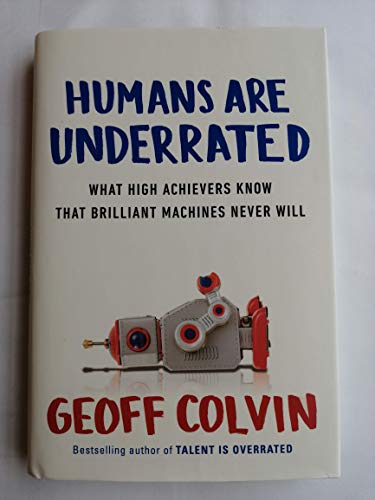
Sinopsis
As technology races ahead, what will people do better than computers?
What hope will there be for us when computers can drive cars better than humans, predict Supreme Court decisions better than legal experts, identify faces, scurry helpfully around offices and factories, even perform some surgeries, all faster, more reliably, and less expensively than people?
It’s easy to imagine a nightmare scenario in which computers simply take over most of the tasks that people now get paid to do. While we’ll still need high-level decision makers and computer developers, those tasks won’t keep most working-age people employed or allow their living standard to rise. The unavoidable question—will millions of people lose out, unable to best the machine?—is increasingly dominating business, education, economics, and policy.
The bestselling author of Talent Is Overrated explains how the skills the economy values are changing in historic ways. The abilities that will prove most essential to our success are no longer the technical, classroom-taught left-brain skills that economic advances have demanded from workers in the past. Instead, our greatest advantage lies in what we humans are most powerfully driven to do for and with one another, arising from our deepest, most essentially human abilities—empathy, creativity, social sensitivity, storytelling, humor, building relationships, and expressing ourselves with greater power than logic can ever achieve. This is how we create durable value that is not easily replicated by technology—because we’re hardwired to want it from humans.
These high-value skills create tremendous competitive advantage—more devoted customers, stronger cultures, breakthrough ideas, and more effective teams. And while many of us regard these abilities as innate traits—“he’s a real people person,” “she’s naturally creative”—it turns out they can all be developed. They’re already being developed in a range of far-sighted organizations, such as:
• the Cleveland Clinic, which emphasizes empathy training of doctors and all employees to improve patient outcomes and lower medical costs;
• the U.S. Army, which has revolutionized its training to focus on human interaction, leading to stronger teams and greater success in real-world missions;
• Stanford Business School, which has overhauled its curriculum to teach interpersonal skills through human-to-human experiences.
As technology advances, we shouldn’t focus on beating computers at what they do—we’ll lose that contest. Instead, we must develop our most essential human abilities and teach our kids to value not just technology but also the richness of interpersonal experience. They will be the most valuable people in our world because of it. Colvin proves that to a far greater degree than most of us ever imagined, we already have what it takes to be great.
"Sinopsis" puede pertenecer a otra edición de este libro.
Acerca de los autores
GEOFF COLVIN, Fortune’s senior editor at large, is one of America’s most respected journalists. He lectures widely and is the regular lead moderator for the Fortune Global Forum. He also appears daily on the CBS Radio Network, reaching seven million listeners each week. His previous book, Talent is Overrated, was a national bestseller and has been translated into a dozen languages.
GEOFF COLVIN, Fortune’s senior editor at large, is one of America’s most respected journalists. He lectures widely and is the regular lead moderator for the Fortune Global Forum. He also appears daily on the CBS Radio Network, reaching seven million listeners each week. His previous book, Talent is Overrated, was aWall Street Journal bestseller.
"Sobre este título" puede pertenecer a otra edición de este libro.
Resultados de la búsqueda para Humans Are Underrated: What High Achievers Know That...

Imagen de archivo
Humans Are Underrated: What High Achievers Know That Brilliant Machines Never Will
Librería: World of Books (was SecondSale), Montgomery, IL, Estados Unidos de America
Calificación del vendedor: 5 de 5 estrellas

Condición: Good. Item in good condition. Textbooks may not include supplemental items i.e. CDs, access codes etc. Nº de ref. del artículo: 00062704494
Comprar usado
EUR 4,50
Gastos de envío gratis
Se envía dentro de Estados Unidos de America
Se envía dentro de Estados Unidos de America
Cantidad disponible: 3 disponibles
Imagen del vendedor
Humans Are Underrated: What High Achievers Know That Brilliant Machines Never Will
Librería: Greenworld Books, Arlington, TX, Estados Unidos de America
Calificación del vendedor: 5 de 5 estrellas
Condición: good. Fast Free Shipping â" Good condition. It may show normal signs of use, such as light writing, highlighting, or library markings, but all pages are intact and the book is fully readable. A solid, complete copy that's ready to enjoy. Nº de ref. del artículo: GWV.1591847206.G
Comprar usado
EUR 4,51
Gastos de envío gratis
Se envía dentro de Estados Unidos de America
Se envía dentro de Estados Unidos de America
Cantidad disponible: 1 disponibles
Imagen de archivo
Humans Are Underrated: What High Achievers Know That Brilliant Machines Never Will
Publicado por
Portfolio (edition ), 2015
ISBN 10: 1591847206
ISBN 13: 9781591847205
Antiguo o usado
Tapa dura
Librería: BooksRun, Philadelphia, PA, Estados Unidos de America
Calificación del vendedor: 5 de 5 estrellas
Hardcover. Condición: Very Good. With dust jacket. It's a well-cared-for item that has seen limited use. The item may show minor signs of wear. All the text is legible, with all pages included. It may have slight markings and/or highlighting. Nº de ref. del artículo: 1591847206-11-6-29
Comprar usado
EUR 5,58
Gastos de envío gratis
Se envía dentro de Estados Unidos de America
Se envía dentro de Estados Unidos de America
Cantidad disponible: 1 disponibles
Imagen de archivo
Humans Are Underrated: What High Achievers Know That Brilliant Machines Never Will
Librería: HPB-Ruby, Dallas, TX, Estados Unidos de America
Calificación del vendedor: 5 de 5 estrellas
hardcover. Condición: Very Good. Connecting readers with great books since 1972! Used books may not include companion materials, and may have some shelf wear or limited writing. We ship orders daily and Customer Service is our top priority! Nº de ref. del artículo: S_470240655
Comprar usado
EUR 2,29
Envío por EUR 3,33
Se envía dentro de Estados Unidos de America
Se envía dentro de Estados Unidos de America
Cantidad disponible: 1 disponibles
Imagen de archivo
Humans Are Underrated: What High Achievers Know That Brilliant Machines Never Will
Librería: World of Books Inc, Montgomery, IL, Estados Unidos de America
Calificación del vendedor: 4 de 5 estrellas

Hardback. Condición: Good. As technology races ahead, what will people do better than computers? What hope will there be for us when computers can drive cars better than humans, predict Supreme Court decisions better than legal experts, identify faces, scurry helpfully around offices and factories, even perform some surgeries, all faster, more reliably, and less expensively than people? It's easy to imagine a nightmare scenario in which computers simply take over most of the tasks that people now get paid to do. While we'll still need high-level decision makers and computer developers, those tasks won't keep most working-age people employed or allow their living standard to rise. The unavoidable question--will millions of people lose out, unable to best the machine?--is increasingly dominating business, education, economics, and policy. The bestselling author of Talent Is Overrated explains how the skills the economy values are changing in historic ways. The abilities that will prove most essential to our success are no longer the technical, classroom-taught left-brain skills that economic advances have demanded from workers in the past. Instead, our greatest advantage lies in what we humans are most powerfully driven to do for and with one another, arising from our deepest, most essentially human abilities--empathy, creativity, social sensitivity, storytelling, humor, building relationships, and expressing ourselves with greater power than logic can ever achieve. This is how we create durable value that is not easily replicated by technology--because we're hardwired to want it from humans. These high-value skills create tremendous competitive advantage--more devoted customers, stronger cultures, breakthrough ideas, and more effective teams. And while many of us regard these abilities as innate traits--he's a real people person, she's naturally creative--it turns out they can all be developed. They're already being developed in a range of far-sighted organizations, such as: - the Cleveland Clinic, which emphasizes empathy training of doctors and all employees to improve patient outcomes and lower medical costs; - the U.S. Army, which has revolutionized its training to focus on human interaction, leading to stronger teams and greater success in real-world missions; - Stanford Business School, which has overhauled its curriculum to teach interpersonal skills through human-to-human experiences. As technology advances, we shouldn't focus on beating computers at what they do--we'll lose that contest. Instead, we must develop our most essential human abilities and teach our kids to value not just technology but also the richness of interpersonal experience. They will be the most valuable people in our world because of it. Colvin proves that to a far greater degree than most of us ever imagined, we already have what it takes to be great. Nº de ref. del artículo: CIN1591847206G
Comprar usado
EUR 6,33
Gastos de envío gratis
Se envía dentro de Estados Unidos de America
Se envía dentro de Estados Unidos de America
Cantidad disponible: 3 disponibles
Imagen de archivo
Humans Are Underrated: What High Achievers Know That Brilliant Machines Never Will
Librería: Wonder Book, Frederick, MD, Estados Unidos de America
Calificación del vendedor: 5 de 5 estrellas
Condición: Good. Good condition. Very Good dust jacket. A copy that has been read but remains intact. May contain markings such as bookplates, stamps, limited notes and highlighting, or a few light stains. Nº de ref. del artículo: T12I-02763
Comprar usado
EUR 6,40
Gastos de envío gratis
Se envía dentro de Estados Unidos de America
Se envía dentro de Estados Unidos de America
Cantidad disponible: 1 disponibles
Imagen de archivo
Humans Are Underrated : Proving Your Value in the Age of Brilliant Technology
Publicado por
Penguin Publishing Group, 2015
ISBN 10: 1591847206
ISBN 13: 9781591847205
Antiguo o usado
Librería: Better World Books, Mishawaka, IN, Estados Unidos de America
Calificación del vendedor: 5 de 5 estrellas
Condición: Good. Former library copy. Pages intact with minimal writing/highlighting. The binding may be loose and creased. Dust jackets/supplements are not included. Includes library markings. Stock photo provided. Product includes identifying sticker. Better World Books: Buy Books. Do Good. Nº de ref. del artículo: 8141060-75
Comprar usado
EUR 6,54
Gastos de envío gratis
Se envía dentro de Estados Unidos de America
Se envía dentro de Estados Unidos de America
Cantidad disponible: 1 disponibles
Imagen de archivo
Humans Are Underrated : Proving Your Value in the Age of Brilliant Technology
Publicado por
Penguin Publishing Group, 2015
ISBN 10: 1591847206
ISBN 13: 9781591847205
Antiguo o usado
Librería: Better World Books: West, Reno, NV, Estados Unidos de America
Calificación del vendedor: 5 de 5 estrellas
Condición: Good. Pages intact with minimal writing/highlighting. The binding may be loose and creased. Dust jackets/supplements are not included. Stock photo provided. Product includes identifying sticker. Better World Books: Buy Books. Do Good. Nº de ref. del artículo: 9312751-6
Comprar usado
EUR 6,54
Gastos de envío gratis
Se envía dentro de Estados Unidos de America
Se envía dentro de Estados Unidos de America
Cantidad disponible: 1 disponibles
Imagen de archivo
Humans Are Underrated : Proving Your Value in the Age of Brilliant Technology
Publicado por
Penguin Publishing Group, 2015
ISBN 10: 1591847206
ISBN 13: 9781591847205
Antiguo o usado
Librería: Better World Books, Mishawaka, IN, Estados Unidos de America
Calificación del vendedor: 5 de 5 estrellas
Condición: Good. Pages intact with minimal writing/highlighting. The binding may be loose and creased. Dust jackets/supplements are not included. Stock photo provided. Product includes identifying sticker. Better World Books: Buy Books. Do Good. Nº de ref. del artículo: 9312751-6
Comprar usado
EUR 6,54
Gastos de envío gratis
Se envía dentro de Estados Unidos de America
Se envía dentro de Estados Unidos de America
Cantidad disponible: 1 disponibles
Imagen de archivo
Humans Are Underrated: What High Achievers Know That Brilliant Machines Never Will
Librería: ThriftBooks-Atlanta, AUSTELL, GA, Estados Unidos de America
Calificación del vendedor: 5 de 5 estrellas
Hardcover. Condición: Very Good. No Jacket. May have limited writing in cover pages. Pages are unmarked. ~ ThriftBooks: Read More, Spend Less. Nº de ref. del artículo: G1591847206I4N00
Comprar usado
EUR 6,59
Gastos de envío gratis
Se envía dentro de Estados Unidos de America
Se envía dentro de Estados Unidos de America
Cantidad disponible: 1 disponibles