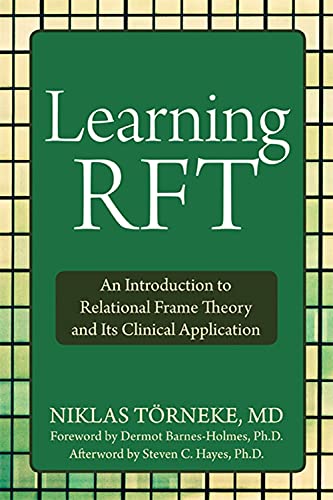
In this book Niklas Törneke presents the building blocks of RFT: language as a particular kind of relating, derived stimulus relations, and transformation of stimulus functions. He then shows how these concepts are essential to understanding acceptance and commitment therapy and other therapeutic models. Learning RFT shows how to use experiential exercises and metaphors in psychological treatment and explains how they can help your clients. This book belongs on the bookshelves of psychologists, psychotherapists, students, and others seeking to deepen their understanding of psychological treatment from a behavioral perspective.
"Sinopsis" puede pertenecer a otra edición de este libro.
Niklas Törneke, MD, is a psychiatrist and has worked as a senior psychiatrist in the department of general psychiatry in his hometown Kalmar (in the southeast of Sweden) from 1991 until he started private practice 1998. He earned license as a psychotherapist in 1996 and was originally trained as a cognitive therapist. Since 1998 he has worked mainly with acceptance and commitment therapy, both in his own practice and as a teacher and clinical supervisor. His clinical experience ranges from psychiatric disorders such as schizophrenia to common anxiety and mood disorders with high prevalence in the general population.
"Sobre este título" puede pertenecer a otra edición de este libro.
Librería: Grand Eagle Retail, Bensenville, IL, Estados Unidos de America
Paperback. Condición: new. Paperback. Relational frame theory, or RFT, is the little-understood behavioral theory behind a recent development in modern psychology: the shift from the cognitive paradigm underpinning cognitive behavioral therapy to a new understanding of language and cognition. Learning RFT presents a basic yet comprehensive introduction to this fascinating theory, which forms the basis of acceptance and commitment therapy. The book also offers practical guidance for directly applying it in clinical work. In the book, author Niklas Toerneke presents the building blocks of RFT: language as a particular kind of relating, derived stimulus relations, and transformation of stimulus functions. He then shows how these concepts are essential to understanding acceptance and commitment therapy and other therapeutic models. Learning RFT shows how to use experiential exercises and metaphors in psychological treatment and explains how they can help your clients. This book belongs on the bookshelves of psychologists, psychotherapists, students, and others seeking to deepen their understanding of psychological treatment from a behavioral perspective. Relational frame theory (RFT) is a theory of language and cognition that upends traditional cognitive paradigms and forms the foundation of today's cutting-edge therapies, including acceptance and commitment therapy (ACT). Learning RFT makes RFT accessible to clinicians for the first time and explains how RFT principles can be directly applied in clinical work. Shipping may be from multiple locations in the US or from the UK, depending on stock availability. Nº de ref. del artículo: 9781572249066
Cantidad disponible: 1 disponibles
Librería: EZ USED BOOKS LLC, East Providence, RI, Estados Unidos de America
Condición: acceptable. Acceptable â" A complete and fully readable copy that may show signs of use, such as highlighting, writing, small tears, stains, or the absence of a dust jacket. It may also be an ex-library copy with the usual stamps, labels, or stickers. Books with water damage are not intentionally listed. Access codes, CDs, DVDs, and other supplemental materials are not guaranteed. Condition varies from copy to copy. Some books may show only minor cosmetic wear and are in better condition than this general description suggests. If you would like to verify the exact condition of this copy before purchasing, please feel free to contact us, we'll be happy to provide photos upon request. Nº de ref. del artículo: EZBV.1572249064.A
Cantidad disponible: 1 disponibles
Librería: WorldofBooks, Goring-By-Sea, WS, Reino Unido
Paperback. Condición: Very Good. The book has been read, but is in excellent condition. Pages are intact and not marred by notes or highlighting. The spine remains undamaged. Nº de ref. del artículo: GOR003339792
Cantidad disponible: 1 disponibles
Librería: WorldofBooks, Goring-By-Sea, WS, Reino Unido
Paperback. Condición: Fine. Nº de ref. del artículo: GOR011114574
Cantidad disponible: 1 disponibles
Librería: eCampus, Lexington, KY, Estados Unidos de America
Condición: New. Nº de ref. del artículo: N:9781572249066:ONHAND
Cantidad disponible: 1 disponibles
Librería: CitiRetail, Stevenage, Reino Unido
Paperback. Condición: new. Paperback. Relational frame theory, or RFT, is the little-understood behavioral theory behind a recent development in modern psychology: the shift from the cognitive paradigm underpinning cognitive behavioral therapy to a new understanding of language and cognition. Learning RFT presents a basic yet comprehensive introduction to this fascinating theory, which forms the basis of acceptance and commitment therapy. The book also offers practical guidance for directly applying it in clinical work. In the book, author Niklas Toerneke presents the building blocks of RFT: language as a particular kind of relating, derived stimulus relations, and transformation of stimulus functions. He then shows how these concepts are essential to understanding acceptance and commitment therapy and other therapeutic models. Learning RFT shows how to use experiential exercises and metaphors in psychological treatment and explains how they can help your clients. This book belongs on the bookshelves of psychologists, psychotherapists, students, and others seeking to deepen their understanding of psychological treatment from a behavioral perspective. Relational frame theory (RFT) is a theory of language and cognition that upends traditional cognitive paradigms and forms the foundation of today's cutting-edge therapies, including acceptance and commitment therapy (ACT). Learning RFT makes RFT accessible to clinicians for the first time and explains how RFT principles can be directly applied in clinical work. Shipping may be from our UK warehouse or from our Australian or US warehouses, depending on stock availability. Nº de ref. del artículo: 9781572249066
Cantidad disponible: 1 disponibles
Librería: AussieBookSeller, Truganina, VIC, Australia
Paperback. Condición: new. Paperback. Relational frame theory, or RFT, is the little-understood behavioral theory behind a recent development in modern psychology: the shift from the cognitive paradigm underpinning cognitive behavioral therapy to a new understanding of language and cognition. Learning RFT presents a basic yet comprehensive introduction to this fascinating theory, which forms the basis of acceptance and commitment therapy. The book also offers practical guidance for directly applying it in clinical work. In the book, author Niklas Toerneke presents the building blocks of RFT: language as a particular kind of relating, derived stimulus relations, and transformation of stimulus functions. He then shows how these concepts are essential to understanding acceptance and commitment therapy and other therapeutic models. Learning RFT shows how to use experiential exercises and metaphors in psychological treatment and explains how they can help your clients. This book belongs on the bookshelves of psychologists, psychotherapists, students, and others seeking to deepen their understanding of psychological treatment from a behavioral perspective. Relational frame theory (RFT) is a theory of language and cognition that upends traditional cognitive paradigms and forms the foundation of today's cutting-edge therapies, including acceptance and commitment therapy (ACT). Learning RFT makes RFT accessible to clinicians for the first time and explains how RFT principles can be directly applied in clinical work. Shipping may be from our Sydney, NSW warehouse or from our UK or US warehouse, depending on stock availability. Nº de ref. del artículo: 9781572249066
Cantidad disponible: 1 disponibles