
Artículos relacionados a Algorithmic Randomness and Complexity: 0 (Theory and...
Sinopsis
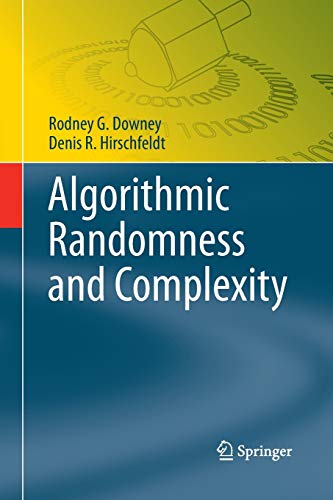
Computability and complexity theory are two central areas of research in theoretical computer science. This book provides a systematic, technical development of "algorithmic randomness" and complexity for scientists from diverse fields.
"Sinopsis" puede pertenecer a otra edición de este libro.
De la contraportada
Intuitively, a sequence such as 101010101010101010… does not seem random, whereas 101101011101010100…, obtained using coin tosses, does. How can we reconcile this intuition with the fact that both are statistically equally likely? What does it mean to say that an individual mathematical object such as a real number is random, or to say that one real is more random than another? And what is the relationship between randomness and computational power. The theory of algorithmic randomness uses tools from computability theory and algorithmic information theory to address questions such as these. Much of this theory can be seen as exploring the relationships between three fundamental concepts: relative computability, as measured by notions such as Turing reducibility; information content, as measured by notions such as Kolmogorov complexity; and randomness of individual objects, as first successfully defined by Martin-Löf. Although algorithmic randomness has been studied for several decades, a dramatic upsurge of interest in the area, starting in the late 1990s, has led to significant advances. This is the first comprehensive treatment of this important field, designed to be both a reference tool for experts and a guide for newcomers. It surveys a broad section of work in the area, and presents most of its major results and techniques in depth. Its organization is designed to guide the reader through this large body of work, providing context for its many concepts and theorems, discussing their significance, and highlighting their interactions. It includes a discussion of effective dimension, which allows us to assign concepts like Hausdorff dimension to individual reals, and a focused but detailed introduction to computability theory. It will be of interest to researchers and students in computability theory, algorithmic information theory, and theoretical computer science.
"Sobre este título" puede pertenecer a otra edición de este libro.
Resultados de la búsqueda para Algorithmic Randomness and Complexity: 0 (Theory and...

Imagen de archivo
Algorithmic Randomness and Complexity (Theory and Applications of Computability)
Librería: Books From California, Simi Valley, CA, Estados Unidos de America
Calificación del vendedor: 4 de 5 estrellas

paperback. Condición: Very Good. Cover and edges may have some wear. Nº de ref. del artículo: mon0004248041
Comprar usado
EUR 71,06
Envío por EUR 4,44
Se envía dentro de Estados Unidos de America
Se envía dentro de Estados Unidos de America
Cantidad disponible: 1 disponibles
Imagen de archivo
Algorithmic Randomness and Complexity (eng)
Impresión bajo demandaLibrería: Brook Bookstore On Demand, Napoli, NA, Italia
Calificación del vendedor: 5 de 5 estrellas

Condición: new. Questo è un articolo print on demand. Nº de ref. del artículo: U03BYHV4YN
Comprar nuevo
EUR 94,25
Envío por EUR 11,00
Se envía de Italia a Estados Unidos de America
Se envía de Italia a Estados Unidos de America
Cantidad disponible: Más de 20 disponibles
Imagen de archivo
Algorithmic Randomness and Complexity
Impresión bajo demandaLibrería: Chiron Media, Wallingford, Reino Unido
Calificación del vendedor: 5 de 5 estrellas
PF. Condición: New. This item is printed on demand. Brand new book, sourced directly from publisher. Dispatch time is 6-7 days from our warehouse. Book will be sent in robust, secure packaging to ensure it reaches you securely. Nº de ref. del artículo: 6666-IUK-9781493938209
Comprar nuevo
EUR 116,34
Envío por EUR 11,85
Se envía de Reino Unido a Estados Unidos de America
Se envía de Reino Unido a Estados Unidos de America
Cantidad disponible: 20 disponibles
Imagen del vendedor
Algorithmic Randomness and Complexity
Librería: GreatBookPrices, Columbia, MD, Estados Unidos de America
Calificación del vendedor: 5 de 5 estrellas
Condición: New. Nº de ref. del artículo: 26597719-n
Comprar nuevo
EUR 129,04
Envío por EUR 2,35
Se envía dentro de Estados Unidos de America
Se envía dentro de Estados Unidos de America
Cantidad disponible: 15 disponibles
Imagen del vendedor
Algorithmic Randomness and Complexity
Librería: GreatBookPrices, Columbia, MD, Estados Unidos de America
Calificación del vendedor: 5 de 5 estrellas
Condición: As New. Unread book in perfect condition. Nº de ref. del artículo: 26597719
Comprar usado
EUR 137,49
Envío por EUR 2,35
Se envía dentro de Estados Unidos de America
Se envía dentro de Estados Unidos de America
Cantidad disponible: 15 disponibles
Imagen del vendedor
Algorithmic Randomness and Complexity
Publicado por
Springer, Humana Aug 2016, 2016
ISBN 10: 1493938207
ISBN 13: 9781493938209
Nuevo
Taschenbuch
Librería: BuchWeltWeit Ludwig Meier e.K., Bergisch Gladbach, Alemania
Calificación del vendedor: 5 de 5 estrellas
Taschenbuch. Condición: Neu. This item is printed on demand - it takes 3-4 days longer - Neuware -Intuitively, a sequence such as 101010101010101010. does not seem random, whereas 101101011101010100., obtained using coin tosses, does. How can we reconcile this intuition with the fact that both are statistically equally likely What does it mean to say that an individual mathematical object such as a real number is random, or to say that one real is more random than another And what is the relationship between randomness and computational power. The theory of algorithmic randomness uses tools from computability theory and algorithmic information theory to address questions such as these. Much of this theory can be seen as exploring the relationships between three fundamental concepts: relative computability, as measured by notions such as Turing reducibility; information content, as measured by notions such as Kolmogorov complexity; and randomness of individual objects, as first successfully defined by Martin-Löf. Although algorithmic randomness has been studied for several decades, a dramatic upsurge of interest in the area, starting in the late 1990s, has led to significant advances. This is the first comprehensive treatment of this important field, designed to be both a reference tool for experts and a guide for newcomers. It surveys a broad section of work in the area, and presents most of its major results and techniques in depth. Its organization is designed to guide the reader through this large body of work, providing context for its many concepts and theorems, discussing their significance, and highlighting their interactions. It includes a discussion of effective dimension, which allows us to assign concepts like Hausdorff dimension to individual reals, and a focused but detailed introduction to computability theory. It will be of interest to researchers and students in computability theory, algorithmic information theory, and theoretical computer science. 884 pp. Englisch. Nº de ref. del artículo: 9781493938209
Comprar nuevo
EUR 117,69
Envío por EUR 23,00
Se envía de Alemania a Estados Unidos de America
Se envía de Alemania a Estados Unidos de America
Cantidad disponible: 2 disponibles
Imagen del vendedor
Algorithmic Randomness and Complexity
Impresión bajo demandaLibrería: moluna, Greven, Alemania
Calificación del vendedor: 5 de 5 estrellas
Condición: New. Dieser Artikel ist ein Print on Demand Artikel und wird nach Ihrer Bestellung fuer Sie gedruckt. Authors were awarded the 2016 Shoenfield Prize by the Association for Symbolic Logic for outstanding expository writing in the field of logicEssential resource for researchers and graduate students in theoretical computer scie. Nº de ref. del artículo: 447955355
Comprar nuevo
EUR 98,54
Envío por EUR 48,99
Se envía de Alemania a Estados Unidos de America
Se envía de Alemania a Estados Unidos de America
Cantidad disponible: Más de 20 disponibles
Imagen de archivo
Algorithmic Randomness and Complexity (Theory and Applications of Computability)
Librería: Ria Christie Collections, Uxbridge, Reino Unido
Calificación del vendedor: 5 de 5 estrellas
Condición: New. In English. Nº de ref. del artículo: ria9781493938209_new
Comprar nuevo
EUR 130,35
Envío por EUR 17,72
Se envía de Reino Unido a Estados Unidos de America
Se envía de Reino Unido a Estados Unidos de America
Cantidad disponible: Más de 20 disponibles
Imagen del vendedor
Algorithmic Randomness and Complexity
Librería: preigu, Osnabrück, Alemania
Calificación del vendedor: 5 de 5 estrellas
Taschenbuch. Condición: Neu. Algorithmic Randomness and Complexity | Rodney G. Downey (u. a.) | Taschenbuch | xxviii | Englisch | 2016 | Springer | EAN 9781493938209 | Verantwortliche Person für die EU: Springer Verlag GmbH, Tiergartenstr. 17, 69121 Heidelberg, juergen[dot]hartmann[at]springer[dot]com | Anbieter: preigu. Nº de ref. del artículo: 103425700
Comprar nuevo
EUR 104,25
Envío por EUR 70,00
Se envía de Alemania a Estados Unidos de America
Se envía de Alemania a Estados Unidos de America
Cantidad disponible: 5 disponibles
Imagen del vendedor
Algorithmic Randomness and Complexity
Impresión bajo demandaLibrería: AHA-BUCH GmbH, Einbeck, Alemania
Calificación del vendedor: 5 de 5 estrellas
Taschenbuch. Condición: Neu. nach der Bestellung gedruckt Neuware - Printed after ordering - Intuitively, a sequence such as 101010101010101010. does not seem random, whereas 101101011101010100., obtained using coin tosses, does. How can we reconcile this intuition with the fact that both are statistically equally likely What does it mean to say that an individual mathematical object such as a real number is random, or to say that one real is more random than another And what is the relationship between randomness and computational power. The theory of algorithmic randomness uses tools from computability theory and algorithmic information theory to address questions such as these. Much of this theory can be seen as exploring the relationships between three fundamental concepts: relative computability, as measured by notions such as Turing reducibility; information content, as measured by notions such as Kolmogorov complexity; and randomness of individual objects, as first successfully defined by Martin-Löf. Although algorithmic randomness has been studied for several decades, a dramatic upsurge of interest in the area, starting in the late 1990s, has led to significant advances. This is the first comprehensive treatment of this important field, designed to be both a reference tool for experts and a guide for newcomers. It surveys a broad section of work in the area, and presents most of its major results and techniques in depth. Its organization is designed to guide the reader through this large body of work, providing context for its many concepts and theorems, discussing their significance, and highlighting their interactions. It includes a discussion of effective dimension, which allows us to assign concepts like Hausdorff dimension to individual reals, and a focused but detailed introduction to computability theory. It will be of interest to researchers and students in computability theory, algorithmic information theory, and theoretical computer science. Nº de ref. del artículo: 9781493938209
Comprar nuevo
EUR 133,20
Envío por EUR 44,18
Se envía de Alemania a Estados Unidos de America
Se envía de Alemania a Estados Unidos de America
Cantidad disponible: 1 disponibles