
Artículos relacionados a Move: How Mass Migration Will Reshape the World –...
Sinopsis
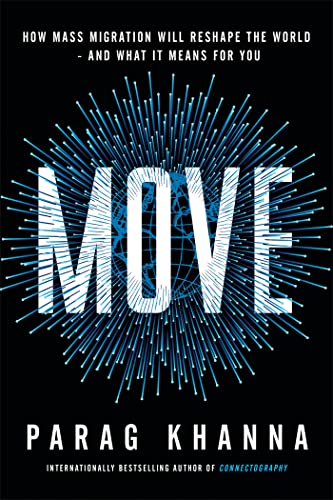
Where will you live in 2030? Where will your children settle in 2040? What will the map of humanity look like in 2050?
In the 60,000 years since people began colonising the continents, a recurring feature of human civilisation has been mobility - the constant search for resources and stability. Seismic global events - wars and genocides, revolutions and pandemics - have only accelerated the process. The map of humanity isn't settled, not now, not ever.
As climate change tips toward full-blown crisis, economies collapse, governments destabilise and technology disrupts, we're entering a new age of mass migrations - one that will scatter both the dispossessed and the well-off. Which areas will people abandon and where will they resettle? Which countries will accept or reject them? As today's world population, which includes four billion restless youth, votes with their feet, what map of human geography will emerge?
Here global strategy advisor Parag Khanna provides an illuminating and authoritative vision of the next phase of human civilisation - one that is both mobile and sustainable. As the book explores, in the years ahead people will move to where the resources are and technologies will flow to the people who need them, returning us to our nomadic roots while building more secure habitats. Move is a fascinating look at the deep trends that are shaping the most likely scenarios for the future. Most importantly, it guides each of us as we determine our optimal location on humanity's ever-changing map.
"Sinopsis" puede pertenecer a otra edición de este libro.
Acerca del autor
Parag Khanna is the founder and managing partner of FutureMap, a global strategic advisory firm that specialises in data-driven scenarios and visualisations. He is the internationally bestselling author of seven books including The Second World, Connectography and The Future is Asian. Parag was named one of Esquire's '75 Most Influential People of the 21st Century' and featured in WIRED magazine's 'Smart List.' He holds a PhD from the London School of Economics and both a bachelor's and master's degree from the School of Foreign Service at Georgetown University. He has travelled to more than 150 countries.
"Sobre este título" puede pertenecer a otra edición de este libro.
Resultados de la búsqueda para Move: How Mass Migration Will Reshape the World –...

Imagen de archivo
Move: How Mass Migration Will Reshape the World â" and What It Means for You
Librería: WorldofBooks, Goring-By-Sea, WS, Reino Unido
Calificación del vendedor: 5 de 5 estrellas

Paperback. Condición: Very Good. The book has been read, but is in excellent condition. Pages are intact and not marred by notes or highlighting. The spine remains undamaged. Nº de ref. del artículo: GOR011692221
Comprar usado
EUR 3,78
Envío por EUR 6,63
Se envía de Reino Unido a Estados Unidos de America
Se envía de Reino Unido a Estados Unidos de America
Cantidad disponible: 3 disponibles
Imagen de archivo
Move : How Mass Migration Will Reshape the World - and What It Means for You
Publicado por
Orion Publishing Group, Limited, 2021
ISBN 10: 1474620833
ISBN 13: 9781474620833
Antiguo o usado
Tapa dura
Librería: Better World Books Ltd, Dunfermline, Reino Unido
Calificación del vendedor: 5 de 5 estrellas
Condición: Good. Former library copy. Pages intact with minimal writing/highlighting. The binding may be loose and creased. Dust jackets/supplements are not included. Includes library markings. Stock photo provided. Product includes identifying sticker. Better World Books: Buy Books. Do Good. Nº de ref. del artículo: 57561820-20
Comprar usado
EUR 6,59
Envío por EUR 5,92
Se envía de Reino Unido a Estados Unidos de America
Se envía de Reino Unido a Estados Unidos de America
Cantidad disponible: 1 disponibles
Imagen de archivo
Move: How Mass Migration Will Reshape the World ? and What It Means for You
Librería: medimops, Berlin, Alemania
Calificación del vendedor: 5 de 5 estrellas
Condición: very good. Gut/Very good: Buch bzw. Schutzumschlag mit wenigen Gebrauchsspuren an Einband, Schutzumschlag oder Seiten. / Describes a book or dust jacket that does show some signs of wear on either the binding, dust jacket or pages. Nº de ref. del artículo: M01474620833-V
Comprar usado
EUR 23,17
Envío por EUR 10,00
Se envía de Alemania a Estados Unidos de America
Se envía de Alemania a Estados Unidos de America
Cantidad disponible: 1 disponibles
Imagen del vendedor
Move: How Mass Migration Will Reshape the World - and What It Means for You
Librería: Book Grocer, Tullamarine, VIC, Australia
Calificación del vendedor: 5 de 5 estrellas
Hardback. [Author], [Publisher]. Author: Parag Khanna Format: Hardback Number of Pages: 352 Where will you live in 2030? Where will your children settle in 2040? What will the map of humanity look like in 2050? In the 60,000 years since people began colonising the continents, a recurring feature of human civilisation has been mobility - the constant search for resources and stability. Seismic global events - wars and genocides, revolutions and pandemics - have only accelerated the process. The map of humanity isn't settled, not now, not ever. As climate change tips toward full-blown crisis, economies collapse, governments destabilise and technology disrupts, we're entering a new age of mass migrations - one that will scatter both the dispossessed and the well-off. Which areas will people abandon and where will they resettle? Which countries will accept or reject them? As today's world population, which includes four billion restless youth, votes with their feet, what map of human geography will emerge? Here global strategy advisor Parag Khanna provides an illuminating and authoritative vision of the next phase of human civilisation - one that is both mobile and sustainable. As the book explores, in the years ahead people will move to where the resources are and technologies will flow to the people who need them, returning us to our nomadic roots while building more secure habitats. Move is a fascinating look at the deep trends that are shaping the most likely scenarios for the future. Most importantly, it guides each of us as we determine our optimal location on humanity's ever-changing map. Hardback. Nº de ref. del artículo: 9781474620833
Comprar usado
EUR 9,63
Envío por EUR 26,88
Se envía de Australia a Estados Unidos de America
Se envía de Australia a Estados Unidos de America
Cantidad disponible: 20 disponibles
Imagen de archivo
Move: How Mass Migration Will Reshape the World â" and What It Means for You
Librería: HR1 Books, Hereford, Reino Unido
Calificación del vendedor: 5 de 5 estrellas
hardcover. Condición: Fine. Same / next day dispatch (Monday - Friday), Nº de ref. del artículo: mon0000109027
Comprar usado
EUR 18,35
Envío por EUR 18,35
Se envía de Reino Unido a Estados Unidos de America
Se envía de Reino Unido a Estados Unidos de America
Cantidad disponible: 1 disponibles
Imagen del vendedor
Move: How mass migration will reshape the world - and what it means for you
Publicado por
Weidenfeld & Nicolson: London, 2021, 2021
ISBN 10: 1474620833
ISBN 13: 9781474620833
Antiguo o usado
Tapa dura
Librería: Antiquariaat Fenix, Amsterdam, Holanda
Calificación del vendedor: 5 de 5 estrellas
Condición: Good. Bound with dustwrapper, xii + 334 pp. Acknowledgments, bibliography, notes, illustration credits, index. 24x16x3 cm. Fine condition. [Parcel service]. Nº de ref. del artículo: 51114
Comprar usado
EUR 10,00
Envío por EUR 31,50
Se envía de Holanda a Estados Unidos de America
Se envía de Holanda a Estados Unidos de America
Cantidad disponible: 1 disponibles