
Artículos relacionados a Petri Net Synthesis for Discrete Event Control of Manufactur...
Petri Net Synthesis for Discrete Event Control of Manufacturing Systems: 204 (The Springer International Series in Engineering and Computer Science) - Tapa blanda
Libro 154 de 260: The Springer International Series in Engineering and Computer Science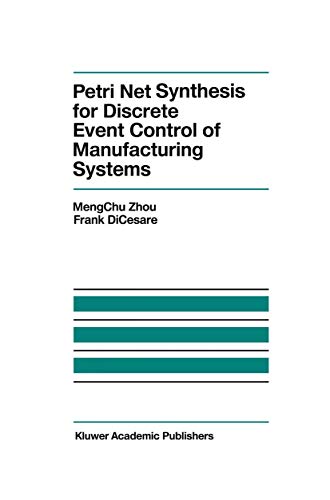
Sinopsis
Petri Net Synthesis for Discrete Event Control of Manufacturing Systems develops two essential resource-sharing concepts: parallel and sequential mutual exclusions and theoretical results in Petri synthesis. A parallel mutual exclusion (PME) is defined to model a resource shared by independent distributed processes, and a sequential mutual exclusion is a sequential composition of PMEs, modeling a resource shared by sequentially-related processes.
A hybrid synthesis methodology for Petri net models and controllers is proposed using top-down, modular, and bottom-up design ideas and the mutual exclusion theory. An aggregate Petri net model is refined by replacing places and /or transitions with basic design modules which are mathematically and graphically described. Petri net design methods are presented for such buffers as automatic storage and retrieval systems. Using the proposed method synthesizes both Petri net structure and feasible initial markings, guaranteeing that resulting Petri nets have desirable system properties such as freedom from deadlock and cyclic behavior.
A Petri net controller is extended to error recovery for automated manufacturing systems. The theory can guarantee that the desired system properties achieved by the original design will be preserved when the controller is augmented to deal with an error in the prescribed methods. Control code has been directly generated from Petri net definitions. The algorithm and implementation details are given for a flexible manufacturing system. Using the approach presented in Petri Net Synthesis for Discrete Event Control of Manufacturing Systems, engineers and research workers can develop their own discrete event control applications and experiments.
"Sinopsis" puede pertenecer a otra edición de este libro.
Reseña del editor
Petri Net Synthesis for Discrete Event Control of Manufacturing Systems develops two essential resource-sharing concepts: parallel and sequential mutual exclusions and theoretical results in Petri synthesis. A parallel mutual exclusion (PME) is defined to model a resource shared by independent distributed processes, and a sequential mutual exclusion is a sequential composition of PMEs, modeling a resource shared by sequentially-related processes.
A hybrid synthesis methodology for Petri net models and controllers is proposed using top-down, modular, and bottom-up design ideas and the mutual exclusion theory. An aggregate Petri net model is refined by replacing places and /or transitions with basic design modules which are mathematically and graphically described. Petri net design methods are presented for such buffers as automatic storage and retrieval systems. Using the proposed method synthesizes both Petri net structure and feasible initial markings, guaranteeing that resulting Petri nets have desirable system properties such as freedom from deadlock and cyclic behavior.
A Petri net controller is extended to error recovery for automated manufacturing systems. The theory can guarantee that the desired system properties achieved by the original design will be preserved when the controller is augmented to deal with an error in the prescribed methods. Control code has been directly generated from Petri net definitions. The algorithm and implementation details are given for a flexible manufacturing system. Using the approach presented in Petri Net Synthesis for Discrete Event Control of Manufacturing Systems, engineers and research workers can develop their own discrete event control applications and experiments.
"Sobre este título" puede pertenecer a otra edición de este libro.
Resultados de la búsqueda para Petri Net Synthesis for Discrete Event Control of Manufactur...

Imagen de archivo
Petri Net Synthesis for Discrete Event Control of Manufacturing Systems (eng)
Impresión bajo demandaLibrería: Brook Bookstore On Demand, Napoli, NA, Italia
Calificación del vendedor: 5 de 5 estrellas

Condición: new. Questo è un articolo print on demand. Nº de ref. del artículo: NLZEISP6S3
Comprar nuevo
EUR 126,26
Envío por EUR 5,50
Se envía de Italia a Estados Unidos de America
Se envía de Italia a Estados Unidos de America
Cantidad disponible: Más de 20 disponibles
Imagen de archivo
Petri Net Synthesis for Discrete Event Control of Manufacturing Systems (The Springer International Series in Engineering and Computer Science)
Librería: Ria Christie Collections, Uxbridge, Reino Unido
Calificación del vendedor: 5 de 5 estrellas
Condición: New. In. Nº de ref. del artículo: ria9781461363682_new
Comprar nuevo
EUR 165,57
Envío por EUR 13,17
Se envía de Reino Unido a Estados Unidos de America
Se envía de Reino Unido a Estados Unidos de America
Cantidad disponible: Más de 20 disponibles
Imagen del vendedor
Petri Net Synthesis for Discrete Event Control of Manufacturing Systems
Publicado por
Springer, Springer Okt 2012, 2012
ISBN 10: 1461363683
ISBN 13: 9781461363682
Nuevo
Taschenbuch
Librería: BuchWeltWeit Ludwig Meier e.K., Bergisch Gladbach, Alemania
Calificación del vendedor: 5 de 5 estrellas
Taschenbuch. Condición: Neu. This item is printed on demand - it takes 3-4 days longer - Neuware -Petri Net Synthesis for Discrete Event Control of Manufacturing Systems develops two essential resource-sharing concepts: parallel and sequential mutual exclusions and theoretical results in Petri synthesis. A parallel mutual exclusion (PME) is defined to model a resource shared by independent distributed processes, and a sequential mutual exclusion is a sequential composition of PMEs, modeling a resource shared by sequentially-related processes. A hybrid synthesis methodology for Petri net models and controllers is proposed using top-down, modular, and bottom-up design ideas and the mutual exclusion theory. An aggregate Petri net model is refined by replacing places and /or transitions with basic design modules which are mathematically and graphically described. Petri net design methods are presented for such buffers as automatic storage and retrieval systems. Using the proposed method synthesizes both Petri net structure and feasible initial markings, guaranteeing that resulting Petri nets have desirable system properties such as freedom from deadlock and cyclic behavior. A Petri net controller is extended to error recovery for automated manufacturing systems. The theory can guarantee that the desired system properties achieved by the original design will be preserved when the controller is augmented to deal with an error in the prescribed methods. Control code has been directly generated from Petri net definitions. The algorithm and implementation details are given for a flexible manufacturing system. Using the approach presented in Petri Net Synthesis for Discrete Event Control of Manufacturing Systems, engineers and research workers can develop their own discrete event control applications and experiments. 256 pp. Englisch. Nº de ref. del artículo: 9781461363682
Comprar nuevo
EUR 160,49
Envío por EUR 23,00
Se envía de Alemania a Estados Unidos de America
Se envía de Alemania a Estados Unidos de America
Cantidad disponible: 2 disponibles
Imagen del vendedor
Petri Net Synthesis for Discrete Event Control of Manufacturing Systems
Impresión bajo demandaLibrería: moluna, Greven, Alemania
Calificación del vendedor: 5 de 5 estrellas
Condición: New. Dieser Artikel ist ein Print on Demand Artikel und wird nach Ihrer Bestellung fuer Sie gedruckt. Petri Net Synthesis for Discrete Event Control of Manufacturing Systems develops two essential resource-sharing concepts: parallel and sequential mutual exclusions and theoretical results in Petri synthesis. A parallel mutual exclusion . Nº de ref. del artículo: 4194554
Comprar nuevo
EUR 136,16
Envío por EUR 48,99
Se envía de Alemania a Estados Unidos de America
Se envía de Alemania a Estados Unidos de America
Cantidad disponible: Más de 20 disponibles
Imagen de archivo
Petri Net Synthesis for Discrete Event Control of Manufacturing Systems
Librería: Books Puddle, New York, NY, Estados Unidos de America
Calificación del vendedor: 4 de 5 estrellas

Condición: New. pp. 256. Nº de ref. del artículo: 2697846238
Comprar nuevo
EUR 209,88
Envío por EUR 3,44
Se envía dentro de Estados Unidos de America
Se envía dentro de Estados Unidos de America
Cantidad disponible: 4 disponibles
Imagen del vendedor
Petri Net Synthesis for Discrete Event Control of Manufacturing Systems
Publicado por
Springer, Springer Okt 2012, 2012
ISBN 10: 1461363683
ISBN 13: 9781461363682
Nuevo
Taschenbuch
Librería: buchversandmimpf2000, Emtmannsberg, BAYE, Alemania
Calificación del vendedor: 5 de 5 estrellas
Taschenbuch. Condición: Neu. This item is printed on demand - Print on Demand Titel. Neuware -Petri Net Synthesis for Discrete Event Control of Manufacturing Systems develops two essential resource-sharing concepts: parallel and sequential mutual exclusions and theoretical results in Petri synthesis. A parallel mutual exclusion (PME) is defined to model a resource shared by independent distributed processes, and a sequential mutual exclusion is a sequential composition of PMEs, modeling a resource shared by sequentially-related processes.A hybrid synthesis methodology for Petri net models and controllers is proposed using top-down, modular, and bottom-up design ideas and the mutual exclusion theory. An aggregate Petri net model is refined by replacing places and /or transitions with basic design modules which are mathematically and graphically described. Petri net design methods are presented for such buffers as automatic storage and retrieval systems. Using the proposed method synthesizes both Petri net structure and feasible initial markings, guaranteeing that resulting Petri nets have desirable system properties such as freedom from deadlock and cyclic behavior.A Petri net controller is extended to error recovery for automated manufacturing systems. The theory can guarantee that the desired system properties achieved by the original design will be preserved when the controller is augmented to deal with an error in the prescribed methods. Control code has been directly generated from Petri net definitions. The algorithm and implementation details are given for a flexible manufacturing system. Using the approach presented in Petri Net Synthesis for Discrete Event Control of Manufacturing Systems, engineers and research workers can develop their own discrete event control applications and experiments.Springer-Verlag KG, Sachsenplatz 4-6, 1201 Wien 256 pp. Englisch. Nº de ref. del artículo: 9781461363682
Comprar nuevo
EUR 160,49
Envío por EUR 60,00
Se envía de Alemania a Estados Unidos de America
Se envía de Alemania a Estados Unidos de America
Cantidad disponible: 1 disponibles
Imagen de archivo
Petri Net Synthesis for Discrete Event Control of Manufacturing Systems
Impresión bajo demandaLibrería: Majestic Books, Hounslow, Reino Unido
Calificación del vendedor: 4 de 5 estrellas
Condición: New. Print on Demand pp. 256 49:B&W 6.14 x 9.21 in or 234 x 156 mm (Royal 8vo) Perfect Bound on White w/Gloss Lam. Nº de ref. del artículo: 94551041
Comprar nuevo
EUR 217,47
Envío por EUR 7,58
Se envía de Reino Unido a Estados Unidos de America
Se envía de Reino Unido a Estados Unidos de America
Cantidad disponible: 4 disponibles
Imagen de archivo
Petri Net Synthesis for Discrete Event Control of Manufacturing Systems
Impresión bajo demandaLibrería: Biblios, Frankfurt am main, HESSE, Alemania
Calificación del vendedor: 4 de 5 estrellas
Condición: New. PRINT ON DEMAND pp. 256. Nº de ref. del artículo: 1897846228
Comprar nuevo
EUR 222,74
Envío por EUR 9,95
Se envía de Alemania a Estados Unidos de America
Se envía de Alemania a Estados Unidos de America
Cantidad disponible: 4 disponibles
Imagen del vendedor
Petri Net Synthesis for Discrete Event Control of Manufacturing Systems
Librería: AHA-BUCH GmbH, Einbeck, Alemania
Calificación del vendedor: 5 de 5 estrellas
Taschenbuch. Condición: Neu. Druck auf Anfrage Neuware - Printed after ordering - Petri Net Synthesis for Discrete Event Control of Manufacturing Systems develops two essential resource-sharing concepts: parallel and sequential mutual exclusions and theoretical results in Petri synthesis. A parallel mutual exclusion (PME) is defined to model a resource shared by independent distributed processes, and a sequential mutual exclusion is a sequential composition of PMEs, modeling a resource shared by sequentially-related processes. A hybrid synthesis methodology for Petri net models and controllers is proposed using top-down, modular, and bottom-up design ideas and the mutual exclusion theory. An aggregate Petri net model is refined by replacing places and /or transitions with basic design modules which are mathematically and graphically described. Petri net design methods are presented for such buffers as automatic storage and retrieval systems. Using the proposed method synthesizes both Petri net structure and feasible initial markings, guaranteeing that resulting Petri nets have desirable system properties such as freedom from deadlock and cyclic behavior. A Petri net controller is extended to error recovery for automated manufacturing systems. The theory can guarantee that the desired system properties achieved by the original design will be preserved when the controller is augmented to deal with an error in the prescribed methods. Control code has been directly generated from Petri net definitions. The algorithm and implementation details are given for a flexible manufacturing system. Using the approach presented in Petri Net Synthesis for Discrete Event Control of Manufacturing Systems, engineers and research workers can develop their own discrete event control applications and experiments. Nº de ref. del artículo: 9781461363682
Comprar nuevo
EUR 223,07
Envío por EUR 30,50
Se envía de Alemania a Estados Unidos de America
Se envía de Alemania a Estados Unidos de America
Cantidad disponible: 1 disponibles
Imagen de archivo
Petri Net Synthesis for Discrete Event Control of Manufacturing Systems (The Springer International Series in Engineering and Computer Science, 204)
Librería: Mispah books, Redhill, SURRE, Reino Unido
Calificación del vendedor: 4 de 5 estrellas
Paperback. Condición: Like New. LIKE NEW. SHIPS FROM MULTIPLE LOCATIONS. book. Nº de ref. del artículo: ERICA80014613636836
Comprar usado
EUR 258,24
Envío por EUR 29,15
Se envía de Reino Unido a Estados Unidos de America
Se envía de Reino Unido a Estados Unidos de America
Cantidad disponible: 1 disponibles