
Artículos relacionados a The THEMIS Mission
Sinopsis
J.L. Burch·V. Angelopoulos Originally published in the journal Space Science Reviews, Volume 141, Nos 1–4, 1–3. DOI: 10.1007/s11214-008-9474-5 © Springer Science+Business Media B.V. 2008 The Earth, like all the other planets, is continuously bombarded by the solar wind, which is variable on many time scales owing to its connection to the activity of the Sun. But the Earth is unique among planets because its atmosphere, magnetic eld, and rotation rates are each signi cant, though not dominant, players in the formation of its magnetosphere and its reaction to solar-wind inputs. An intriguing fact is that no matter what the time scale of solar-wind variations, the Earth’s response has a de nite pattern lasting a few hours. Known as a magnetospheric substorm, the response involves a build-up, a crash, and a recovery. The build-up (known as the growth phase) occurs because of an interlinking of the geom- netic eld and the solar-wind magnetic eld known as magnetic reconnection, which leads to storage of increasing amounts of magnetic energy and stress in the tail of the mag- tosphere and lasts about a half hour. The crash (known as the expansion phase) occurs when the increased magnetic energy and stresses are impulsively relieved, the current system that supports the stretched out magnetic tail is diverted into the ionosphere, and bright, dynamic displays of the aurora appear in the upper atmosphere. The expansion and subsequent rec- ery phases result from a second magnetic reconnection event that decouples the solar-wind and geomagnetic elds.
"Sinopsis" puede pertenecer a otra edición de este libro.
De la contraportada
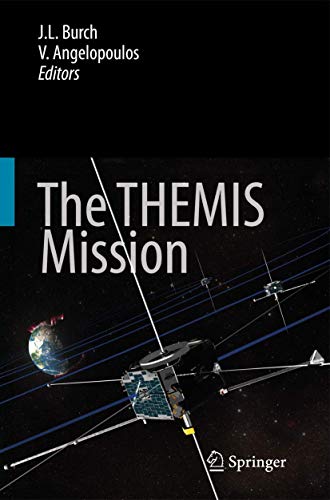
The THEMIS mission aims to determine the trigger and large-scale evolution of substorms by employing five identical micro-satellites which line up along the Earth's magnetotail to track the motion of particles, plasma, and waves from one point to another and for the first time, resolve space-time ambiguities in key regions of the magnetosphere on a global scale. The primary goal of THEMIS is to elucidate which magnetotail process is responsible for substorm onset at the region where substorm auroras map: (i) local disruption of the plasma sheet current (current disruption) or (ii) the interaction of the current sheet with the rapid influx of plasma emanating from reconnection. The probes also traverse the radiation belts and the dayside magnetosphere, allowing THEMIS to address additional baseline objectives. This volume describes the mission, the instrumentation, and the data derived from them.
"Sobre este título" puede pertenecer a otra edición de este libro.
Resultados de la búsqueda para The THEMIS Mission

Imagen de archivo
The THEMIS Mission (eng)
Impresión bajo demandaLibrería: Brook Bookstore On Demand, Napoli, NA, Italia
Calificación del vendedor: 5 de 5 estrellas

Condición: new. Questo è un articolo print on demand. Nº de ref. del artículo: c36cd3f67d771114c88f5b26d17ce94c
Comprar nuevo
EUR 126,26
Envío por EUR 13,50
Se envía de Italia a Estados Unidos de America
Se envía de Italia a Estados Unidos de America
Cantidad disponible: Más de 20 disponibles
Imagen de archivo
The THEMIS Mission
Librería: Ria Christie Collections, Uxbridge, Reino Unido
Calificación del vendedor: 5 de 5 estrellas
Condición: New. In. Nº de ref. del artículo: ria9781441928030_new
Comprar nuevo
EUR 165,57
Envío por EUR 13,17
Se envía de Reino Unido a Estados Unidos de America
Se envía de Reino Unido a Estados Unidos de America
Cantidad disponible: Más de 20 disponibles
Imagen del vendedor
The THEMIS Mission
Publicado por
Springer New York Dez 2010, 2010
ISBN 10: 1441928030
ISBN 13: 9781441928030
Nuevo
Taschenbuch
Librería: BuchWeltWeit Ludwig Meier e.K., Bergisch Gladbach, Alemania
Calificación del vendedor: 5 de 5 estrellas
Taschenbuch. Condición: Neu. This item is printed on demand - it takes 3-4 days longer - Neuware -J.L. Burch V. Angelopoulos Originally published in the journal Space Science Reviews, Volume 141, Nos 1-4, 1-3. DOI: 10.1007/s11214-008-9474-5 Springer Science+Business Media B.V. 2008 The Earth, like all the other planets, is continuously bombarded by the solar wind, which is variable on many time scales owing to its connection to the activity of the Sun. But the Earth is unique among planets because its atmosphere, magnetic eld, and rotation rates are each signi cant, though not dominant, players in the formation of its magnetosphere and its reaction to solar-wind inputs. An intriguing fact is that no matter what the time scale of solar-wind variations, the Earth's response has a de nite pattern lasting a few hours. Known as a magnetospheric substorm, the response involves a build-up, a crash, and a recovery. The build-up (known as the growth phase) occurs because of an interlinking of the geom- netic eld and the solar-wind magnetic eld known as magnetic reconnection, which leads to storage of increasing amounts of magnetic energy and stress in the tail of the mag- tosphere and lasts about a half hour. The crash (known as the expansion phase) occurs when the increased magnetic energy and stresses are impulsively relieved, the current system that supports the stretched out magnetic tail is diverted into the ionosphere, and bright, dynamic displays of the aurora appear in the upper atmosphere. The expansion and subsequent rec- ery phases result from a second magnetic reconnection event that decouples the solar-wind and geomagnetic elds. 588 pp. Englisch. Nº de ref. del artículo: 9781441928030
Comprar nuevo
EUR 160,49
Envío por EUR 23,00
Se envía de Alemania a Estados Unidos de America
Se envía de Alemania a Estados Unidos de America
Cantidad disponible: 2 disponibles
Imagen del vendedor
The THEMIS Mission
Librería: moluna, Greven, Alemania
Calificación del vendedor: 5 de 5 estrellas
Condición: New. Nº de ref. del artículo: 4173279
Comprar nuevo
EUR 136,16
Envío por EUR 48,99
Se envía de Alemania a Estados Unidos de America
Se envía de Alemania a Estados Unidos de America
Cantidad disponible: Más de 20 disponibles
Imagen del vendedor
The THEMIS Mission
Librería: preigu, Osnabrück, Alemania
Calificación del vendedor: 5 de 5 estrellas
Taschenbuch. Condición: Neu. The THEMIS Mission | Vassilis Angelopoulos (u. a.) | Taschenbuch | iv | Englisch | 2010 | Springer | EAN 9781441928030 | Verantwortliche Person für die EU: Springer Verlag GmbH, Tiergartenstr. 17, 69121 Heidelberg, juergen[dot]hartmann[at]springer[dot]com | Anbieter: preigu. Nº de ref. del artículo: 107152405
Comprar nuevo
EUR 140,10
Envío por EUR 70,00
Se envía de Alemania a Estados Unidos de America
Se envía de Alemania a Estados Unidos de America
Cantidad disponible: 5 disponibles
Imagen de archivo
The Themis Mission
Librería: Books Puddle, New York, NY, Estados Unidos de America
Calificación del vendedor: 4 de 5 estrellas

Condición: New. pp. 588. Nº de ref. del artículo: 263544001
Comprar nuevo
EUR 216,71
Envío por EUR 3,44
Se envía dentro de Estados Unidos de America
Se envía dentro de Estados Unidos de America
Cantidad disponible: 4 disponibles
Imagen del vendedor
The THEMIS Mission
Publicado por
Springer New York, Springer Dez 2010, 2010
ISBN 10: 1441928030
ISBN 13: 9781441928030
Nuevo
Taschenbuch
Librería: buchversandmimpf2000, Emtmannsberg, BAYE, Alemania
Calificación del vendedor: 5 de 5 estrellas
Taschenbuch. Condición: Neu. This item is printed on demand - Print on Demand Titel. Neuware -J.L. Burch V. Angelopoulos Originally published in the journal Space Science Reviews, Volume 141, Nos 1¿4, 1¿3. DOI: 10.1007/s11214-008-9474-5 Springer Science+Business Media B.V. 2008 The Earth, like all the other planets, is continuously bombarded by the solar wind, which is variable on many time scales owing to its connection to the activity of the Sun. But the Earth is unique among planets because its atmosphere, magnetic eld, and rotation rates are each signi cant, though not dominant, players in the formation of its magnetosphere and its reaction to solar-wind inputs. An intriguing fact is that no matter what the time scale of solar-wind variations, the Earth¿s response has a de nite pattern lasting a few hours. Known as a magnetospheric substorm, the response involves a build-up, a crash, and a recovery. The build-up (known as the growth phase) occurs because of an interlinking of the geom- netic eld and the solar-wind magnetic eld known as magnetic reconnection, which leads to storage of increasing amounts of magnetic energy and stress in the tail of the mag- tosphere and lasts about a half hour. The crash (known as the expansion phase) occurs when the increased magnetic energy and stresses are impulsively relieved, the current system that supports the stretched out magnetic tail is diverted into the ionosphere, and bright, dynamic displays of the aurora appear in the upper atmosphere. The expansion and subsequent rec- ery phases result from a second magnetic reconnection event that decouples the solar-wind and geomagnetic elds.Springer-Verlag GmbH, Tiergartenstr. 17, 69121 Heidelberg 588 pp. Englisch. Nº de ref. del artículo: 9781441928030
Comprar nuevo
EUR 160,49
Envío por EUR 60,00
Se envía de Alemania a Estados Unidos de America
Se envía de Alemania a Estados Unidos de America
Cantidad disponible: 1 disponibles
Imagen de archivo
The Themis Mission
Impresión bajo demandaLibrería: Majestic Books, Hounslow, Reino Unido
Calificación del vendedor: 4 de 5 estrellas
Condición: New. Print on Demand pp. 588 49:B&W 6.14 x 9.21 in or 234 x 156 mm (Royal 8vo) Perfect Bound on White w/Gloss Lam. Nº de ref. del artículo: 4303902
Comprar nuevo
EUR 223,39
Envío por EUR 7,58
Se envía de Reino Unido a Estados Unidos de America
Se envía de Reino Unido a Estados Unidos de America
Cantidad disponible: 4 disponibles
Imagen de archivo
The Themis Mission
Impresión bajo demandaLibrería: Biblios, Frankfurt am main, HESSE, Alemania
Calificación del vendedor: 4 de 5 estrellas
Condición: New. PRINT ON DEMAND pp. 588. Nº de ref. del artículo: 183544011
Comprar nuevo
EUR 227,21
Envío por EUR 9,95
Se envía de Alemania a Estados Unidos de America
Se envía de Alemania a Estados Unidos de America
Cantidad disponible: 4 disponibles
Imagen del vendedor
The THEMIS Mission
Publicado por
Springer New York, Springer, 2010
ISBN 10: 1441928030
ISBN 13: 9781441928030
Nuevo
Taschenbuch
Librería: AHA-BUCH GmbH, Einbeck, Alemania
Calificación del vendedor: 5 de 5 estrellas
Taschenbuch. Condición: Neu. Druck auf Anfrage Neuware - Printed after ordering - J.L. Burch V. Angelopoulos Originally published in the journal Space Science Reviews, Volume 141, Nos 1-4, 1-3. DOI: 10.1007/s11214-008-9474-5 Springer Science+Business Media B.V. 2008 The Earth, like all the other planets, is continuously bombarded by the solar wind, which is variable on many time scales owing to its connection to the activity of the Sun. But the Earth is unique among planets because its atmosphere, magnetic eld, and rotation rates are each signi cant, though not dominant, players in the formation of its magnetosphere and its reaction to solar-wind inputs. An intriguing fact is that no matter what the time scale of solar-wind variations, the Earth's response has a de nite pattern lasting a few hours. Known as a magnetospheric substorm, the response involves a build-up, a crash, and a recovery. The build-up (known as the growth phase) occurs because of an interlinking of the geom- netic eld and the solar-wind magnetic eld known as magnetic reconnection, which leads to storage of increasing amounts of magnetic energy and stress in the tail of the mag- tosphere and lasts about a half hour. The crash (known as the expansion phase) occurs when the increased magnetic energy and stresses are impulsively relieved, the current system that supports the stretched out magnetic tail is diverted into the ionosphere, and bright, dynamic displays of the aurora appear in the upper atmosphere. The expansion and subsequent rec- ery phases result from a second magnetic reconnection event that decouples the solar-wind and geomagnetic elds. Nº de ref. del artículo: 9781441928030
Comprar nuevo
EUR 224,71
Envío por EUR 30,50
Se envía de Alemania a Estados Unidos de America
Se envía de Alemania a Estados Unidos de America
Cantidad disponible: 1 disponibles