
Artículos relacionados a The Problem of Forming Social Capital: Why Trust? (Political...
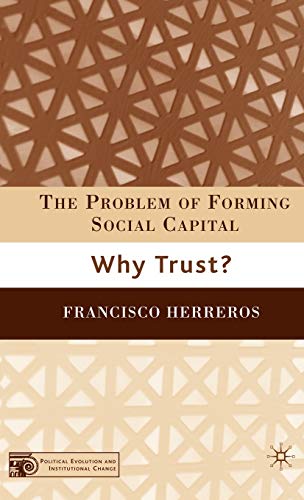
The Problem of Forming Social Capital: Why Trust? (Political Evolution and Institutional Change) - Tapa dura
Sinopsis
Herreros examines from the ground up, and from first principles, how social capital is formed. He gives special attention to "particularized trust," the byproduct of associational participation, and its relationship to generalized social trust. He argues that social capital, the resources drawn from obligations of reciprocity and information, derives from participation in social networks, including voluntary associations. The book uses game theoretical models to highlight mechanisms facilitating the formation of trust and, in contrast to many theorists, Herreros places emphasis on the role of the state in the creation of social capital. The theoretical arguments are tested empirically using survey data and historical cases. This sophisticated analysis is sure to generate debate.
"Sinopsis" puede pertenecer a otra edición de este libro.
Acerca del autor
Francisco Herreros holds a Ph.D. in Sociology and is a member of the Juan March Institute, Madrid, Spain. Currently, he is a visiting scholar at the New York University, USA.
De la contraportada
"Herreros, far more than anyone else to date, gives the concept social capital both theoretical and empirical standing. He clarifies the questions that matter, shows how we can answer them, and even answers some. This is a truly cross-national study, informed by sophisticated analytics and imaginative tests of plausible hypotheses. His most important finding is that the state fosters social capital directly through its efficacy in enforcing agreements and indirectly through its subsidies of associations. Herreros thus counters many earlier analyses of social capital and provides the basis for further theoretical and policy advance."--Margaret Levi, Jere L. Bacharach Professor of International Studies, University of Washington
"Herreros's Problem of Forming Social Capital is a well-argued analysis of the importance of trust and voluntary associations in civic life. His argument is not mine, but this is an engaging book that will make an important contribution to debates on social capital. More so than almost anyone else, Herreros presents a clear argument about the underlying mechanisms of social capital. His reasoning will play a key role in the ongoing controversy about how and whether trust and membership in civic associations make democracy work better."--Eric Uslaner, University of Maryland, College Park
"This is a brilliant book. The arguments are rigorous and sharp; the evidence, convincing; the style, incisive and witty. Herreros departs from the mainstream literature on social capital showing, first, that social trust can be explained from a rational choice perspective; and second, that the State can generate social capital. Both on theoretical and empirical grounds, the book is a major contribution to the study of social capital; it is also enjoyable to read."--José María Maravall, Juan March Institute, Madrid
"Herreros's Problem of Forming Social Capital is a well-argued analysis of the importance of trust and voluntary associations in civic life. His argument is not mine, but this is an engaging book that will make an important contribution to debates on social capital. More so than almost anyone else, Herreros presents a clear argument about the underlying mechanisms of social capital. His reasoning will play a key role in the ongoing controversy about how and whether trust and membership in civic associations make democracy work better."--Eric Uslaner, University of Maryland, College Park
"This is a brilliant book. The arguments are rigorous and sharp; the evidence, convincing; the style, incisive and witty. Herreros departs from the mainstream literature on social capital showing, first, that social trust can be explained from a rational choice perspective; and second, that the State can generate social capital. Both on theoretical and empirical grounds, the book is a major contribution to the study of social capital; it is also enjoyable to read."--José María Maravall, Juan March Institute, Madrid
De la solapa interior
"Herreros, far more than anyone else to date, gives the concept social capital both theoretical and empirical standing. He clarifies the questions that matter, shows how we can answer them, and even answers some. This is a truly cross-national study, informed by sophisticated analytics and imaginative tests of plausible hypotheses. His most important finding is that the state fosters social capital directly through its efficacy in enforcing agreements and indirectly through its subsidies of associations. Herreros thus counters many earlier analyses of social capital and provides the basis for further theoretical and policy advance."--Margaret Levi, Jere L. Bacharach Professor of International Studies, University of Washington
"Herreros's Problem of Forming Social Capital is a well-argued analysis of the importance of trust and voluntary associations in civic life. His argument is not mine, but this is an engaging book that will make an important contribution to debates on social capital. More so than almost anyone else, Herreros presents a clear argument about the underlying mechanisms of social capital. His reasoning will play a key role in the ongoing controversy about how and whether trust and membership in civic associations make democracy work better."--Eric Uslaner, University of Maryland, College Park
"This is a brilliant book. The arguments are rigorous and sharp; the evidence, convincing; the style, incisive and witty. Herreros departs from the mainstream literature on social capital showing, first, that social trust can be explained from a rational choice perspective; and second, that the State can generate social capital. Both on theoretical and empirical grounds, the book is a major contribution to the study of social capital; it is also enjoyable to read."--José María Maravall, Juan March Institute, Madrid
|"Herreros's Problem of Forming Social Capital is a well-argued analysis of the importance of trust and voluntary associations in civic life. His argument is not mine, but this is an engaging book that will make an important contribution to debates on social capital. More so than almost anyone else, Herreros presents a clear argument about the underlying mechanisms of social capital. His reasoning will play a key role in the ongoing controversy about how and whether trust and membership in civic associations make democracy work better."--Eric Uslaner, University of Maryland, College Park
"This is a brilliant book. The arguments are rigorous and sharp; the evidence, convincing; the style, incisive and witty. Herreros departs from the mainstream literature on social capital showing, first, that social trust can be explained from a rational choice perspective; and second, that the State can generate social capital. Both on theoretical and empirical grounds, the book is a major contribution to the study of social capital; it is also enjoyable to read."--José María Maravall, Juan March Institute, Madrid
"Herreros, far more than anyone else to date, gives the concept social capital both theoretical and empirical standing. He clarifies the questions that matter, shows how we can answer them, and even answers some. This is a truly cross-national study, informed by sophisticated analytics and imaginative tests of plausible hypotheses. His most important finding is that the state fosters social capital directly through its efficacy in enforcing agreements and indirectly through its subsidies of associations. Herreros thus counters many earlier analyses of social capital and provides the basis for further theoretical and policy advance."--Margaret Levi, Jere L. Bacharach Professor of International Studies, University of Washington
"Herreros's Problem of Forming Social Capital is a well-argued analysis of the importance of trust and voluntary associations in civic life. His argument is not mine, but this is an engaging book that will make an important contribution to debates on social capital. More so than almost anyone else, Herreros presents a clear argument about the underlying mechanisms of social capital. His reasoning will play a key role in the ongoing controversy about how and whether trust and membership in civic associations make democracy work better."--Eric Uslaner, University of Maryland, College Park
"This is a brilliant book. The arguments are rigorous and sharp; the evidence, convincing; the style, incisive and witty. Herreros departs from the mainstream literature on social capital showing, first, that social trust can be explained from a rational choice perspective; and second, that the State can generate social capital. Both on theoretical and empirical grounds, the book is a major contribution to the study of social capital; it is also enjoyable to read."--José María Maravall, Juan March Institute, Madrid
"Herreros's Problem of Forming Social Capital is a well-argued analysis of the importance of trust and voluntary associations in civic life. His argument is not mine, but this is an engaging book that will make an important contribution to debates on social capital. More so than almost anyone else, Herreros presents a clear argument about the underlying mechanisms of social capital. His reasoning will play a key role in the ongoing controversy about how and whether trust and membership in civic associations make democracy work better."--Eric Uslaner, University of Maryland, College Park
"This is a brilliant book. The arguments are rigorous and sharp; the evidence, convincing; the style, incisive and witty. Herreros departs from the mainstream literature on social capital showing, first, that social trust can be explained from a rational choice perspective; and second, that the State can generate social capital. Both on theoretical and empirical grounds, the book is a major contribution to the study of social capital; it is also enjoyable to read."--José María Maravall, Juan March Institute, Madrid
"Sobre este título" puede pertenecer a otra edición de este libro.
Resultados de la búsqueda para The Problem of Forming Social Capital: Why Trust? (Political...

Imagen de archivo
The Problem of Forming Social Capital: Why Trust? (Political Evolution and Institutional Change)
Publicado por
Palgrave Macmillan, 2004
ISBN 10: 1403964823
ISBN 13: 9781403964823
Antiguo o usado
Tapa dura
Librería: Midtown Scholar Bookstore, Harrisburg, PA, Estados Unidos de America
Calificación del vendedor: 5 de 5 estrellas

Hardcover. Condición: Very Good. Very Good - Crisp, clean, unread book with some shelfwear/edgewear, may have a remainder mark - NICE Oversized. Nº de ref. del artículo: M1403964823Z2
Comprar usado
EUR 11,12
Envío por EUR 5,36
Se envía dentro de Estados Unidos de America
Se envía dentro de Estados Unidos de America
Cantidad disponible: 1 disponibles
Imagen del vendedor
Problem of Forming Social Capital : Why Trust?
Publicado por
Palgrave Macmillan, 2004
ISBN 10: 1403964823
ISBN 13: 9781403964823
Antiguo o usado
Tapa dura
Librería: GreatBookPrices, Columbia, MD, Estados Unidos de America
Calificación del vendedor: 5 de 5 estrellas
Condición: As New. Unread book in perfect condition. Nº de ref. del artículo: 2410833
Comprar usado
EUR 63,68
Envío por EUR 2,36
Se envía dentro de Estados Unidos de America
Se envía dentro de Estados Unidos de America
Cantidad disponible: 15 disponibles
Imagen del vendedor
The Problem of Forming Social Capital
Publicado por
SPRINGER NATURE Aug 2004, 2004
ISBN 10: 1403964823
ISBN 13: 9781403964823
Nuevo
Tapa dura
Librería: BuchWeltWeit Ludwig Meier e.K., Bergisch Gladbach, Alemania
Calificación del vendedor: 5 de 5 estrellas
Buch. Condición: Neu. This item is printed on demand - it takes 3-4 days longer - Neuware -Social capital is a concept which has only recently been incorporated into the social sciences. It has been used to explain a series of phenomena ranging from the creation of human capital and the effectiveness of democratic institutions to the reduction of crime or the eradication of poverty. However, there is not a general explanation about how to create social capital. That is the aim of this book. More concretely, it answers the following questions: How to create social capital and what accounts for the different stocks of social capital between states These questions are answered both theoretically and empirically, using quantitative and qualitative analysis as well as game theoretic models. 151 pp. Englisch. Nº de ref. del artículo: 9781403964823
Comprar nuevo
EUR 53,49
Envío por EUR 23,00
Se envía de Alemania a Estados Unidos de America
Se envía de Alemania a Estados Unidos de America
Cantidad disponible: 2 disponibles
Imagen de archivo
The Problem of Forming Social Capital. Why Trust?.
Librería: Kennys Bookshop and Art Galleries Ltd., Galway, GY, Irlanda
Calificación del vendedor: 5 de 5 estrellas
Condición: New. Series: Political Evolution & Institutional Change. Num Pages: 159 pages, biography. BIC Classification: JHBA. Category: (P) Professional & Vocational; (U) Tertiary Education (US: College). Dimension: 216 x 140 x 16. Weight in Grams: 354. . 2004. 2004th Edition. hardcover. . . . . Nº de ref. del artículo: V9781403964823
Comprar nuevo
EUR 68,12
Envío por EUR 9,50
Se envía de Irlanda a Estados Unidos de America
Se envía de Irlanda a Estados Unidos de America
Cantidad disponible: 15 disponibles
Imagen de archivo
The Problem of Forming Social Capital: Why Trust? (Political Evolution and Institutional Change)
Librería: Ria Christie Collections, Uxbridge, Reino Unido
Calificación del vendedor: 5 de 5 estrellas
Condición: New. In English. Nº de ref. del artículo: ria9781403964823_new
Comprar nuevo
EUR 68,81
Envío por EUR 11,19
Se envía de Reino Unido a Estados Unidos de America
Se envía de Reino Unido a Estados Unidos de America
Cantidad disponible: Más de 20 disponibles
Imagen de archivo
Problem of Forming Social Capital : Why Trust?
Librería: GreatBookPrices, Columbia, MD, Estados Unidos de America
Calificación del vendedor: 5 de 5 estrellas
Condición: New. Nº de ref. del artículo: 2410833-n
Comprar nuevo
EUR 78,00
Envío por EUR 2,36
Se envía dentro de Estados Unidos de America
Se envía dentro de Estados Unidos de America
Cantidad disponible: 15 disponibles
Imagen de archivo
The Problem of Forming Social Capital
Librería: Books Puddle, Woodside, NY, Estados Unidos de America
Calificación del vendedor: 4 de 5 estrellas

Condición: New. pp. 160. Nº de ref. del artículo: 2647764548
Comprar nuevo
EUR 84,94
Envío por EUR 3,56
Se envía dentro de Estados Unidos de America
Se envía dentro de Estados Unidos de America
Cantidad disponible: 4 disponibles
Imagen de archivo
The Problem of Forming Social Capital: Why Trust? (Political Evolution and Institutional Change)
Librería: Revaluation Books, Exeter, Reino Unido
Calificación del vendedor: 5 de 5 estrellas
Hardcover. Condición: Brand New. 151 pages. 8.25x5.50x0.50 inches. In Stock. Nº de ref. del artículo: x-1403964823
Comprar nuevo
EUR 80,35
Envío por EUR 11,94
Se envía de Reino Unido a Estados Unidos de America
Se envía de Reino Unido a Estados Unidos de America
Cantidad disponible: 2 disponibles
Imagen de archivo
The Problem of Forming Social Capital
Impresión bajo demandaLibrería: Majestic Books, Hounslow, Reino Unido
Calificación del vendedor: 4 de 5 estrellas
Condición: New. Print on Demand pp. 160. Nº de ref. del artículo: 45050779
Comprar nuevo
EUR 85,84
Envío por EUR 7,76
Se envía de Reino Unido a Estados Unidos de America
Se envía de Reino Unido a Estados Unidos de America
Cantidad disponible: 4 disponibles
Imagen de archivo
The Problem of Forming Social Capital
Impresión bajo demandaLibrería: Biblios, Frankfurt am main, HESSE, Alemania
Calificación del vendedor: 4 de 5 estrellas
Condición: New. PRINT ON DEMAND pp. 160. Nº de ref. del artículo: 1847764558
Comprar nuevo
EUR 85,09
Envío por EUR 9,95
Se envía de Alemania a Estados Unidos de America
Se envía de Alemania a Estados Unidos de America
Cantidad disponible: 4 disponibles