
Artículos relacionados a Managerial Monitoring of a Single Data Stream (Classic...
Sinopsis
Explore how managers decide when to intervene by watching a single data stream.
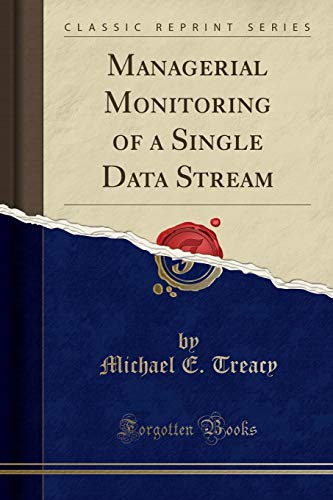
This book-style extract outlines a practical framework for managerial monitoring. It treats monitoring as a choice to intervene, guided by a manager’s judgment and the costs and benefits of acting. The approach favors descriptive models that reflect real-world behavior over purely prescriptive rules, using a simple two-state view and a single data stream to illustrate the core concepts.
- Modeling the decision to intervene as comparing a subjective probability of trouble against a threshold.
- Descriptive approaches that blend prior judgment with observed data, avoiding heavy reliance on unknown data distributions.
- Discussion of how data quality, time, and the perceived link between signals and the situation influence judgments.
- Consideration of the value of information and how information systems can sharpen a manager’s mental models, not just the signals themselves.
Ideal for readers seeking clear, accessible insight into how monitoring decisions are made in practice and how information systems can support—not just replace—their judgment.
"Sinopsis" puede pertenecer a otra edición de este libro.
Reseña del editor
Excerpt from Managerial Monitoring of a Single Data Stream
The next section of this paper outlines a general framework for describing the monitoring function of management. Monitoring is characterized as a decision of whether or not to intervene in a situation. The decision is made by comparing the subjective probability that the situation is in need of intervention, determined from the monitored data and personal judgement, with a threshold probability determined from the relative costs and benefits of intervening. In subsequent sections, normative cost investigation models, which prescribe the determination of the subjective probability and the threshold probability, are reviewed with an aim toward selecting from them that which is descriptive of managerial monitoring behavior. Unfortunately, not all of the theory is descriptively valid.
About the Publisher
Forgotten Books publishes hundreds of thousands of rare and classic books. Find more at www.forgottenbooks.com
This book is a reproduction of an important historical work. Forgotten Books uses state-of-the-art technology to digitally reconstruct the work, preserving the original format whilst repairing imperfections present in the aged copy. In rare cases, an imperfection in the original, such as a blemish or missing page, may be replicated in our edition. We do, however, repair the vast majority of imperfections successfully; any imperfections that remain are intentionally left to preserve the state of such historical works.
Reseña del editor
Excerpt from Managerial Monitoring of a Single Data Stream
Much of management activity involves monitoring: scanning and surveying situations for which there is a potential need for corrective action. The purpose of monitoring is to routinely assess this potential and thereby to indicate when managerial intervention is required. If there is never a need for corrective action, then there is never an economic benefit to monitoring, for payoffs are obtained only through actions which improve the economic circumstances of the firm.
Monitoring involves the gathering and assessment of information. It is what Simon calls the intelligence phase of decision making [1977] and what Pounds calls the process of problem finding. [1969] Monitoring is differentiated from other managerial information processing activities by its purpose, to routinely assess the potential need for corrective action. Routine implies a repetitive and somewhat structured activity. Corrective action suggests that the situation is being guided toward some target or goal.
This paper is an inquiry into the design of information systems to support managerial monitoring functions. The guiding paradigm in this effort is provided by information economics theory. As Treacy [1981] has observed, economics models of information value concentrate upon only the choice phase of decision making.
About the Publisher
Forgotten Books publishes hundreds of thousands of rare and classic books. Find more at www.forgottenbooks.com
This book is a reproduction of an important historical work. Forgotten Books uses state-of-the-art technology to digitally reconstruct the work, preserving the original format whilst repairing imperfections present in the aged copy. In rare cases, an imperfection in the original, such as a blemish or missing page, may be replicated in our edition. We do, however, repair the vast majority of imperfections successfully; any imperfections that remain are intentionally left to preserve the state of such historical works.
"Sobre este título" puede pertenecer a otra edición de este libro.
Resultados de la búsqueda para Managerial Monitoring of a Single Data Stream (Classic...

Imagen del vendedor
Managerial Monitoring of a Single Data Stream (Classic Reprint)
Impresión bajo demandaLibrería: Forgotten Books, London, Reino Unido
Calificación del vendedor: 5 de 5 estrellas

Paperback. Condición: New. Print on Demand. This book examines managerial monitoring, the process by which managers assess whether intervention is needed to address potential issues. By combining insights from behavioral economics and management, the author presents a novel descriptive model of how managers make these assessments, challenging traditional normative approaches. Through this model, the book explores the value of information systems not only in providing data but also in sharpening managers' understanding of their operating environment. The author's research suggests that the real value of information systems lies in their ability to assist managers in honing their mental models, leading to better decision-making and more effective monitoring. This book is a reproduction of an important historical work, digitally reconstructed using state-of-the-art technology to preserve the original format. In rare cases, an imperfection in the original, such as a blemish or missing page, may be replicated in the book. print-on-demand item. Nº de ref. del artículo: 9781332246007_0
Comprar nuevo
EUR 15,85
Gastos de envío gratis
Se envía de Reino Unido a Estados Unidos de America
Se envía de Reino Unido a Estados Unidos de America
Cantidad disponible: Más de 20 disponibles
Imagen de archivo
Managerial Monitoring of a Single Data Stream Classic Reprint
Librería: PBShop.store US, Wood Dale, IL, Estados Unidos de America
Calificación del vendedor: 5 de 5 estrellas
PAP. Condición: New. New Book. Shipped from UK. Established seller since 2000. Nº de ref. del artículo: LW-9781332246007
Comprar nuevo
EUR 24,84
Gastos de envío gratis
Se envía dentro de Estados Unidos de America
Se envía dentro de Estados Unidos de America
Cantidad disponible: 15 disponibles
Imagen de archivo
Managerial Monitoring of a Single Data Stream Classic Reprint
Librería: PBShop.store UK, Fairford, GLOS, Reino Unido
Calificación del vendedor: 5 de 5 estrellas
PAP. Condición: New. New Book. Shipped from UK. Established seller since 2000. Nº de ref. del artículo: LW-9781332246007
Comprar nuevo
EUR 24,82
Envío por EUR 3,92
Se envía de Reino Unido a Estados Unidos de America
Se envía de Reino Unido a Estados Unidos de America
Cantidad disponible: 15 disponibles