
Artículos relacionados a Quality Software Management, Volume 1: Systems Thinking
Reseña del editor
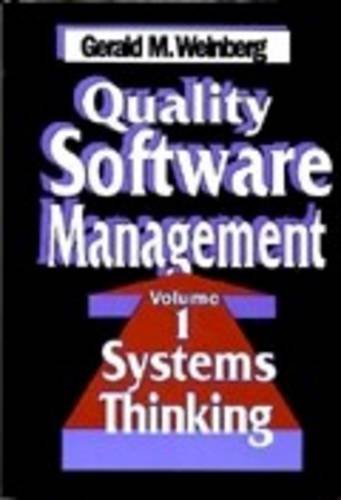
High-quality software demands high-quality management. That's the subject of Quality Software Management, a four-volume series that has grown out of acclaimed author Gerald M. Weinberg's forty-year love affair with computers.
In Volume 1, Systems Thinking, the author tackles the first requirement for developing quality software: learning to think correctly—about problems, solutions, and quality itself. He also sets out guidelines that stimulate the kind of thinking needed. "Act early, act small" is key to staying in control of the software process. Managers need to serve as both planners and catalysts within the organization: to continually plan what to do, observe what happens, and then act decisively to bring the actual closer to the planned. Numerous examples illustrate "control points," areas that can be managed to prevent a crisis or to keep one from getting worse.
Topics include:
* understanding quality
* pressure and breakdowns
* software cultures
* patterns of quality
* patterns of management
* feedback effects
* the size/complexity dynamic in software engineering
* detecting failures and reacting to them
* fault resolution dynamics
* the role of customers.
Useful diagrams, references, exercises, and a bibliography augment the text.
"Sobre este título" puede pertenecer a otra edición de este libro.
Resultados de la búsqueda para Quality Software Management, Volume 1: Systems Thinking

Imagen del vendedor
Quality Software Management, Volume 1: Systems Thinking
Publicado por
Dorset House Publishing Co Inc.,U.S., 2011
ISBN 10: 0932633722
ISBN 13: 9780932633729
Antiguo o usado
Paperback
Librería: Book Grocer, Tullamarine, VIC, Australia
Calificación del vendedor: 5 de 5 estrellas

Paperback. Gerald M. Weinberg, Dorset House Publishing Co Inc.,U.S. High-quality software demands high-quality management. That's the subject of Quality Software Management, a four-volume series that has grown out of acclaimed author Gerald M. Weinberg's forty-year love affair with computers. In Volume 1, Systems Thinking, the author tackles the first requirement for developing quality software: learning to think correctly about problems, solutions, and quality itself. He also sets out guidelines that stimulate the kind of thinking needed. "Act early, act small" is key to staying in control of the software process. Managers need to serve as both planners and catalysts within the organization: to continually plan what to do, observe what happens, and then act decisively to bring the actual closer to the planned. Numerous examples illustrate "control points," areas that can be managed to prevent a crisis or to keep one from getting worse. Topics include: * understanding quality * pressure and breakdowns * software cultures * patterns of quality * patterns of management * feedback effects * the size/complexity dynamic in software engineering * detecting failures and reacting to them * fault resolution dynamics * the role of customers. Useful diagrams, references, exercises, and a bibliography augment the text. Paperback. Nº de ref. del artículo: 9780932633729-SECONDHAND
Comprar usado
EUR 7,64
Envío por EUR 25,98
Se envía de Australia a Estados Unidos de America
Se envía de Australia a Estados Unidos de America
Cantidad disponible: 1 disponibles
Imagen de archivo
Quality Software Management: Systems Thinking
Librería: GoldBooks, Denver, CO, Estados Unidos de America
Calificación del vendedor: 5 de 5 estrellas
Paperback. Condición: new. New Copy. Customer Service Guaranteed. Nº de ref. del artículo: 4O34_36_0932633722
Comprar nuevo
EUR 61,62
Envío por EUR 4,76
Se envía dentro de Estados Unidos de America
Se envía dentro de Estados Unidos de America
Cantidad disponible: 1 disponibles
Imagen de archivo
Quality Software Management, Volume 1: Systems Thinking, Paperback Edition
Publicado por
Dorset House Publishing, 2011
ISBN 10: 0932633722
ISBN 13: 9780932633729
Nuevo
Paperback
Librería: Revaluation Books, Exeter, Reino Unido
Calificación del vendedor: 5 de 5 estrellas
Paperback. Condición: Brand New. 336 pages. 8.90x6.70x0.80 inches. In Stock. Nº de ref. del artículo: 0932633722
Comprar nuevo
EUR 57,12
Envío por EUR 14,61
Se envía de Reino Unido a Estados Unidos de America
Se envía de Reino Unido a Estados Unidos de America
Cantidad disponible: 1 disponibles