
Artículos relacionados a Voltaire's Riddle Hardback: Micromegas and the...
Voltaire's Riddle Hardback: Micromegas and the Measure of All Things (Dolciani Mathematical Expositions) - Tapa dura
Sinopsis
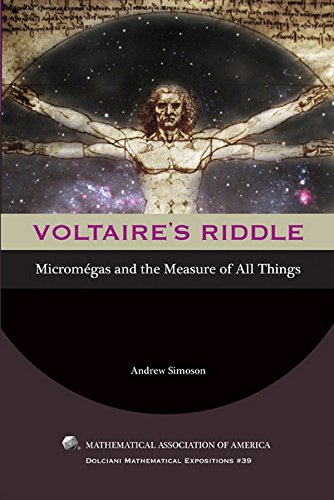
An exploration of Voltaire's Micromégas, the story of a giant from a planet of Sirius who visits a French expedition on its return from testing Newton's theory of gravity in the polar regions. This book suggests some possible answers to Voltaire's riddle, and presents the related mathematics behind the expedition.
"Sinopsis" puede pertenecer a otra edición de este libro.
Acerca del autor
Andrew Simoson earned a Ph.D. in Mathematics under Leonard Asimow at the University of Wyoming in 1979, working on extensions of separating theorems in functional analysis. Since then, he has been chairman of the mathematics department at King College in Bristol, Tennessee, and has authored over thirty papers in various mathematical journals. He has twice been a Fulbright professor, at the University of Botswana, 1990–91, and at the University of Dar es Salaam in Tanzania, 1997–98.
De la contraportada
Did you know that Voltaire was the first to publish the legend of Isaac Newton discovering gravity upon seeing an apple fall? That he tried for about eight years to be a mathematician? That in 1752 he wrote Micromégas, a story about a French expedition to the arctic (1736 7) whose purpose was to test Newton s controversial theories about gravity? This book is about that story and its underlying mathematics. Briefly, an alien giant visits the earth and encounters the expedition returning from north of the Baltic Sea. Their ensuing dialogue ranges from measurements of the very small to the very large, from gnats and micro-organisms to planets and stars, from man s tendency to make war to dreams of understanding his own spirit. At the end of their conversation, the giant gives man a book with the answers to all things. But when they open it, it is blank. That is the riddle of this book. What does such an ending mean? As a series of vignettes and chapters, we give some riddle resolutions. The vignettes---requiring no special mathematical knowledge---describe the people, traditions, and events of the expedition and story. The chapters---accessible to anyone with a background in undergraduate linear algebra, vector calculus, and differential equations---show why a rotating earth must be flattened at the poles, why the tip of earth s polar axis traces out a curve with period of nearly twenty-six thousand years, why the path of a small black hole dropped at the earth s equator must be a hypocycloid, why an old problem studied by Maupertuis---the leader of the French expedition---is a pursuit curve, and why in measuring phenomena we sometimes get it wrong. All in all, this book is a case study in how mathematical and scientific knowledge becomes common knowledge.
"Sobre este título" puede pertenecer a otra edición de este libro.
Resultados de la búsqueda para Voltaire's Riddle Hardback: Micromegas and the...

Imagen de archivo
Voltaire's Riddle : Micromegas and the Measure of All Things;
Publicado por
Mathematical Association of America, 2010
ISBN 10: 0883853450
ISBN 13: 9780883853450
Antiguo o usado
Tapa dura
Original o primera edición
Librería: Novel Ideas Books & Gifts, Decatur, IL, Estados Unidos de America
Calificación del vendedor: 4 de 5 estrellas

Hardcover. Condición: Fine. Estado de la sobrecubierta: No Dust Jacket. First Edition; First Printing. Small 4to 9" - 11" tall; 376 pages. Nº de ref. del artículo: 191769
Comprar usado
EUR 36,70
Envío por EUR 4,45
Se envía dentro de Estados Unidos de America
Se envía dentro de Estados Unidos de America
Cantidad disponible: 1 disponibles
Imagen de archivo
Voltaire's Riddle : Micromegas and the Measure of All Things
Publicado por
American Mathematical Society, 2010
ISBN 10: 0883853450
ISBN 13: 9780883853450
Antiguo o usado
Tapa dura
Librería: Better World Books: West, Reno, NV, Estados Unidos de America
Calificación del vendedor: 5 de 5 estrellas

Condición: Very Good. Former library copy. Pages intact with possible writing/highlighting. Binding strong with minor wear. Dust jackets/supplements may not be included. Includes library markings. Stock photo provided. Product includes identifying sticker. Better World Books: Buy Books. Do Good. Nº de ref. del artículo: 17050150-75
Comprar usado
EUR 43,58
Gastos de envío gratis
Se envía dentro de Estados Unidos de America
Se envía dentro de Estados Unidos de America
Cantidad disponible: 1 disponibles
Imagen de archivo
Voltaire's Riddle
Publicado por
Mathematical Association of America (MAA), 2010
ISBN 10: 0883853450
ISBN 13: 9780883853450
Antiguo o usado
Tapa dura
Librería: ThriftBooks-Atlanta, AUSTELL, GA, Estados Unidos de America
Calificación del vendedor: 5 de 5 estrellas
Hardcover. Condición: Very Good. No Jacket. May have limited writing in cover pages. Pages are unmarked. ~ ThriftBooks: Read More, Spend Less. Nº de ref. del artículo: G0883853450I4N00
Comprar usado
EUR 51,56
Gastos de envío gratis
Se envía dentro de Estados Unidos de America
Se envía dentro de Estados Unidos de America
Cantidad disponible: 1 disponibles
Imagen de archivo
Voltaire's Riddle: Micromegas and the Measure of All Things (Dolciani Mathematical Expositions)
Publicado por
The Mathematical Association of America, 2010
ISBN 10: 0883853450
ISBN 13: 9780883853450
Nuevo
Tapa dura
Librería: Kennys Bookshop and Art Galleries Ltd., Galway, GY, Irlanda
Calificación del vendedor: 5 de 5 estrellas
Condición: New. An exploration of Voltaire's Micromegas which presents the mathematics behind the polar expedition and suggests some answers to Voltaire's riddle. Series: Dolciani Mathematical Expositions. Num Pages: 396 pages, Illustrations, 1 map. BIC Classification: PB. Category: (G) General (US: Trade); (U) Tertiary Education (US: College). Dimension: 247 x 174 x 24. Weight in Grams: 650. . 2010. Annotated. hardcover. . . . . Nº de ref. del artículo: V9780883853450
Comprar nuevo
EUR 61,90
Envío por EUR 9,50
Se envía de Irlanda a Estados Unidos de America
Se envía de Irlanda a Estados Unidos de America
Cantidad disponible: 1 disponibles
Imagen de archivo
Voltaire's Riddle : Micromegas and the Measure of All Things
Publicado por
The Mathematical Association of America, 2010
ISBN 10: 0883853450
ISBN 13: 9780883853450
Nuevo
Tapa dura
Librería: GreatBookPrices, Columbia, MD, Estados Unidos de America
Calificación del vendedor: 5 de 5 estrellas
Condición: New. Nº de ref. del artículo: 7763603-n
Comprar nuevo
EUR 73,03
Envío por EUR 2,35
Se envía dentro de Estados Unidos de America
Se envía dentro de Estados Unidos de America
Cantidad disponible: 2 disponibles
Imagen de archivo
Voltaire's Riddle : Micromegas and the Measure of All Things
Publicado por
The Mathematical Association of America, 2010
ISBN 10: 0883853450
ISBN 13: 9780883853450
Antiguo o usado
Tapa dura
Librería: GreatBookPrices, Columbia, MD, Estados Unidos de America
Calificación del vendedor: 5 de 5 estrellas
Condición: As New. Unread book in perfect condition. Nº de ref. del artículo: 7763603
Comprar usado
EUR 82,47
Envío por EUR 2,35
Se envía dentro de Estados Unidos de America
Se envía dentro de Estados Unidos de America
Cantidad disponible: 2 disponibles
Imagen de archivo
Voltaire`s Riddle Micromegas and the Measure of All Things
Publicado por
Mathematical Assn of Amer, 2010
ISBN 10: 0883853450
ISBN 13: 9780883853450
Nuevo
Tapa dura
Librería: Revaluation Books, Exeter, Reino Unido
Calificación del vendedor: 5 de 5 estrellas
Hardcover. Condición: Brand New. 377 pages. 9.00x6.00x1.00 inches. In Stock. Nº de ref. del artículo: __0883853450
Comprar nuevo
EUR 69,99
Envío por EUR 14,85
Se envía de Reino Unido a Estados Unidos de America
Se envía de Reino Unido a Estados Unidos de America
Cantidad disponible: 1 disponibles
Imagen de archivo
Voltaire's Riddle: Micromegas and the Measure of All Things (Dolciani Mathematical Expositions)
Publicado por
The Mathematical Association of America, 2010
ISBN 10: 0883853450
ISBN 13: 9780883853450
Nuevo
Tapa dura
Librería: Kennys Bookstore, Olney, MD, Estados Unidos de America
Calificación del vendedor: 5 de 5 estrellas
Condición: New. An exploration of Voltaire's Micromegas which presents the mathematics behind the polar expedition and suggests some answers to Voltaire's riddle. Series: Dolciani Mathematical Expositions. Num Pages: 396 pages, Illustrations, 1 map. BIC Classification: PB. Category: (G) General (US: Trade); (U) Tertiary Education (US: College). Dimension: 247 x 174 x 24. Weight in Grams: 650. . 2010. Annotated. hardcover. . . . . Books ship from the US and Ireland. Nº de ref. del artículo: V9780883853450
Comprar nuevo
EUR 79,90
Envío por EUR 9,35
Se envía dentro de Estados Unidos de America
Se envía dentro de Estados Unidos de America
Cantidad disponible: 1 disponibles
Imagen de archivo
Voltaire's Riddle Hardback: Micromegas and the Measure of All Things (Dolciani Mathematical Expositions)
Publicado por
The Mathematical Association of America, 2010
ISBN 10: 0883853450
ISBN 13: 9780883853450
Nuevo
Tapa dura
Librería: Llibreria Hispano Americana, Barcelona, B, España
Calificación del vendedor: 2 de 5 estrellas

Encuadernación de tapa dura. Condición: Nuevo. Estado de la sobrecubierta: Nuevo. Nº de ref. del artículo: 92,,,,,,,,,,,,,,,,,,,,
Comprar nuevo
EUR 20,00
Envío por EUR 70,00
Se envía de España a Estados Unidos de America
Se envía de España a Estados Unidos de America
Cantidad disponible: 1 disponibles
Imagen de archivo
Voltaire's Riddle Hardback: Micromegas and the Measure of All Things (Dolciani Mathematical Expositions)
Publicado por
The Mathematical Association of America, 2010
ISBN 10: 0883853450
ISBN 13: 9780883853450
Nuevo
Tapa dura
Librería: Llibreria Hispano Americana, Barcelona, B, España
Calificación del vendedor: 2 de 5 estrellas
Encuadernación de tapa dura. Condición: Nuevo. Estado de la sobrecubierta: Nuevo. Nº de ref. del artículo: 92,,,,,,,,,,,,,,,,,,,
Comprar nuevo
EUR 20,00
Envío por EUR 70,00
Se envía de España a Estados Unidos de America
Se envía de España a Estados Unidos de America
Cantidad disponible: 1 disponibles