
Artículos relacionados a Philosophical Commentary on These Words of the Gospel,...
Philosophical Commentary on These Words of the Gospel, Luke 14.23, "Compel Them to Come In, That My House May Be Full" (Natural Law and Enlightenment Classics) - Tapa blanda
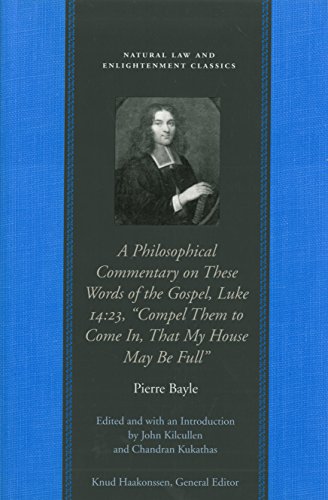
Sinopsis
The popular mind often associates scepticism with irreligion, and critical distance with unbelief. In this view, reason and faith, or scientific method and religious dogma, are not only different but indeed antagonistic means of viewing the world, understanding human existence, and conducting one's life. Pierre Bayle's scepticism was of a singularly distinct sort. He argued not that religion is untrue, but that the discourses proper to theology and the discourses proper to philosophy are incapable of any meaningful exchange. Bayle sought to advance a secular morality that would be independent of both speculative theism and religious revelation. Bayle blazed a philosophical path that Denis Diderot, David Hume, and other Enlightenment thinkers would follow. The continuing significance of this work is its vigorous defence of complete religious toleration. It is in itself a primary historical source of our modern tradition of religious tolerance.
"Sinopsis" puede pertenecer a otra edición de este libro.
Acerca del autor
Pierre Bayle (1647-1706), Protestant philosopher and critic, was born in France. In 1675 he became professor of philosophy at Sedan until forced into exile in Rotterdam in 1681, where he published works on religion with a liberal and tolerant tendency. He was dismissed from his position at the Huguenot refugees academy in 1693 following the accusation that he was an agent of France and an enemy of Protestantism. In 1696 he completed his major work, the Dictionnaire historique et critique.
"Sobre este título" puede pertenecer a otra edición de este libro.
Resultados de la búsqueda para Philosophical Commentary on These Words of the Gospel,...

Imagen del vendedor
A Philosophical Commentary on These Words of the Gospel, Luke 14:23, âCompel Them to Come In, That My House May Be Fullâ (Natural Law and Enlightenment Classics)
Publicado por
Liberty Fund, 2005
ISBN 10: 0865974950
ISBN 13: 9780865974951
Antiguo o usado
Tapa blanda
Librería: Coas Books, Las Cruces, NM, Estados Unidos de America
Calificación del vendedor: 5 de 5 estrellas

Condición: acceptable. Cover image may vary. Cover is worn. Item has staining. Paperback. Nº de ref. del artículo: COBV.0865974950.A
Comprar usado
EUR 6,02
Envío por EUR 3,43
Se envía dentro de Estados Unidos de America
Se envía dentro de Estados Unidos de America
Cantidad disponible: 1 disponibles
Imagen del vendedor
Philosophical Commentary on These Words of the Gospel, Luke 14.23 : Compel Them to Come In, That My House May Be Full
Publicado por
Liberty Fund, 2005
ISBN 10: 0865974950
ISBN 13: 9780865974951
Antiguo o usado
Tapa blanda
Librería: GreatBookPrices, Columbia, MD, Estados Unidos de America
Calificación del vendedor: 5 de 5 estrellas
Condición: As New. Unread book in perfect condition. Nº de ref. del artículo: 4081125
Comprar usado
EUR 13,47
Envío por EUR 2,27
Se envía dentro de Estados Unidos de America
Se envía dentro de Estados Unidos de America
Cantidad disponible: 4 disponibles
Imagen del vendedor
Philosophical Commentary on These Words of the Gospel, Luke 14.23 : Compel Them to Come In, That My House May Be Full
Librería: GreatBookPrices, Columbia, MD, Estados Unidos de America
Calificación del vendedor: 5 de 5 estrellas
Condición: New. Nº de ref. del artículo: 4081125-n
Comprar nuevo
EUR 13,52
Envío por EUR 2,27
Se envía dentro de Estados Unidos de America
Se envía dentro de Estados Unidos de America
Cantidad disponible: 4 disponibles
Imagen de archivo
PHILOSOPHICAL COMMENTARY, A Format: Paperback
Publicado por
Liberty Fund, 2005
ISBN 10: 0865974950
ISBN 13: 9780865974951
Antiguo o usado
Tapa blanda
Librería: INDOO, Avenel, NJ, Estados Unidos de America
Calificación del vendedor: 5 de 5 estrellas
Condición: As New. Unread copy in mint condition. Nº de ref. del artículo: PG9780865974951
Comprar usado
EUR 15,82
Gastos de envío gratis
Se envía dentro de Estados Unidos de America
Se envía dentro de Estados Unidos de America
Cantidad disponible: Más de 20 disponibles
Imagen de archivo
PHILOSOPHICAL COMMENTARY, A Format: Paperback
Librería: INDOO, Avenel, NJ, Estados Unidos de America
Calificación del vendedor: 5 de 5 estrellas
Condición: New. Nº de ref. del artículo: 9780865974951
Comprar nuevo
EUR 15,87
Gastos de envío gratis
Se envía dentro de Estados Unidos de America
Se envía dentro de Estados Unidos de America
Cantidad disponible: Más de 20 disponibles
Imagen de archivo
Philosophical Commentary on these Words of The Gospel, Luke 14.23 : 'Compel Them to Come In, That My House May Be Full'
Publicado por
Liberty Fund December 2005, 2005
ISBN 10: 0865974950
ISBN 13: 9780865974951
Nuevo
Paper Back
Librería: Eighth Day Books, LLC, Wichita, KS, Estados Unidos de America
Calificación del vendedor: 4 de 5 estrellas

Paper Back. Condición: New. Christian apologists as early as St. Augustine have appealed to Christ's words in Luke 14:23-'Go out into the highways and hedges and compel them to come in, that my house may be filled'-as a mandate for forcible conversion. In 1685, Protestant philosopher and critic Pierre Bayle wrote a compelling and thorough critique of this belief, contending that all coercion in religious matters is morally untenable as being inconsistent with reason. His Philosophical Commentary establishes the case against this supposed literal interpretation of Luke 14:23, arguing that reason must govern all interpretations of Scripture. According to Bayle, the erroneous conscience has the same rights as the enlightened one, his central tenet being a doctrine of mutual toleration grounded in a theory of the morality of conscience-namely, that all God requires is that people act on what seems to them to be the truth. Though not as well known as John Locke's Letter Concerning Toleration, Bayle's Commentary (which preceded Locke's Letter) is more comprehensive and substantially deeper-greatly influencing the likes of Diderot, Hume, and other Enlightenment thinkers. This edition is a reprint of the 1708 English translation, checked against the French original and corrected with an introduction and annotations designed to make it more accessible for the modern reader. Nº de ref. del artículo: 20100216168707
Comprar nuevo
EUR 15,94
Envío por EUR 5,12
Se envía dentro de Estados Unidos de America
Se envía dentro de Estados Unidos de America
Cantidad disponible: 2 disponibles
Imagen del vendedor
A Philosophical Commentary on These Words of the Gospel, Luke 14:23, "Compel Them to Come In, That My House May Be Full"
Publicado por
Liberty Fund, Indianapolis, IN, 2005
ISBN 10: 0865974950
ISBN 13: 9780865974951
Antiguo o usado
Tapa blanda
Original o primera edición
Librería: Monroe Street Books, Middlebury, VT, Estados Unidos de America
Calificación del vendedor: 4 de 5 estrellas
Condición: Very Good. Estado de la sobrecubierta: None. 639 pages. Softcover. Normal light wear to covers. Name of former owner in pen and light pencil marking in front end papers. Otherwise clean and tight copy. Record # 2231083. Nº de ref. del artículo: 2231083
Comprar usado
EUR 16,83
Envío por EUR 4,30
Se envía dentro de Estados Unidos de America
Se envía dentro de Estados Unidos de America
Cantidad disponible: 1 disponibles
Imagen del vendedor
Philosophical Commentary on these Words of The Gospel Luke 14:23, "Compel Them to Come In That My House May Be Full'
Publicado por
Liberty Fund, Indianapolis, 2005
ISBN 10: 0865974950
ISBN 13: 9780865974951
Antiguo o usado
Tapa blanda
Librería: Browsing Is Arousing, Middlebury, VT, Estados Unidos de America
Calificación del vendedor: 4 de 5 estrellas
Condición: Very Good. Softcover, 639 pages. Christian apologists as early as St. Augustine have appealed to Christ's words in Luke 14:23-'Go out into the highways and hedges and compel them to come in, that my house may be filled'- as a mandate for forcible conversion. In 1685, Protestant philosopher and critic Pierre Bayle wrote a compelling and thorough critique of this belief, contending that all coercion in religious matters is morally untenable as being inconsistent with reason. His Philosophical Commentary establishes the case against this supposed literal interpretation of Luke 14:23, arguing that reason must govern all interpretations of Scripture. According to Bayle, the erroneous conscience has the same rights as the enlightened one, his central tenet being a doctrine of mutual toleration grounded in a theory of the morality of conscience-namely, that all God requires is that people act on what seems to them to be the truth. Clean copy. Record # 386535. Nº de ref. del artículo: 386535
Comprar usado
EUR 15,94
Envío por EUR 6,02
Se envía dentro de Estados Unidos de America
Se envía dentro de Estados Unidos de America
Cantidad disponible: 1 disponibles
Imagen del vendedor
Philosophical Commentary on These Words of the Gospel, Luke 14.23, "Compel Them to Come In, That My House May Be Full"
Librería: Rarewaves USA, HEBRON, KY, Estados Unidos de America
Calificación del vendedor: 5 de 5 estrellas
Paperback. Condición: New. The popular mind often associates scepticism with irreligion, and critical distance with unbelief. In this view, reason and faith, or scientific method and religious dogma, are not only different but indeed antagonistic means of viewing the world, understanding human existence, and conducting one's life. Pierre Bayle's scepticism was of a singularly distinct sort. He argued not that religion is untrue, but that the discourses proper to theology and the discourses proper to philosophy are incapable of any meaningful exchange. Bayle sought to advance a secular morality that would be independent of both speculative theism and religious revelation. Bayle blazed a philosophical path that Denis Diderot, David Hume, and other Enlightenment thinkers would follow. The continuing significance of this work is its vigorous defence of complete religious toleration. It is in itself a primary historical source of our modern tradition of religious tolerance. Nº de ref. del artículo: LU-9780865974951
Comprar nuevo
EUR 22,88
Gastos de envío gratis
Se envía dentro de Estados Unidos de America
Se envía dentro de Estados Unidos de America
Cantidad disponible: Más de 20 disponibles
Imagen de archivo
Philosophical Commentary on These Words of the Gospel, Luke 14.23, "Compel Them to Come In, That My House May Be Full"
Librería: PBShop.store UK, Fairford, GLOS, Reino Unido
Calificación del vendedor: 5 de 5 estrellas
PAP. Condición: New. New Book. Shipped from UK. Established seller since 2000. Nº de ref. del artículo: GZ-9780865974951
Comprar nuevo
EUR 15,16
Envío por EUR 7,88
Se envía de Reino Unido a Estados Unidos de America
Se envía de Reino Unido a Estados Unidos de America
Cantidad disponible: 2 disponibles