
Artículos relacionados a A Revolution for Our Rights: Indigenous Struggles for...
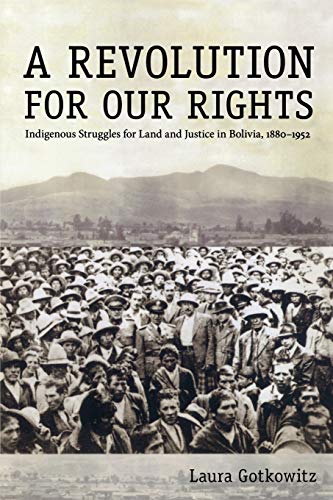
A Revolution for Our Rights: Indigenous Struggles for Land and Justice in Bolivia, 1880–1952 - Tapa blanda
Sinopsis
A Revolution for Our Rights is a critical reassessment of the causes and significance of the Bolivian Revolution of 1952. Historians have tended to view the revolution as the result of class-based movements that accompanied the rise of peasant leagues, mineworker unions, and reformist political projects in the 1930s. Laura Gotkowitz argues that the revolution had deeper roots in the indigenous struggles for land and justice that swept through Bolivia during the first half of the twentieth century. Challenging conventional wisdom, she demonstrates that rural indigenous activists fundamentally reshaped the military populist projects of the 1930s and 1940s. In so doing, she chronicles a hidden rural revolution-before the revolution of 1952-that fused appeals for equality with demands for a radical reconfiguration of political power, landholding, and rights.
Gotkowitz combines an emphasis on national political debates and congresses with a sharply focused analysis of Indian communities and large estates in the department of Cochabamba. The fragmented nature of Cochabamba’s Indian communities and the pioneering significance of its peasant unions make it a propitious vantage point for exploring contests over competing visions of the nation, justice, and rights. Scrutinizing state authorities’ efforts to impose the law in what was considered a lawless countryside, Gotkowitz shows how, time and again, indigenous activists shrewdly exploited the ambiguous status of the state’s pro-Indian laws to press their demands for land and justice. Bolivian indigenous and social movements have captured worldwide attention during the past several years. By describing indigenous mobilization in the decades preceding the revolution of 1952, A Revolution for Our Rights illuminates a crucial chapter in the long history behind present-day struggles in Bolivia and contributes to an understanding of indigenous politics in modern Latin America more broadly.
"Sinopsis" puede pertenecer a otra edición de este libro.
Acerca del autor
Laura Gotkowitz is Associate Professor of History at the University of Iowa.
De la contraportada
""A Revolution for Our Rights" is a major contribution to studies of Andean history and anthropology and to studies of indigenous and popular politics in Latin America as a whole. In this exciting and powerful study, Laura Gotkowitz illuminates modern Indian political engagements in what is today the most indigenous country in the Americas."--Sinclair Thomson, author of "We Alone Will Rule: Native Andean Politics in the Age of Insurgency"
Fragmento. © Reproducción autorizada. Todos los derechos reservados.
A REVOLUTION FOR OUR RIGHTS
Indigenous Struggles for Land and Justice in Bolivia, 1880-1952By Laura GotkowitzDUKE UNIVERSITY PRESS
Copyright © 2007 Duke University PressAll right reserved.
ISBN: 978-0-8223-4067-6
Contents
Illustrations...........................................................................................................................ixAcknowledgments.........................................................................................................................xiIntroduction............................................................................................................................1CHAPTER ONE The Peculiar Paths of the Liberal Project..................................................................................17CHAPTER TWO Indigenista Statecraft and the Rise of the Caciques Apoderados.............................................................43CHAPTER THREE "In Our Provinces There Is No Justice": Caciques Apoderados and the Crisis of the Liberal Project........................69CHAPTER FOUR The Problem of National Unity: From the Chaco War to the 1938 Constitutional Convention...................................101CHAPTER FIVE The Unruly Countryside: Defending Land, Labor Rights, and Autonomy........................................................131CHAPTER SIX The Unwilling City: Villarroel Populism and the Politics of Mestizaje......................................................164CHAPTER SEVEN "The Disgrace of the Pongo and the Mitani": The 1945 Indigenous Congress and a Law against Servitude.....................192CHAPTER EIGHT "Under the Dominion of the Indian": The 1947 Cycle of Unrest.............................................................233Conclusion and Epilogue: Rethinking the Rural Roots of the 1952 Revolution..............................................................268Notes...................................................................................................................................291Bibliography............................................................................................................................359Index...................................................................................................................................385
Chapter One
THE PECULIAR PATHS OF THE LIBERAL PROJECT
Three months after Bolivia's long wars of independence ended in April 1825, the victors convened a general assembly to deliberate the fate of the liberated territory. The forty-eight deputies assembled in Sucre, the nation's new capital, overwhelmingly agreed to proclaim Bolivia an independent state. They made "the Liberator," Simn Bolvar, its first president. Bolivar and his associates viewed the founding of the republic as a fundamental break with colonialism. Once installed in the presidency in August 1825, Bolvar set about applying the force of the law to that break. He announced a rapid succession of decrees on all the most urgent aspects of the country's political and economic organization.
A fundamental subset of the new laws aimed to free Indians from the discrimination of the colonial past. Embracing ideals of liberty and equality, and proclaiming an end to all taxes "degrading to the dignity of citizens," Bolvar ended tribute, the colonial-era head tax imposed on Indian men between the ages of eighteen and fifty. He also abolished the position of the cacique (Spanish term for kuraka or mallku, ethnic lord) and declared Indians owners of the land in their possession. Fiscal and administrative shortcomings quickly derailed Bolvar's liberal dream: just one year after tribute was abolished, his successor, President Jos Antonio de Sucre, reinstated the discriminatory charge. Rather than giving Indians the "dignity of citizens," Bolivia's first generation of liberal statesmen partially revived the "degrading" obligations of the colonial past.
In the 1860s and 1870s, as international demand for Bolivian raw materials surged, a second generation of free-trade liberal reformers took power. They emerged in the wake of the silver-mining industry's recovery, which diminished the state's reliance on income from tribute. Thanks to this revival, mine owners and landed elites pushed through plans to ease free trade, privatize corporate entities, liberalize land and capital markets, and construct an export-oriented railroad network. Inspired by Bolvar's liberalism, the second generation of reformers also sought to eliminate discriminatory legacies of colonial rule: tribute, caste, the cacique, and even the Indian community itself. Although their efforts to eradicate communal landholding ultimately proved unsuccessful, the second wave of reforms would have more enduring, and damaging, effects on Indian communities than those of Bolvar. Most notably, the late-nineteenth-century reform process dramatically reduced the amount of land controlled by communities and exacerbated divisions within them. Inadvertently, it also engendered a new form of indigenous leadership that would wage a national campaign to recover usurped land. Rather than abolishing the Indian community, the reforms unleashed a lengthy struggle over its legal status and the political power of community authorities.
Bolivia's late-nineteenth-century attempt to privatize communal land was hardly unique: it was a hallmark of liberalism throughout much of Latin America. Yet the Bolivian reforms stand out in two ways. First, Bolivia's laws followed an exceptionally aggressive path, for the state intervened directly in one of the region's most brutal privatization campaigns. Second, the reform process initially proved markedly unsuccessful. The first two significant attempts to privatize the land not only resulted in major legal concessions but in wide-scale rebellion. President Melgarejo's attempt to disentail communal property concluded with his overthrow in 1870 and the restoration of usurped land. A decade later, another privatization law sparked legal protests that first extracted from the government provisions for collective tenure and ultimately resulted in the 1899 rebellion for Indian self-rule. These attempts at disentailment also provoked disputes among politicians over the rights of Indians. After the 1870 defeat of Melgarejo, some statesmen acknowledged Indians' contribution to the removal of the dictator and offered a form of gradual citizenship. But this potentially more inclusionary strand of liberalism withered with the 1899 Indian rebellion, which led rival elites to unify around racist images of Indians as a "barbaric" and allegedly antinational force. After 1899, most elite politicians would deem Indians unqualified for citizenship.
The tensions between inclusion and exclusion that marked Bolivia's liberal project were neither simply intrinsic to liberalism nor purely traces of the colonial past. Above all they sprang from a history of conflict over attempts to abolish the Indian community. Late-nineteenth-century ideas about rights, obligations, property, and "race" were shaped and reshaped by what happened on the ground when the government intruded on Indian communities with titles, fees, and survey teams. Although politicians vowed to eliminate communal landholding and the Indian community itself, time and again they had to admit publicly that they could not.
* Melgarejo's 1860s Assault against the Indian Community
The nemesis of Latin American liberals was the military strongman or caudillo, who embodied the most stubborn obstacle to national order, growth, and progress. Mariano Melgarejo (1820-71), a Cochabamba general of lower-class origins, played that role in Bolivia from 1864, when he took power in a coup, to 1871, when a popular uprising overthrew him with the collaboration of an estimated 40,000 Indians. Vilified by late-nineteenth-century politicians, Melgarejo became an enduring symbol of lawlessness, tyranny, and transgression. For generations of liberals, his regime epitomized the antiliberal practices that stymied the formation of a modern nation.
If Bolivian liberals differentiated their "enlightened" program from Melgarejo's darker age, their economic and anti-Indian policies nevertheless sprang from the dictator's attempt to construct a liberal order. The Melgarejo regime advanced the first concerted attack against protectionism, ending tariffs on imports from Argentina and Brazil and a government monopoly on purchases of silver, Bolivia's main export product. The cancellation of the monopoly allowed Bolivia's large silver companies to sell overseas freely. Melgarejo also unleashed the first major attempt to dismantle the Indian corporate community since President Sucre had suspended Simn Bolvar's early-nineteenth-century decrees. With an 1866 decree, Melgarejo ordered Indians to purchase individual titles within sixty days or forfeit land for auction by the state. His government deliberately tried to keep Indians from obtaining those titles by requiring a substantial size and cost for all sales. Two years later, a second decree stipulated that communal land was state property. Since approximately half of all farmland was still in communal hands, the measures had devastating implications.
Melgarejo's policies engendered an unprecedented process of communal land expropriation. Between 1866 and 1869, government auctioneers sold the land of 356 communities to private bidders. Three hundred twenty-one of them were located in the department of La Paz, primarily in its most densely populated provinces (Omasuyos, Pacajes, Ingavi, Sicasica [present-day Aroma], and Muecas). The land sales sparked a series of indigenous uprisings in 1869 and 1870, largely in La Paz but also in the Potos region. Since most of the communal territory accrued to parvenus closely linked to the state bureaucracy and the army, the sales also antagonized traditional landholding elites. Indeed the underlying logic of the sales was Melgarejo's need to pay off loyal relatives or clients and subsidize costly military activities. In numerous instances, medium-scale producers, merchants, townspeople, and former indigenous authorities benefited from the auctions. The nonelite origin of these buyers is key to understanding traditional elites' outcry against Melgarejo, for the land sales enabled upwardly aspiring sectors to gain a foothold in local and regional power structures. The anti-Melgarejo sentiments culminated in a massive uprising in 1870 that deposed the regime and expelled the dictator across the Bolivia-Peru border. Under a torrent of stones, so the story goes, Melgarejo was sent packing.
The 1870 revolt against Melgarejo marked a fundamental watershed, for it was the first such political alliance between Indians and non-Indians in postindependence Bolivia. Indians, however, pursued their own objectives, pressuring for the return of communal land and in effect reoccupying usurped territory. Traditional elites risked this pact because they were angered by Melgarejo's disregard for the law and by his favoritism for cronies, the army, and aspiring new middle sectors. They also opposed the extensive concessions foreigners received on southern land rich in guano and nitrates. But anger quickly turned to fear. Reflecting on the uprising, anti-Melgarejo elites recalled the massive Indian rebellions of the 1780s and the 1811 siege of La Paz; one congressional deputy insisted that the future of the nation would be jeopardized if the government again threatened Indian communities by permitting the usurpation of their land. Indian participation in the 1870-71 revolt not only sealed Melgarejo's fate. It cast an ineffaceable shadow over the legislative debates about land, tribute, and nationhood that ensued once the "barbarous caudillo" was expelled.
* Small Communal Properties
Immediately after Melgarejo's overthrow, political elites clamored to define a new legal order in the 1871 Constituent Assembly. Not coincidentally, the question of communal landholding overwhelmingly colored the legislative debates. After allowing a public reckoning on the effects of Melgarejo's assault against Indian communities, the 1871 assembly unanimously ratified indigenous rights to all the land they possessed, including the so-called sobrantes (common land considered vacant because cultivated on rotating cycles).
The 1871 assembly's confirmation of communal landholding, at a time when plans to privatize it were gaining ground, could not be more striking. Yet ratification did not necessarily equal approval. The assembly restored the land largely because its members feared Indian uprisings. And its members intertwined anxious utterances about Indian political power with praise for private property. Indeed their resolve to restore usurped land was only temporary. Both within Congress and beyond its halls, politicians voiced support for the privatization of communal land over the long term.
Hand in hand with the 1871 assembly, political elites fiercely debated in the press and in pamphlets the particular form that the privatization of communal property should eventually take. One group of statesmen who defended Melgarejo's sales advocated the rapid incorporation of communal land into haciendas and the transformation of Indian comunarios into dependent estate laborers (colonos). An opposing cluster of politicians instead heralded a nation of independent smallholders. Since the participants linked the ability to own and manage property with the capacity to exercise political rights, their debate also touched on questions of citizenship. The discussion broke down between those who viewed Indians as servile laborers and noncitizens (i.e., as inherently lacking the very quality on which citizenship was based), and those who considered them productive proprietors and therefore potential citizens.
To back its position, each side traced a distinct history of property regimes back to the Inca empire. The participants then raised a series of questions about land tenure. Did Indians own property in the past? Did they own it now? Could they exercise the "full and absolute rights of dominion"? Their answers drew on a mix of imported ideas; inexact reflections on colonialism; political and fiscal exigencies; and the demands and virtues of myriad arrangements of communal and private property. Because the arguments of the smallholding faction left the most visible stamp on subsequent legislation, the following pages focus on its vision of property, "civilization," and rights. The pro-smallholder views also shed light on the underlying contradictions of Bolivia's liberal project. Although this bloc favored small private property, some of its members expressed hesitant praise for Indian communities.
The smallholding faction's contradictory perspective is best exemplified by the views of its principal spokesperson, Jose Maria Santivaez, a Cochabamba estate owner and congressional delegate. In a widely circulated 1871 pamphlet, Santivaez lauded Indian communities while referring to them as "small communal properties." For social, economic, and political reasons "of vital importance to the republic," Santivaez maintained, communal property could not be subsumed by latifundios. When opponents disparaged his desire to preserve Indian communities intact, Santivaez clarified his position: "comunarios" should be declared "owners of their lands." It was because Indian communities were already subdivided, he implied, that such ownership was both viable and just.
Surely Santivaez viewed Indian communities as a cluster of small properties because he was inspired by a particular geographic backdrop, his native Cochabamba. In contrast to the resistance that community members in La Paz waged against the 1860s land sales, comunarios of Cochabamba's productive Valle Bajo (Santivaez's principal reference point) purchased title to their own parcels when Melgarejo put their land up for sale. In lauding these "small communal properties," however, Santivaez not only spoke about Cochabamba's present, but about the colonial and Inca past. He never acknowledged that smallholding within Indian communities might be an anomaly of Cochabamba. Instead he took the region's fragmented communities as a universal pattern of the nation's agrarian history-and as a model for its future. The import of the smallholding argument thus resides not only in its anti-hacienda position, but in the way its proponents connected ideas about property, justice, and rights with a specific vision of the past.
In advancing his peculiar view of the Indian community, Santivaez labored to refute the pro-hacienda faction's claims that Indians under Inca rule were not property owners but merely held use rights to state-controlled land. To prove that Indians were in fact proprietors, Santivaez made predictable allusions to republican legislation such as the early-nineteenth-century decree in which Simn Bolvar called indgenas "natural and absolute owners of the land that they inherited from their fathers." But Santivaez did not rely just on republican laws. He grounded the republican restoration of Indians' "small communal properties" in colonial as well as precolonial land tenure systems. Drawing on works by the nineteenth-century U.S. historian William H. Prescott and the eighteenth-century Scottish historian William Robertson, as well as Garcilaso de la Vega's sixteenth-century account, Santivaez first maintained that the Inca empire had itself promulgated private property. After denouncing the devastation of the conquest, he then praised the Spanish Crown for creating an even more efficient system of land tenure. The concessions in land that Spain gave Indians, Santivaez said, were equal to the private grants that immigrants received in the nineteenth-century United States.
(Continues...)
Excerpted from A REVOLUTION FOR OUR RIGHTSby Laura Gotkowitz Copyright © 2007 by Duke University Press. Excerpted by permission.
All rights reserved. No part of this excerpt may be reproduced or reprinted without permission in writing from the publisher.
Excerpts are provided by Dial-A-Book Inc. solely for the personal use of visitors to this web site.
"Sobre este título" puede pertenecer a otra edición de este libro.
Resultados de la búsqueda para A Revolution for Our Rights: Indigenous Struggles for...

Imagen de archivo
A Revolution for Our Rights: Indigenous Struggles for Land and Justice in Bolivia, 1880-1952
Publicado por
Duke University Press Books, 2008
ISBN 10: 0822340674
ISBN 13: 9780822340676
Antiguo o usado
Tapa blanda
Librería: World of Books (was SecondSale), Montgomery, IL, Estados Unidos de America
Calificación del vendedor: 5 de 5 estrellas

Condición: Good. Item in good condition. Textbooks may not include supplemental items i.e. CDs, access codes etc. Nº de ref. del artículo: 00106523714
Comprar usado
EUR 3,35
Gastos de envío gratis
Se envía dentro de Estados Unidos de America
Se envía dentro de Estados Unidos de America
Cantidad disponible: 1 disponibles
Imagen de archivo
A Revolution for Our Rights: Indigenous Struggles for Land and Justice in Bolivia, 1880-1952
Publicado por
Duke University Press (edition ), 2008
ISBN 10: 0822340674
ISBN 13: 9780822340676
Antiguo o usado
Paperback
Librería: BooksRun, Philadelphia, PA, Estados Unidos de America
Calificación del vendedor: 5 de 5 estrellas
Paperback. Condición: Very Good. It's a well-cared-for item that has seen limited use. The item may show minor signs of wear. All the text is legible, with all pages included. It may have slight markings and/or highlighting. Nº de ref. del artículo: 0822340674-8-1
Comprar usado
EUR 5,82
Gastos de envío gratis
Se envía dentro de Estados Unidos de America
Se envía dentro de Estados Unidos de America
Cantidad disponible: 1 disponibles
Imagen de archivo
A Revolution for Our Rights: Indigenous Struggles for Land and Justice in Bolivia, 1880-1952
Publicado por
Duke University Press, 2008
ISBN 10: 0822340674
ISBN 13: 9780822340676
Antiguo o usado
Paperback
Librería: ThriftBooks-Atlanta, AUSTELL, GA, Estados Unidos de America
Calificación del vendedor: 5 de 5 estrellas
Paperback. Condición: Good. No Jacket. Pages can have notes/highlighting. Spine may show signs of wear. ~ ThriftBooks: Read More, Spend Less. Nº de ref. del artículo: G0822340674I3N00
Comprar usado
EUR 5,94
Gastos de envío gratis
Se envía dentro de Estados Unidos de America
Se envía dentro de Estados Unidos de America
Cantidad disponible: 1 disponibles
Imagen de archivo
A Revolution for Our Rights: Indigenous Struggles for Land and Justice in Bolivia, 1880-1952
Publicado por
Duke University Press, 2008
ISBN 10: 0822340674
ISBN 13: 9780822340676
Antiguo o usado
Paperback
Librería: ThriftBooks-Dallas, Dallas, TX, Estados Unidos de America
Calificación del vendedor: 5 de 5 estrellas
Paperback. Condición: Very Good. No Jacket. May have limited writing in cover pages. Pages are unmarked. ~ ThriftBooks: Read More, Spend Less. Nº de ref. del artículo: G0822340674I4N00
Comprar usado
EUR 5,94
Gastos de envío gratis
Se envía dentro de Estados Unidos de America
Se envía dentro de Estados Unidos de America
Cantidad disponible: 1 disponibles
Imagen de archivo
A Revolution for Our Rights: Indigenous Struggles for Land and Justice in Bolivia, 1880-1952
Publicado por
Duke University Press, 2007
ISBN 10: 0822340674
ISBN 13: 9780822340676
Antiguo o usado
Paperback
Librería: Red's Corner LLC, Tucker, GA, Estados Unidos de America
Calificación del vendedor: 5 de 5 estrellas
Paperback. Condición: Good. Illustrated. Grade 2 out 5 points. This is a used book. Books with this grade may have any of the following: Personalized notes/names, stickers/labels, markings on pages, bends/creases on cover/spine, ex-library markings, moderate wear on cover and pages. May not include extra materials such as dust jackets, access codes, CDs, accessories, etc. All orders ship by next business day! We are a small company and very thankful for your business! Nº de ref. del artículo: mon0000059408
Comprar usado
EUR 2,91
Envío por EUR 3,44
Se envía dentro de Estados Unidos de America
Se envía dentro de Estados Unidos de America
Cantidad disponible: 1 disponibles
Imagen de archivo
A Revolution for Our Rights: Indigenous Struggles for Land and Justice in Bolivia, 1880â"1952
Publicado por
Duke University Press Books, 2008
ISBN 10: 0822340674
ISBN 13: 9780822340676
Antiguo o usado
Paperback
Librería: HPB-Red, Dallas, TX, Estados Unidos de America
Calificación del vendedor: 5 de 5 estrellas
Paperback. Condición: Good. Connecting readers with great books since 1972! Used textbooks may not include companion materials such as access codes, etc. May have some wear or writing/highlighting. We ship orders daily and Customer Service is our top priority! Nº de ref. del artículo: S_466404494
Comprar usado
EUR 4,43
Envío por EUR 3,23
Se envía dentro de Estados Unidos de America
Se envía dentro de Estados Unidos de America
Cantidad disponible: 1 disponibles
Imagen de archivo
A Revolution for Our Rights : Indigenous Struggles for Land and Justice in Bolivia, 1880-1952
Publicado por
Duke University Press, 2008
ISBN 10: 0822340674
ISBN 13: 9780822340676
Antiguo o usado
Tapa blanda
Librería: Better World Books, Mishawaka, IN, Estados Unidos de America
Calificación del vendedor: 5 de 5 estrellas
Condición: Good. Pages intact with minimal writing/highlighting. The binding may be loose and creased. Dust jackets/supplements are not included. Stock photo provided. Product includes identifying sticker. Better World Books: Buy Books. Do Good. Nº de ref. del artículo: 8711985-6
Comprar usado
EUR 8,27
Gastos de envío gratis
Se envía dentro de Estados Unidos de America
Se envía dentro de Estados Unidos de America
Cantidad disponible: 1 disponibles
Imagen de archivo
A Revolution for Our Rights: Indigenous Struggles for Land and Justice in Bolivia, 1880â"1952
Publicado por
Duke University Press Books, 2008
ISBN 10: 0822340674
ISBN 13: 9780822340676
Antiguo o usado
Paperback
Librería: Midtown Scholar Bookstore, Harrisburg, PA, Estados Unidos de America
Calificación del vendedor: 5 de 5 estrellas
Paperback. Condición: Good. Good - Bumped and creased book with tears to the extremities, but not affecting the text block, may have remainder mark or previous owner's name - GOOD PAPERBACK Standard-sized. Nº de ref. del artículo: M0822340674Z3
Comprar usado
EUR 3,48
Envío por EUR 5,17
Se envía dentro de Estados Unidos de America
Se envía dentro de Estados Unidos de America
Cantidad disponible: 1 disponibles
Imagen de archivo
A Revolution for Our Rights: Indigenous Struggles for Land and Justice in Bolivia, 1880-1952
Publicado por
Duke University Press Books, 2008
ISBN 10: 0822340674
ISBN 13: 9780822340676
Antiguo o usado
paperback
Librería: Textbooks_Source, Columbia, MO, Estados Unidos de America
Calificación del vendedor: 5 de 5 estrellas
paperback. Condición: Good. Illustrated. Ships in a BOX from Central Missouri! May not include working access code. Will not include dust jacket. Has used sticker(s) and some writing or highlighting. UPS shipping for most packages, (Priority Mail for AK/HI/APO/PO Boxes). Nº de ref. del artículo: 000902347U
Comprar usado
EUR 10,75
Envío por EUR 3,44
Se envía dentro de Estados Unidos de America
Se envía dentro de Estados Unidos de America
Cantidad disponible: 1 disponibles
Imagen de archivo
A Revolution for Our Rights: Indigenous Struggles for Land and Justice in Bolivia, 1880-1952
Publicado por
Duke University Press Books, 2008
ISBN 10: 0822340674
ISBN 13: 9780822340676
Nuevo
paperback
Librería: Textbooks_Source, Columbia, MO, Estados Unidos de America
Calificación del vendedor: 5 de 5 estrellas
paperback. Condición: New. Illustrated. Ships in a BOX from Central Missouri! UPS shipping for most packages, (Priority Mail for AK/HI/APO/PO Boxes). Nº de ref. del artículo: 000902347N
Comprar nuevo
EUR 24,85
Envío por EUR 3,44
Se envía dentro de Estados Unidos de America
Se envía dentro de Estados Unidos de America
Cantidad disponible: 2 disponibles