
Artículos relacionados a Sex in Development: Science, Sexuality, and Morality...
Sinopsis
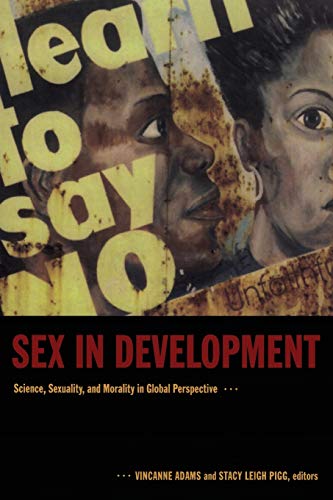
Sex in Development examines how development projects around the world intended to promote population management, disease prevention, and maternal and child health intentionally and unintentionally shape ideas about what constitutes “normal” sexual practices and identities. From sex education in Uganda to aids prevention in India to family planning in Greece, various sites of development work related to sex, sexuality, and reproduction are examined in the rich, ethnographically grounded essays in this volume. These essays demonstrate that ideas related to morality are repeatedly enacted in ostensibly value-neutral efforts to put into practice a “global” agenda reflecting the latest medical science.
Sex in Development combines the cultural analysis of sexuality, critiques of global development, and science and technology studies. Whether considering the resistance encountered by representatives of an American pharmaceutical company attempting to teach Russian doctors a “value free” way to offer patients birth control or the tension between Tibetan Buddhist ideas of fertility and the modernization schemes of the Chinese government, these essays show that attempts to make sex a universal moral object to be managed and controlled leave a host of moral ambiguities in their wake as they are engaged, resisted, and reinvented in different ways throughout the world.
Contributors. Vincanne Adams, Leslie Butt, Lawrence Cohen, Heather Dell, Vinh-Kim Nguyen, Shanti Parikh, Heather Paxson, Stacy Leigh Pigg, Michele Rivkin-Fish
"Sinopsis" puede pertenecer a otra edición de este libro.
Acerca del autor
Vincanne Adams is Professor in the Department of Anthropology, History, and Social Medicine at the University of California, San Francisco. She is the author of Doctors for Democracy: Health Professionals in the Nepal Revolution.
Stacy Leigh Pigg is Associate Professor in the Department of Sociology and Anthropology at Simon Fraser University in British Columbia. She is the editor of the journal Medical Anthropology: Cross-Cultural Studies in Health and Illness.
De la contraportada
"This important and timely book makes a case for thinking in new directions about sexuality in relation to the 'scientization' of development policies. It will become an important reference work for future scholarship in anthropology, public health, and gender and sexuality studies, and, one would hope, in development studies."--Rayna Rapp, coeditor of "Conceiving the New World Order: The Global Politics of Reproduction"
Fragmento. © Reproducción autorizada. Todos los derechos reservados.
SEX IN DEVELOPMENT
Science, Sexuality, and Morality in Global PerspectiveDuke University Press
Copyright © 2005 Duke University PressAll right reserved.
ISBN: 978-0-8223-3491-0
Contents
Acknowledgments.................................................................................................................................ixIntroduction: The Moral Object of Sex STACY LEIGH PIGG VINCANNE ADAMS.........................................................................1Globalizing the Facts of Life STACY LEIGH PIGG.................................................................................................39Part 1 The Production of New Subjectivities....................................................................................................67Moral Science and the Management of "Sexual Revolution" in Russia MICHELE RIVKIN-FISH..........................................................71Family Planning, Human Nature, and the Ethical Subject of Sex in Urban Greece HEATHER PAXSON...................................................95From Auntie to Disco: The Bifurcation of Risk and Pleasure in Sex Education in Uganda SHANTI A. PARIKH.........................................125Part 2 The Creation of Normativities as a Biopolitical Project.................................................................................159Sexuality, the State, and the Runaway Wives of Highlands Papua, Indonesia LESLIE BUTT..........................................................163"Ordinary" Sex, Prostitutes, and Middle-Class Wives: Liberalization and National Identity in India HEATHER S. DELL..............................187Moral Orgasm and Productive Sex: Tantrism Faces Fertility Control in Lhasa, Tibet (China) VINCANNE ADAMS.......................................207Part 3 Contestations of Liberal Humanism Forged in Sexual Identity Politics....................................................................241Uses and Pleasures: Sexual Modernity, HIV/AIDS, and Confessional Technologies in a West African Metropolis VINH-KIM NGUYEN.....................245The Kothi Wars: aids Cosmopolitanism and the Morality of Classification LAWRENCE COHEN.........................................................269References......................................................................................................................................305Contributors....................................................................................................................................333Index...........................................................................................................................................335
Chapter One
STACY LEIGH PIGGGlobalizing the Facts of Life
* * *
Sexuality has been the last domain (trailing even gender) to have its natural, biologized status called into question.-CAROLE VANCE
It is April 1997 and a week-long refresher course for youth "peer educators," run by a Nepali nongovernmental organization (NGO) with funds aimed at HIV/AIDS prevention activities for young people, is being held in a rooftop meeting room in a modest hotel for local travelers in the city of Pokhara in Nepal. Six months earlier this group of Nepali college students, ranging in age from eighteen to twenty-one, had spent two weeks learning about sexual health, sexually transmitted diseases (STDS), AIDS, and condoms. Now they had been brought together for an additional week of discussions, role-playing exercises, and education. A mild breeze flutters papers on tabletops as twenty students shift restlessly in their seats, hoping to cover up the fact that they cannot remember the set of vocabulary terms that they had been assigned to master in their first round of training. Each student examines a photocopied worksheet with three simple line drawings labeled "male genitalia," "female genitalia (external)," and "female genitalia (internal)." Arrows extend from the drawings to blank lines, where these peer educators in training are expected to fill in the correct term. Some of these body parts, like the penis, are easy enough to identify on the drawing, and young men and women alike know the appropriate technical term to write on their sheet of paper. Other parts are harder to identify; indeed, some are organs that these students have never had occasion to consider, much less name, either because it has never been considered important to do so or because these organs are not externally visible-or both. The black squiggles on white paper are drawn from an anatomist's or gynecologist's angle of inspection, and these peculiar renderings of the most intimate regions of the body do not necessarily match the landscape known to the embodied self.
When this worksheet was passed to me, I had a sudden flashback to the sex education courses I had sat through in church basements and in school classrooms as a teenager in suburban Milwaukee. The worksheets whose arcane information was confounding the Nepali students might have been taken from the same sex education textbook from which I had been taught. For that teenaged me, living some twenty-five years earlier in an American midde-class enclave coming to grips with the so-called sexual revolution, information about the reproductive organs, hormonal changes in puberty, the menstrual cycle, ovulation, and fertilization was fundamentally integrated into my concepts of "sex," along with "facts" about masturbation (normal), homosexuality (possibly okay but not normal), and gendered differences in desire (girls have to be careful not to lead boys on because the latter can't control themselves). I was awash in medico-moral discourses on sex, buffeted on one side by the sex education classes taught by the gym teacher and on the other by my reading of Our Bodies, Ourselves, the bible of the women's health movement (with furtive peeks at The Joy of Sex sandwiched in-between).
That April in 1997, watching the Nepali students struggle with their worksheets, it struck me that outside of this training session there were few (if any) other ways that they would encounter this particular configuration of information about the body. I realized then just how deeply my own body sense was informed by the sexual sciences. The facts of life that seemed obvious and basic to me and that shaped the way I handled my sexual relationships and my reproductive possibilities were not the same as those shared by the rest of the people in the room that day. The formats within which I have encountered this information, the myriad subtle ways it has always been echoed and reinforced in my world, and the uses to which I have put it have made it-and the phrase itself is telling-"second nature" for me. Would it become so for these Nepali students?
Stepping Back: Sex Education and Persuasion
Worldwide, health programs dealing with fertility regulation, reproductive health, and HIV/STD prevention are based on and actively promulgate a particular set of ideas about the sexual and reproductive body. Planned by experts in public health and development, set up within the context of national governments and donor-government-NGO relations, and tied to visions of social reform, these programs eventually take concrete form in the often mundane activities of education and service delivery. Some of these activities involve concrete alterations to the body (getting Norplant into arms, condoms onto penises, penicillin into bloodstreams, iron supplements into gestating women, etc.), but many others intervene in the social sphere (e.g., increasing the age of marriage for women, encouraging spacing of childbirths, urging husbands and wives to communicate about sexual and reproductive decisions) and involve complicated mixtures of education and persuasion. As a collection of activities, motivated by a variety of agendas and carried out in diverse locales, these endeavors form part of a larger historical phenomenon in which a particular set of institutional networks is internationalizing biomedically based knowledge and technology.
The internationalization of sexology and the sexual sciences is not new. The well-known sexologists of the late-nineteenth and early-twentieth-century Anglo-European tradition were widely translated, and contemporaneous medical/sexological treatises were written by intellectuals in countries outside the West (Diktter 1995; Frstck 2000). The elaboration of these imported and parallel sexual sciences was linked to state projects of modernization and, in some cases, decolonization. And, for the most part, it was a bourgeois elite who engaged with the new sciences of sex. Clearly, the sexual sciences have a history of being entangled with visions of social reform.
Although lower socioeconomic classes and marginalized groups have long been targeted by technological interventions (sterilization, contraceptives, medical treatments of venereal disease), the more recent wave of programs attempts to target such groups through sex education. Targeted groups are portrayed by experts and elites as either ignorant or, more benignly, as objects of pity when they are presented as voicing reasoning about their sexual and reproductive bodies that is nonscience based. Whether scoffed at, ridiculed, or gently corrected, difference as both inferiority and deviance is set in relation to the normative baseline of scientific fact. In such programs the idiom of rationality and the project of education often become vehicles through which class or racial distinctions are marked. That the invocation of scientific facts can so readily function as a tool for carving out social superiority raises questions about the scope for diversity within sexual and reproductive health programs.
The sex education components of sexual and reproductive health programs aim to improve health and autonomy by improving the knowledge base from which people make their decisions, but there are persistent, troubling gaps between biomedical messages and local knowledge. Indeed, there is a pressing need to find a way to strike "a balance between respecting and building on what women know and giving them essential biomedical information" (Cornwall 2002: 229). For instance, women are often urged to use invasive contraception (such as the contraceptive pill, subdermal or injectable contraceptives, or the intrauterine device) with "no information at all on how the medicines or devices they are using work, or on what they do to their bodies" (219). When health workers do attempt to provide some explanation, they find that they are left to their own devices to search for metaphors that might bridge the gap between the biomedical "facts" and local knowledge. However, because women's concerns about the effects of these contraceptives on their bodies stem from indigenous understandings of reproductive health, even these explanations often do not address their worries.
Bringing biomedical knowledge into a nondominating relation with local knowledges is no easy feat. The educational arm of sexual and reproductive health programs restricts itself mainly to providing basic scientific literacy. Yet an instrumental faith in biomedical information fails to ask what people take on along with a biomedical view of sexuality and reproduction; what people in different locales actually do with this information and what they might seek from it and unintentionally derive from it. These are questions about the processes through which people in diverse and often severely disadvantaged circumstances come to have (or not to have) stakes in a biomedical view of their bodies-questions that, in turn, demand that we take into account the various institutional stakes involved in this situation. The dominant frame for thinking about these issues persistently juxtaposes "facts" with "beliefs," "science" with "values," and "biology" with "culture." The optimistic hopes for achieving health via sex education sustain a view that, on the one hand, tends to overestimate the inherent, self-evident power of "the facts" to change the world and, on the other, to underestimate the degree to which the sexual and reproductive sciences are inextricably tangled in social issues.
In this essay I extract from my small ethnographic epiphany in Nepal a series of questions about the international presence of this particular conglomerate of ideas concerning the sexual and reproductive body. The vignette that opens this essay is more than a rhetorical gambit: that moment prompted me to ask a series of questions about the relation between theories of sexuality and the history of the sexual sciences. In this study I trace some of those connections by working outward from ethnographic specificity to abstract issues concerning the conceptualization of sexuality, biological facts, and globalization. Note, however, that although I begin with observations from Nepal my aim is neither to analyze processes taking place in Nepal nor to provide a cultural interpretation of Nepalese sexuality. Rather, my goal is for this study to function as a prolegomenon to the kind of inquiry called for by certain transformations around sexuality. We live in a time when sexuality is being increasingly biologized through international public health projects, while, simultaneously, social theory is prying it away from its association with the physical body. Thus there is a need to reexamine the theoretical tools used for thinking about biology and culture in relation to sexuality.
Biological facts elaborated through the sexual and reproductive sciences have been at the heart of the development of the concept of sex. A historical understanding of the codevelopment of, first, scientific objectivity with respect to the sexual body and, second, changing socio-moral debates concerning that body further confounds the self-evidence of the separation between facts and values, and points to how, on a global scale, a biologized notion of sex operates as a standardizing device. Lest we become mired in a negative critique of science as a Western particularism masquerading as a universal, these observations demand a robustly materialist way of envisioning the social production of facts.
A Scientific View of Sexuality
What is a scientific view of the sexual and procreative body, and why is it significant? Consider the following news article, whose headline screams: "African AIDS Epidemic Fueled by Sexual Ignorance." It sums up the case for sex education as a strategy for aids prevention:
Westport, Ct (Reuters Health) May 16 [2001]-Sex and sexuality is at the core of the AIDS pandemic in sub-Saharan Africa and, according to a leading South African health official, researchers and politicians must involve the African public in a much more frank and open discussion of human behavior if they hope to successfully combat the disease.
"Sex is regarded as a taboo in Africa-you don't speak openly about it," said Dr. Malegapuru William Makgoba, president of the Medical Research Council of South Africa [in an address to the National Institute of Allergy and Infectious Diseases in Bethesda, Maryland]. "We all know that this is a sexually transmitted disease and that's the bottom line," he said. "We're doing everything except focusing on the real major factor that determines whether or not you get the disease." ...
African scientific and government leaders need to recognize that the aids crisis in this region is not just about statistics and treatments, Dr. Makgoba said, but involves a complex interaction between science, politics and culture. "The challenges facing science and its development today are no longer predominantly technical but largely social."
Research into the particular cultural backgrounds and sexual practices of Africans is almost nonexistent, he continued, with no focus being placed on combating the sexual mythologies, taboos, and ignorance that inform the sexual behavior of many African men and women ... "The whole subject of human sexuality in Africa is ... based on hearsay," Dr. Makgoba told Reuters Health. Addressing sexuality scientifically, "will make a lot of difference to people, both in the developed and the developing countries."
The position articulated here by Dr. Makgoba (himself a prominent virologist) is a complex one. It is a plea to confront the HIV/AIDS crisis as a social issue. It is also a declaration that science must override the "politics" of the (merely) social disputes over the aids problem. The basis for an adequate public response to aids would involve the "frank and open" approach to sexuality made possible by the clarity provided by medico-scientific knowledge-a clarity that could trump narrow political interests. With his call for more research on "particular cultural backgrounds and sexual practices," Dr. Makgoba recognizes that interventions require reliable contextual understandings of behavior. Here the door appears to be open for conducting research into the contingent, complicated, and changing interactions between personhood, gender, kinship, domestic arrangements, economic strategies, and other factors that form patterns of sexual expression and sexual contacts within particular contexts.
Yet, in the next breath, Dr. Makgoba introduces a universal bottom line: these "mythologies," stemming from "ignorance," must be combated with facts. The sexual practices that increase the risk of HIV transmission can be shown to arise from "taboos," which in the hard light of epidemiological risk can be revealed to be shadowy collective delusions. A penis in a vagina or anus is an opportunity for the movement of microbes from body to body-period. As for ideas about masculinity and erotic longings; or about moral duties, coercion, and complicated goals and tradeoffs; or about hard life circumstances-well, these messy factors can be evaluated in terms of physiological harm (disease) and the "pure truth" of what we know about the sexual function of the human body. In a single sentence, the news article summarizing Dr. Makgoba's lecture leaps from a view of sexuality that could foreground the social (and the local) to a view of sexuality that emphasizes the biological (and the universal). Dr. Makgoba anchors the call for a scientific approach to sexual behavior in biological processes. For him, a "frank and open" public consideration of sexuality is one that makes it an object of medico-scientific knowledge, and this knowledge is assumed to be objective and neutral.
(Continues...)
Excerpted from SEX IN DEVELOPMENT Copyright © 2005 by Duke University Press. Excerpted by permission.
All rights reserved. No part of this excerpt may be reproduced or reprinted without permission in writing from the publisher.
Excerpts are provided by Dial-A-Book Inc. solely for the personal use of visitors to this web site.
"Sobre este título" puede pertenecer a otra edición de este libro.
Resultados de la búsqueda para Sex in Development: Science, Sexuality, and Morality...

Imagen de archivo
Sex in Development: Science, Sexuality, and Morality in Global Perspective
Publicado por
Duke University Press (edition Second Printing 2006), 2005
ISBN 10: 0822334917
ISBN 13: 9780822334910
Antiguo o usado
Paperback
Librería: BooksRun, Philadelphia, PA, Estados Unidos de America
Calificación del vendedor: 5 de 5 estrellas

Paperback. Condición: Fair. Second Printing 2006. The item might be beaten up but readable. May contain markings or highlighting, as well as stains, bent corners, or any other major defect, but the text is not obscured in any way. Nº de ref. del artículo: 0822334917-7-1-13
Comprar usado
EUR 4,47
Gastos de envío gratis
Se envía dentro de Estados Unidos de America
Se envía dentro de Estados Unidos de America
Cantidad disponible: 1 disponibles
Imagen de archivo
Sex in Development: Science, Sexuality, and Morality in Global Perspective
Publicado por
Duke University Press, 2005
ISBN 10: 0822334917
ISBN 13: 9780822334910
Antiguo o usado
Paperback
Librería: ThriftBooks-Dallas, Dallas, TX, Estados Unidos de America
Calificación del vendedor: 5 de 5 estrellas
Paperback. Condición: Very Good. No Jacket. May have limited writing in cover pages. Pages are unmarked. ~ ThriftBooks: Read More, Spend Less. Nº de ref. del artículo: G0822334917I4N00
Comprar usado
EUR 5,87
Gastos de envío gratis
Se envía dentro de Estados Unidos de America
Se envía dentro de Estados Unidos de America
Cantidad disponible: 1 disponibles
Imagen de archivo
Sex in Development: Science, Sexuality, and Morality in Global Perspective
Publicado por
Duke University Press, 2005
ISBN 10: 0822334917
ISBN 13: 9780822334910
Antiguo o usado
Paperback
Librería: ThriftBooks-Atlanta, AUSTELL, GA, Estados Unidos de America
Calificación del vendedor: 5 de 5 estrellas
Paperback. Condición: Good. No Jacket. Pages can have notes/highlighting. Spine may show signs of wear. ~ ThriftBooks: Read More, Spend Less. Nº de ref. del artículo: G0822334917I3N00
Comprar usado
EUR 5,87
Gastos de envío gratis
Se envía dentro de Estados Unidos de America
Se envía dentro de Estados Unidos de America
Cantidad disponible: 1 disponibles
Imagen de archivo
Sex in Development : Science, Sexuality, and Morality in Global Perspective
Publicado por
Duke University Press, 2005
ISBN 10: 0822334917
ISBN 13: 9780822334910
Antiguo o usado
Tapa blanda
Librería: Better World Books, Mishawaka, IN, Estados Unidos de America
Calificación del vendedor: 5 de 5 estrellas
Condición: Good. Former library copy. Pages intact with minimal writing/highlighting. The binding may be loose and creased. Dust jackets/supplements are not included. Includes library markings. Stock photo provided. Product includes identifying sticker. Better World Books: Buy Books. Do Good. Nº de ref. del artículo: GRP102807713
Comprar usado
EUR 7,15
Gastos de envío gratis
Se envía dentro de Estados Unidos de America
Se envía dentro de Estados Unidos de America
Cantidad disponible: 2 disponibles
Imagen de archivo
Sex in Development : Science, Sexuality, and Morality in Global Perspective
Publicado por
Duke University Press, 2005
ISBN 10: 0822334917
ISBN 13: 9780822334910
Antiguo o usado
Tapa blanda
Librería: Better World Books: West, Reno, NV, Estados Unidos de America
Calificación del vendedor: 5 de 5 estrellas
Condición: Fine. Used book that is in almost brand-new condition. May contain a remainder mark. Better World Books: Buy Books. Do Good. Nº de ref. del artículo: 57657625-75
Comprar usado
EUR 7,15
Gastos de envío gratis
Se envía dentro de Estados Unidos de America
Se envía dentro de Estados Unidos de America
Cantidad disponible: 1 disponibles
Imagen de archivo
Sex in Development: Science, Sexuality, and Morality in Global Perspective
Publicado por
Duke University Press Books, 2005
ISBN 10: 0822334917
ISBN 13: 9780822334910
Antiguo o usado
Paperback
Librería: Midtown Scholar Bookstore, Harrisburg, PA, Estados Unidos de America
Calificación del vendedor: 5 de 5 estrellas
Paperback. Condición: Good. Good - Bumped and creased book with tears to the extremities, but not affecting the text block, may have remainder mark or previous owner's name - GOOD PAPERBACK Standard-sized. Nº de ref. del artículo: M0822334917Z3
Comprar usado
EUR 2,33
Envío por EUR 5,18
Se envía dentro de Estados Unidos de America
Se envía dentro de Estados Unidos de America
Cantidad disponible: 1 disponibles
Imagen de archivo
Sex in Development: Science, Sexuality, and Morality in Global Perspective
Publicado por
Duke University Press Books, 2005
ISBN 10: 0822334917
ISBN 13: 9780822334910
Antiguo o usado
Paperback
Librería: HPB-Diamond, Dallas, TX, Estados Unidos de America
Calificación del vendedor: 5 de 5 estrellas
Paperback. Condición: Very Good. Connecting readers with great books since 1972! Used books may not include companion materials, and may have some shelf wear or limited writing. We ship orders daily and Customer Service is our top priority! Nº de ref. del artículo: S_467971346
Comprar usado
EUR 8,89
Envío por EUR 3,24
Se envía dentro de Estados Unidos de America
Se envía dentro de Estados Unidos de America
Cantidad disponible: 1 disponibles
Imagen de archivo
Sex in Development: Science, Sexuality, and Morality in Global Perspective
Publicado por
Duke University Press, 2005
ISBN 10: 0822334917
ISBN 13: 9780822334910
Antiguo o usado
Tapa blanda
Librería: Phatpocket Limited, Waltham Abbey, HERTS, Reino Unido
Calificación del vendedor: 5 de 5 estrellas
Condición: Good. Your purchase helps support Sri Lankan Children's Charity 'The Rainbow Centre'. Ex-library, so some stamps and wear, but in good overall condition. Our donations to The Rainbow Centre have helped provide an education and a safe haven to hundreds of children who live in appalling conditions. Nº de ref. del artículo: Z1-I-018-01628
Comprar usado
EUR 14,65
Envío por EUR 12,43
Se envía de Reino Unido a Estados Unidos de America
Se envía de Reino Unido a Estados Unidos de America
Cantidad disponible: 1 disponibles
Imagen de archivo
Sex in Development: Science, Sexuality, and Morality in Global Perspective
Publicado por
Duke University Press, 2005
ISBN 10: 0822334917
ISBN 13: 9780822334910
Antiguo o usado
Tapa blanda
Librería: Anybook.com, Lincoln, Reino Unido
Calificación del vendedor: 5 de 5 estrellas
Condición: Good. This is an ex-library book and may have the usual library/used-book markings inside.This book has soft covers. In good all round condition. Please note the Image in this listing is a stock photo and may not match the covers of the actual item,600grams, ISBN:9780822334910. Nº de ref. del artículo: 5553474
Comprar usado
EUR 16,34
Envío por EUR 15,89
Se envía de Reino Unido a Estados Unidos de America
Se envía de Reino Unido a Estados Unidos de America
Cantidad disponible: 1 disponibles
Imagen del vendedor
Sex In Development : Science, Sexuality, And Morality In Global Perspective
Publicado por
Duke University Press, 2005
ISBN 10: 0822334917
ISBN 13: 9780822334910
Nuevo
Tapa blanda
Librería: GreatBookPrices, Columbia, MD, Estados Unidos de America
Calificación del vendedor: 5 de 5 estrellas
Condición: New. Nº de ref. del artículo: 3357450-n
Comprar nuevo
EUR 41,19
Envío por EUR 2,28
Se envía dentro de Estados Unidos de America
Se envía dentro de Estados Unidos de America
Cantidad disponible: 1 disponibles