
Artículos relacionados a Socrates in August: From Incondensable Complexity to...
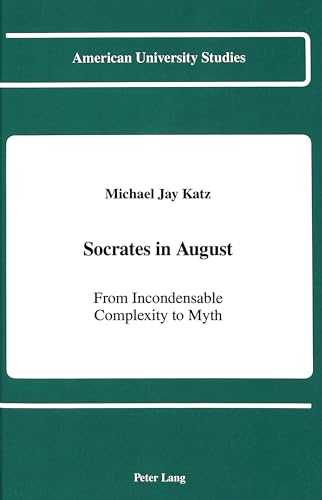
Socrates in August: From Incondensable Complexity to Myth: 66 (American University Studies, Series 5: Philosophy) - Tapa dura
Sinopsis
How is our world incondensably complex? What does this mean for the kinds of understandings with which we must eventually rest satisfied? In 399 B.C., Socrates would have faced this challenge without the language of modern science - a language rife with spacetime continua and four dimensions and genetic codes, all of which hide innumerable elemental assumptions about the structure of human understanding. Instead, Socrates had only his hands and his feet, and trees, houses, and mountains. Most of all, Socrates had the great myths, tales that, having rubbed shoulders with people since time immemorial, still maintain a standing in the crowd. Myths are bald wishes and hopes that are unabashedly fiction and that are human because they resonate in the human soul. They reiterate common human qualities, and they mirror truths that are direct and general and special to us all.
"Sinopsis" puede pertenecer a otra edición de este libro.
Acerca del autor
The Author: Michael Jay Katz, M.D.Ph.D., is Associate Professor of Bio-architectonics in the School of Medicine of Case Western Reserve University. He has written Elements of the Scientific Paper, Templets and the Explanation of Complex Patterns, Pattern Biology and the Complex Architecture of Life, Night Tales of the Shammas, Socrates in October: Dialogues on Incondensable Complexity (Peter Lang), and Socrates in September: The Entanglements of Complexity (Peter Lang).
"Sobre este título" puede pertenecer a otra edición de este libro.
Resultados de la búsqueda para Socrates in August: From Incondensable Complexity to...

Imagen de archivo
Socrates in August: From Incondensable Complexity to Myth (American University Studies Series V, Philosophy, Volume 66)
Publicado por
Peter Lang Inc., International Academic Publishers, 1989
ISBN 10: 082040781X
ISBN 13: 9780820407814
Antiguo o usado
Tapa dura
Librería: Zubal-Books, Since 1961, Cleveland, OH, Estados Unidos de America
Calificación del vendedor: 5 de 5 estrellas

Condición: Good. 193 pp., Hardcover, ex library, else text clean and binding tight. - If you are reading this, this item is actually (physically) in our stock and ready for shipment once ordered. We are not bookjackers. Buyer is responsible for any additional duties, taxes, or fees required by recipient's country. Nº de ref. del artículo: ZB1286733
Comprar usado
EUR 28,50
Envío por EUR 4,03
Se envía dentro de Estados Unidos de America
Se envía dentro de Estados Unidos de America
Cantidad disponible: 1 disponibles
Imagen del vendedor
Socrates in August
Publicado por
Peter Lang Inc., International Academic Publishers, 1991
ISBN 10: 082040781X
ISBN 13: 9780820407814
Antiguo o usado
Tapa dura
Librería: SKULIMA Wiss. Versandbuchhandlung, Westhofen, Alemania
Calificación del vendedor: 5 de 5 estrellas
Condición: Wie Neu. Zustandsbeschreibung: Mängelexemplar/near mint. From Incondensable Complexity to Myth. In Fortführung seiner Behandlung des Themas der Komplexität in Form sokratischer Dialoge ohne Rückgriff auf moderne Wissenschaftssprache, nutzt der Autor insbesondere die Mythen als Ressource der Verständigung. How is our world incondensably complex? What does this mean for the kinds of understandings with which we must eventually rest satisfied? In 399 B.C., Socrates would have faced this challenge without the language of modern science - a language rife with spacetime continua and four dimensions and genetic codes, all of which hide innumerable elemental assumptions about the structure of human understanding. Instead, Socrates had only his hands and his feet, and trees, houses, and mountains. Most of all, Socrates had the great myths, tales that, having rubbed shoulders with people since time immemorial, still maintain a standing in the crowd. Myths are bald wishes and hopes that are unabashedly fiction and that are human because they resonate in the human soul. They reiterate common human qualities, and they mirror truths that are direct and general and special to us all. XI,193 Seiten, gebunden (American University Studies. Series V: Philosophy; Vol. 66/Peter Lang Verlag 1991). Früher EUR 48,50. Gewicht: 451 g - Gebunden/Gebundene Ausgabe. Nº de ref. del artículo: 57519
Comprar usado
EUR 16,00
Envío por EUR 40,00
Se envía de Alemania a Estados Unidos de America
Se envía de Alemania a Estados Unidos de America
Cantidad disponible: 7 disponibles
Imagen de archivo
Socrates in August From Incondensable Complexity to Myth< 2nd Edi
Librería: Librairie La Canopee. Inc., Saint-Armand, QC, Canada
Calificación del vendedor: 5 de 5 estrellas
Condición: AS NEW. Etat de NEUF / AS NEW condition 082040781X 9780820407814 PC566 2. Nº de ref. del artículo: 143122
Comprar usado
EUR 41,83
Envío por EUR 21,51
Se envía de Canada a Estados Unidos de America
Se envía de Canada a Estados Unidos de America
Cantidad disponible: 1 disponibles