
Artículos relacionados a Party-System Collapse: The Roots of Crisis in Peru...
Sinopsis
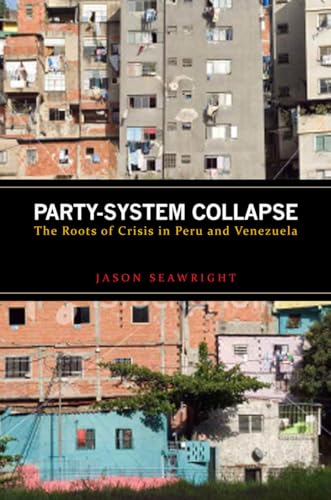
This book shows how voter anger, due to problems of corruption and poor representation, brings about party-system collapse and the rise of important outsider political leaders in South America.
"Sinopsis" puede pertenecer a otra edición de este libro.
Acerca del autor
Jason Seawright is Assistant Professor of Political Science at Northwestern University.
Fragmento. © Reproducción autorizada. Todos los derechos reservados.
PARTY-SYSTEM COLLAPSE
The Roots of Crisis in Peru and VenezuelaBy Jason SeawrightStanford University Press
Copyright © 2012 Board of Trustees of the Leland Stanford Junior UniversityAll right reserved.
ISBN: 978-0-8047-8236-4
Contents
List of Figures and Tables...................................................viiAcknowledgments..............................................................ix1. Party-System Collapse in South America....................................12. Characterizing Party-System Changes.......................................323. Economics, Societal Crisis, and Anxiety...................................634. Corruption and the Collapse of Party Identification.......................885. Ideological Underrepresentation and Voter Defection.......................1136. Voter Affect and the Demise of Party Systems..............................1447. Explaining Parties' Degree of Ideological Flexibility.....................1658. Collapse and the Experience of Politics...................................201Notes........................................................................245Bibliography.................................................................259Index........................................................................275
Chapter One
PARTY-SYSTEM COLLAPSE IN SOUTH AMERICA
Before the 1990s, Venezuela's two-party system was among the most stable and well-institutionalized party systems in the developing world (Coppedge 1994: 174–77). One of the two traditional parties won every fully democratic presidential election in the country's history. From the early 1970s through 1988, these traditional parties, in effect, faced no challengers, winning a combined share of at least 85 percent of the presidential vote in 1973, 1978, 1983, and 1988. Over this period, the traditional parties also dominated the legislature.
In 1993, however, these established electoral patterns began to change rapidly. Both traditional parties lost roughly half of the support they had enjoyed in the previous presidential elections, and—for the first time in Venezuelan democratic history—the winner of the election was not endorsed by either of the established parties.
What began as traditional-party decline in 1993 culminated, in the 1998 presidential elections, in a party-system collapse (Dietz and Myers 2007; Morgan 2007). Neither of the two traditional parties was able to get any traction for its selected candidate. One party endorsed a candidate from outside the party system early in the campaign cycle; the other waited until days before the election to throw its support to that same outsider candidate. Thus the election became a contest between two candidates from outside the established party system. Both traditional parties have been electorally marginalized since that election.
The same election that saw the collapse of the Venezuelan traditional parties also elevated Hugo Chávez to the presidency. Subsequently, Chávez has departed dramatically from the moderate, pro-U.S. politics that were previously traditional in Venezuela, striking out instead in the direction of a bold, confrontational populist leftism (Hawkins 2011)—an approach that regularly reaches provocative symbolic heights, memorably including the moment when Chávez used a United Nations speech (on September 20, 2006) to characterize U.S. President George W. Bush as the devil (Lapper 2007: 19–20); more substantive moments of provocation include Chávez's repeated statements that he intended to construct "21st-century Socialism" and remake his country as a "Socialist Republic of Venezuela." In a country that had once been a leading U.S. ally in Latin America and a model of moderate democracy, the degree of political change represented by these events is breathtaking.
In Peru during the 1980s, a less established party system also collapsed (Cameron 1994; Tanaka 1998; Dietz and Myers 2007). Three political parties had dominated the Peruvian electoral landscape starting roughly with the 1980 presidential elections. These three parties provided all of the major presidential candidates for the elections of the 1980s. They also controlled most of the seats in the legislature and won most local elections.
However, between 1985 and 1990, this three-way party system largely collapsed. From a combined 1985 presidential vote share of 85 percent, the traditional parties fell to a combined 1990 presidential vote share of only 31 percent. Indeed, neither of the two candidates who advanced to the second round of the 1990 Peruvian presidential elections came from a traditional party. In the wake of this 1990 collapse, the Peruvian traditional parties received single-digit vote shares in local and national elections for the rest of the 1990s.
During that decade, outsider president Alberto Fujimori instituted a free-market economic policy, featuring extensive privatizations and a sharp reduction in trade barriers, that substantially departed from the patterns of recent Peruvian economic history. In tandem with these economic reforms, Fujimori launched a military coup that overthrew Peru's democratic regime and dissolved the sitting Congress. He then held a constitutional convention that refounded Peruvian democracy on Fujimori's terms. At the conclusion of a turbulent decade of personalist, anti-party electoral authoritarianism, Fujimori finally lost power in the wake of a fraudulent reelection in 2000 and a series of corruption scandals involving an ally of his: intelligence operative and dirty-tricks specialist Vladimiro Montesinos.
The rise of Hugo Chávez and of Alberto Fujimori involves many convergent series of events. The personal biography of each leader is relevant, as are the stories of their tactical, ideological, and organizational preparations for electoral victory. Yet, the crucial role of these factors notwithstanding, it is difficult to imagine that either man would have won power if the Peruvian or Venezuelan party systems had not been in the process of collapse. If Fujimori or Chávez had faced credible, competitive candidates from established, valued traditional political parties, then they would have faced perhaps insurmountable challenges from voters' strategic voting calculations, citizens' loyalty to the existing parties, and the resource and visibility asymmetries associated with major-party status. Party-system collapse significantly reduced those obstacles to outsider victory. Hence, understanding the process of party-system collapse is a vital part of thinking about the political origins of Chávez or Fujimori.
Latin America is a notoriously turbulent region for political parties. Among countries where no party-system collapse occurred, net electoral volatility scores—the percentage of the overall vote that changes between two specified elections—for the period from 1982 through 1995 range from a low of 17.7 percent in Uruguay to a high of 64.3 percent in Brazil (Coppedge 2001: 175). Change in a party's electoral strength is not at all unusual in the region. Furthermore, the experience of debt crises, economic restructuring, and neoliberal reform during the 1980s and 1990s was far from politically placid. Perhaps the Peruvian and Venezuelan party-system collapses were merely typical instances of political instability during Latin America's neoliberal era?
In fact, while party-system change of some kind has indeed been common in the region, party-system collapse has been rare. In some countries, collapse was not an issue because no identifiable party system exists; examples include Ecuador and Panama. In other countries, including Chile and Costa Rica, an established party system was relatively stable through the 1980s and 1990s. Still other countries, Argentina in particular, but also Mexico and Uruguay, have undergone extensive party-system change without experiencing party-system collapse. Thus, even in the context of Latin America during the 1980s and 1990s, the changes observed in Peru and Venezuela stand out as extraordinary.
How did these party systems collapse? What motivated most Peruvian and Venezuelan voters to abandon the traditional parties and instead vote for outsider candidates and parties? Why did leaders within the established parties not make strategic choices that could preempt voter alienation or bring alienated voters back? Political parties play a central role in processes of democratic representation and often profoundly shape the political experiences of citizens; hence, answers to these questions about party-system collapse are integral to understanding South American politics over the past three decades.
More generally, close attention to the processes of party-system collapse in Peru and Venezuela illuminates why countries may violate the widespread expectation of partisan stability. Stability in party systems is predicted by multiple, convergent lines of research. Downsian theory regarding party decision-making predicts a stable partisan offering, down to the level of consistent ideological appeals over time, because party leaders always face the same strategic incentives in their interactions with each other and the electorate: "If the distribution of ideologies in a society's citizenry remains constant, its political system will move toward a position of equilibrium in which the number of parties and their ideological positions are stable over time" (Downs 1957: 115). Sociological research on party systems posits linkages between parties and fundamental social groups such as classes and religions; party-system stability, then, results from slow rates of change in social structure (Lipset and Rokkan 1967; Bartolini and Mair 1990; see also Wittenberg 2006). Research on voter decision-making supports an expectation of stability in relationships of identification, relationships that either reflect hard-to-change core social identities (Campbell, Converse, Miller, and Stokes 1960; Miller and Shanks 1996; Green, Palmquist, and Schickler 2002) or the heuristic use of long-term information to facilitate short-term decision-making (Fiorina 1981). All three of these separate research traditions generate an expectation that party-system change should be gradual, conservative, and rare, an expectation that is only strengthened by the typical contrast in financial and organizational resources between established parties and their upstart, outsider rivals. Party-system collapses clearly violate this expectation; understanding their occurrence presents the opportunity to discover the conditions under which much of the established theory regarding political parties breaks down.
1.1 EXPLAINING PARTY-SYSTEM COLLAPSE
Perhaps in part because party-system collapse represents an anomaly from many perspectives in the broader comparative theory of parties and party systems, a number of scholars have offered hypotheses regarding the causes of collapse. These hypotheses invoke a wide range of central causes, including both attributes of electorates and features of party leadership and organization. While the existing explanations are incomplete, and in some instances misleading, many provide useful elements for the construction of this book's explanatory account, outlined in Figure 1.1.
Some scholars account for party-system collapse by reference to features of societies' social class systems. For example, Roberts, while noting that political divisions in Venezuela during the process of party-system collapse "did not follow strict class lines," argues that "Chávez's appeal was especially pronounced among the unorganized subaltern sectors of the population" (Roberts 2003: 55). Thus, while arguing that party-system collapse is not a product of conflict between labor and capital, Roberts nonetheless explains it by reference to the politicization of a growing social polarization between "elites" and "the popular sectors." In effect, he says, the lines of class cleavage have shifted since the classical populist age in Latin America—but the social and party-system crisis are nonetheless to be understood as caused by class conflicts. Cameron offers a parallel theoretical account, focusing on party-system collapse in Peru. Here, the relevant political cleavage is between the informal sectors and participants in the formal economy: Cameron argues that "[t]he flight from the formal economy and the breakdown of the traditional party system were two sides of the same coin" (1994: 10). Economic informality weakens established party systems, in Cameron's view, by undermining patterns of party identification, reducing ties of communication and membership between parties and society, and generating a bloc of voters uninterested in traditional ideological appeals. Cameron's and Roberts's accounts differ in the details: party-system collapse may be due to informality or to poor, disorganized segments of society more generally; and the mechanism linking social class with partisan developments may involve the politicization of a perhaps latent social cleavage or more direct political and organizational effects. These points notwithstanding, explanations of party-system collapse as caused by class conflict share a key implication: actors from the specified class, rather than intra-class coalitions defined by a universalist ideological position or other shared political attitudes, should provide the central electoral impetus for party-system collapse. If—as is shown in Chapter 5 using survey data—there are no strong class differences in propensity to vote against the traditional parties during the key elections, then collapse must instead be explained by multi-class factors such as ideologies or attitudes shared by citizens who vote against the established party system.
Another natural approach is to account for party-system collapse as ultimately caused by citizens who engage in retrospective economic voting against the established parties as a group. Building on the well-known generalization that citizens vote against incumbents who preside over periods of poor economic performance, one might suppose that, if the traditional parties alternated in power through a period of consistent or recurrent economic crisis, voters would eventually turn against the parties as a bloc. Levitsky, for example, offers a version of this hypothesis, in conjunction with a party-organizational account to be discussed below, as an explanation for party-system collapse in Peru (Levitsky 2003: 236–38).
A related hypothesis is developed by Corrales (2002). In the context of an argument regarding the causes and consequences of confrontation between presidents and ruling parties during neoliberal reform periods, Corrales highlights Pérez's 1992 decision to accede to his party's demands that reform be abandoned. This decision undermined the credibility of the state's commitment to neoliberalism, offering "cost-bearing sectors" of Venezuelan society the freedom to oppose reform and undermine the existing political parties. This opportunity structure, Corrales suggests, accounts for "the growth of Causa-R," the electoral victory of Convergencia in 1993, and indirectly even the political career of Hugo Chávez (Corrales 2002: 157–58). Here, it is not the economic pain produced by the failure to complete neoliberal reform that generates party-system collapse, but rather the redistributive effects of that reform in combination with elite political turmoil. Nevertheless, this account shares an important feature with the simple retrospective voting approach sketched above. Because reform opponents are identified by the economic costs they suffer owing to new policies, it follows that those voters who have the most intense subjective experience of economic suffering should be at the center of the coalition that brings about party-system collapse. For either version of the hypothesis, the analysis of macro-level data in Chapter 3 and survey data in Chapters 4 and 5 fail to support this hypothesis: some countries passed through devastating economic crises without experiencing party-system collapse, and, in Peru and Venezuela, voters with different views about the economy during the key elections do not differ markedly in their rates of identification with or voting for the traditional parties.
However, this does not imply that Corrales's hypothesis regarding the causes of collapse is altogether unhelpful. The proposed causal connections among perceptions of the economy, redistributive preferences and ideology, and voting behavior all need to hold for the economic-voting hypothesis to be supported. If, instead, we regard redistributive beliefs as somewhat autonomous from experiences of costs due to economic crisis and change, we have the alternative hypothesis that voters who had leftist ideological commitments, and who saw the traditional parties as unresponsive to these preferences, may have served as the driving force behind party-system collapse in Venezuela. This is Morgan's (2007, 2011) argument, in an analysis focusing on party identification rather than vote choice. The process was driven, on this account, by traditional parties' "failure to provide adequate substantive and symbolic representation to growing sectors of society" (Morgan 2007: 84), specifically those ideologically situated toward the center and the left of society. The hypothesis that party-system collapse is driven by poor representation is central to my argument regarding Venezuela; a modified version of this hypothesis, focusing on the center and center-right rather than the left, is important for Peru as well.
Nonetheless, the ideological representation hypothesis can be improved by paying attention to the role of corruption perceptions and to the causal importance of emotion, discussed later in this chapter. Various scholars, particularly those who study Venezuela, have offered explanations of party-system collapse that highlight the probable importance of corruption and scandals in alienating citizens from the traditional parties. Coppedge, for example, argues that party-system collapse was produced by a widespread sense of "moral outrage" (2005: 311–14), a suggestion I develop further later in this volume. In Coppedge's view, outrage was produced by a conjunction of economic crisis, corruption, and the traditional parties' role in shielding corrupt politicians and bureaucrats from prosecution. This hypothesis suggests that the central citizen actors in the process of party-system collapse should be characterized by an interaction of two attitudes: they are both particularly concerned about the state of the economy and especially troubled by problems of corruption. Once again, the analysis of national-level and survey data in Chapters 3 and 5 shows that this expectation is not fully empirically supported; perceptions of corruption alone are not strongly correlated with vote choice; and concerns about corruption in interaction with negative attitudes regarding the performance of the economy is also a weak predictor of the decision by voters to abandon the traditional parties. Thus the roles of outrage and corruption as causes of party-system collapse need some degree of respecification.
(Continues...)
Excerpted from PARTY-SYSTEM COLLAPSEby Jason Seawright Copyright © 2012 by Board of Trustees of the Leland Stanford Junior University. Excerpted by permission of Stanford University Press. All rights reserved. No part of this excerpt may be reproduced or reprinted without permission in writing from the publisher.
Excerpts are provided by Dial-A-Book Inc. solely for the personal use of visitors to this web site.
"Sobre este título" puede pertenecer a otra edición de este libro.
Resultados de la búsqueda para Party-System Collapse: The Roots of Crisis in Peru...

Imagen del vendedor
Party-System Collapse: The Roots of Crisis in Peru and Venezuela
Publicado por
Stanford University Press, Stanford, CA, 2012
ISBN 10: 0804782369
ISBN 13: 9780804782364
Antiguo o usado
Tapa dura
Librería: Lily of the Valley Books, Waynesboro, VA, Estados Unidos de America
Calificación del vendedor: 5 de 5 estrellas

Hardcover. Condición: Good +. No Jacket. Book is gently used with some minor wear. Tightly bound copy with some highlighting and marginalia in the first chapter. Inv. # 13147. Nº de ref. del artículo: 013147
Comprar usado
EUR 39,49
Envío por EUR 3,70
Se envía dentro de Estados Unidos de America
Se envía dentro de Estados Unidos de America
Cantidad disponible: 1 disponibles
Imagen de archivo
Party-System Collapse
Publicado por
Stanford University Press, 2012
ISBN 10: 0804782369
ISBN 13: 9780804782364
Nuevo
Tapa dura
Librería: PBShop.store UK, Fairford, GLOS, Reino Unido
Calificación del vendedor: 5 de 5 estrellas
HRD. Condición: New. New Book. Shipped from UK. Established seller since 2000. Nº de ref. del artículo: FW-9780804782364
Comprar nuevo
EUR 66,86
Envío por EUR 5,93
Se envía de Reino Unido a Estados Unidos de America
Se envía de Reino Unido a Estados Unidos de America
Cantidad disponible: 15 disponibles
Imagen del vendedor
Party-System Collapse : The Roots of Crisis in Peru and Venezuela
Publicado por
Stanford University Press, 2012
ISBN 10: 0804782369
ISBN 13: 9780804782364
Nuevo
Tapa dura
Librería: GreatBookPrices, Columbia, MD, Estados Unidos de America
Calificación del vendedor: 5 de 5 estrellas
Condición: New. Nº de ref. del artículo: 18850966-n
Comprar nuevo
EUR 72,53
Envío por EUR 2,36
Se envía dentro de Estados Unidos de America
Se envía dentro de Estados Unidos de America
Cantidad disponible: Más de 20 disponibles
Imagen del vendedor
Party-System Collapse
Publicado por
Stanford University Press, US, 2012
ISBN 10: 0804782369
ISBN 13: 9780804782364
Nuevo
Tapa dura
Librería: Rarewaves USA, HEBRON, KY, Estados Unidos de America
Calificación del vendedor: 5 de 5 estrellas
Hardback. Condición: New. Most party systems are relatively stable over time. Yet in the 1980s and 1990s, established party systems in Peru and Venezuela broke down, leading to the elections of outsider Alberto Fujimori and anti-party populist Hugo Chavez. Focusing on these two cases, this book explores the causes of systemic collapse. To date, scholars have pointed to economic crises, the rise of the informal economy, and the charisma and political brilliance of Fujimori and Chavez to explain the changes in Peru and Venezuela. This book uses economic data, surveys, and experiments to show that these explanations are incomplete. Political scientist Jason Seawright argues that party-system collapse is motivated fundamentally by voter anger at the traditional political parties, which is produced by corruption scandals and failures of representation. Integrating economic, organizational, and individual considerations, Seawright provides a new explanation and compelling new evidence to present a fuller picture of voters' decisions and actions in bringing about party-system collapse, and the rise of important outsider political leaders in South America. Nº de ref. del artículo: LU-9780804782364
Comprar nuevo
EUR 78,62
Gastos de envío gratis
Se envía dentro de Estados Unidos de America
Se envía dentro de Estados Unidos de America
Cantidad disponible: Más de 20 disponibles
Imagen de archivo
Party-System Collapse - The Roots of Crisis in Peru and Venezuela (eng)
Publicado por
Stanford University Press, 2012
ISBN 10: 0804782369
ISBN 13: 9780804782364
Nuevo
Tapa dura
Librería: Brook Bookstore On Demand, Napoli, NA, Italia
Calificación del vendedor: 5 de 5 estrellas
Condición: new. Nº de ref. del artículo: be75fb2e6148c49f12e27d9c61000397
Comprar nuevo
EUR 75,81
Envío por EUR 6,80
Se envía de Italia a Estados Unidos de America
Se envía de Italia a Estados Unidos de America
Cantidad disponible: Más de 20 disponibles
Imagen del vendedor
Party-System Collapse : The Roots of Crisis in Peru and Venezuela
Publicado por
Stanford University Press, 2012
ISBN 10: 0804782369
ISBN 13: 9780804782364
Antiguo o usado
Tapa dura
Librería: GreatBookPrices, Columbia, MD, Estados Unidos de America
Calificación del vendedor: 5 de 5 estrellas
Condición: As New. Unread book in perfect condition. Nº de ref. del artículo: 18850966
Comprar usado
EUR 81,32
Envío por EUR 2,36
Se envía dentro de Estados Unidos de America
Se envía dentro de Estados Unidos de America
Cantidad disponible: Más de 20 disponibles
Imagen de archivo
Party-System Collapse: The Roots of Crisis in Peru and Venezuela
Publicado por
Stanford University Press, 2012
ISBN 10: 0804782369
ISBN 13: 9780804782364
Nuevo
Tapa dura
Librería: THE SAINT BOOKSTORE, Southport, Reino Unido
Calificación del vendedor: 5 de 5 estrellas
Hardback. Condición: New. New copy - Usually dispatched within 4 working days. Nº de ref. del artículo: B9780804782364
Comprar nuevo
EUR 67,07
Envío por EUR 19,48
Se envía de Reino Unido a Estados Unidos de America
Se envía de Reino Unido a Estados Unidos de America
Cantidad disponible: Más de 20 disponibles
Imagen de archivo
Party-System Collapse
Publicado por
Stanford University Press, 2012
ISBN 10: 0804782369
ISBN 13: 9780804782364
Nuevo
Tapa dura
Librería: Majestic Books, Hounslow, Reino Unido
Calificación del vendedor: 4 de 5 estrellas

Condición: New. pp. 312. Nº de ref. del artículo: 49565727
Comprar nuevo
EUR 81,64
Envío por EUR 7,68
Se envía de Reino Unido a Estados Unidos de America
Se envía de Reino Unido a Estados Unidos de America
Cantidad disponible: 3 disponibles
Imagen de archivo
Party-System Collapse
Publicado por
Stanford University Press, 2012
ISBN 10: 0804782369
ISBN 13: 9780804782364
Nuevo
Tapa dura
Original o primera edición
Librería: Kennys Bookshop and Art Galleries Ltd., Galway, GY, Irlanda
Calificación del vendedor: 5 de 5 estrellas
Condición: New. This book shows how voter anger, due to problems of corruption and poor representation, brings about party-system collapse and the rise of important outsider political leaders in South America. Num Pages: 312 pages, Illustrations. BIC Classification: 1KLSR; 1KLSV; JPB; JPL. Category: (G) General (US: Trade). Dimension: 5817 x 3887 x 534. Weight in Grams: 544. . 2012. 1st Edition. hardcover. . . . . Nº de ref. del artículo: V9780804782364
Comprar nuevo
EUR 81,27
Envío por EUR 9,50
Se envía de Irlanda a Estados Unidos de America
Se envía de Irlanda a Estados Unidos de America
Cantidad disponible: Más de 20 disponibles
Imagen del vendedor
Party-System Collapse
Publicado por
Stanford University Press Okt 2012, 2012
ISBN 10: 0804782369
ISBN 13: 9780804782364
Nuevo
Tapa dura
Librería: BuchWeltWeit Ludwig Meier e.K., Bergisch Gladbach, Alemania
Calificación del vendedor: 5 de 5 estrellas
Buch. Condición: Neu. This item is printed on demand - it takes 3-4 days longer - Neuware -Most party systems are relatively stable over time. Yet in the 1980s and 1990s, established party systems in Peru and Venezuela broke down, leading to the elections of outsider Alberto Fujimori and anti-party populist Hugo Chavez. Focusing on these two cases, this book explores the causes of systemic collapse. To date, scholars have pointed to economic crises, the rise of the informal economy, and the charisma and political brilliance of Fujimori and Chavez to explain the changes in Peru and Venezuela. This book uses economic data, surveys, and experiments to show that these explanations are incomplete. Political scientist Jason Seawright argues that party-system collapse is motivated fundamentally by voter anger at the traditional political parties, which is produced by corruption scandals and failures of representation. Integrating economic, organizational, and individual considerations, Seawright provides a new explanation and compelling new evidence to present a fuller picture of voters' decisions and actions in bringing about party-system collapse, and the rise of important outsider political leaders in South America. 312 pp. Englisch. Nº de ref. del artículo: 9780804782364
Comprar nuevo
EUR 69,55
Envío por EUR 23,00
Se envía de Alemania a Estados Unidos de America
Se envía de Alemania a Estados Unidos de America
Cantidad disponible: 2 disponibles