
Artículos relacionados a Post-Industrial Capitalism: Exploring Economic Inequality...
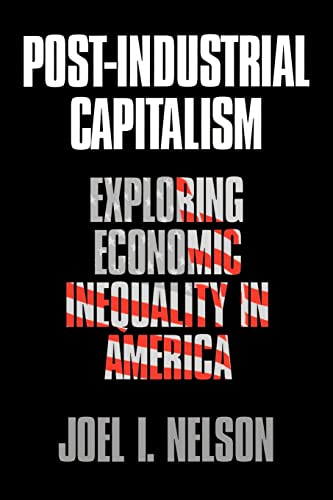
Sinopsis
The work is provocative and ambitious and the writing is clear. --Choice "It is a topic in need of systematic analysis. . . . Joel I. Nelson understands and, in fact, has mastered the issues. . . . It will undoubtedly be a major contribution. . . . His approach is fresh and refreshing. . . . He has the appropriate conceptual tools to complete his synthesis. . . . I believe not only scholars--sociologists, economists, political scientists, and historians, would find Post-Industrial Capitalism useful but policymakers might also find it of interest. . . . The book can also be used as a text in an advanced undergraduate class and in a graduate seminar. . . . Nelson′s thesis is coherent and logically developed. . . . I imagine this book as a college text or on a desk in Washington, DC. . . . Nelson′s last book Economic Inequality was a huge success. . . . Certainly the many who relied on it in their teaching and research will welcome and use Post-Industrial Capitalism." --Lionel L. Lewis, State University of New York at Buffalo "Too often authors focus only on the positive aspects or on the downside of postindustrialism. Joel I. Nelson is proposing something that fits neatly between the two camps. . . . Nelson′s strategy of building a new explanation based on a synthesis of these older approaches is very attractive. . . . There are no other books that attempt this. . . . Post-Industrial Capitalism might also be used in an advanced undergraduate course on economic sociology or social change. . . . [It] will be also acquired by professionals in sociology, social work, political science, and economics. . . . The sequence of the topics are clear and concise. . . . Each chapter pulls together arguments that--heretofore--have been scattered across numerous books and articles (and across disciplines for that matter)." --Charles M. Tolbert II, Professor of Sociology and Rural Sociology, Louisiana State University The social and economic well-being of many Americans is increasingly at risk. Disparities in earnings and wealth are escalating, reversing a century of declining inequality. Excesses of the free market are growing-and growing more difficult to contain. Politics are increasingly conservative across the ideological spectrum, with economic competitiveness considered more important than equality and humanitarian aid. Post-Industrial Capitalism offers an alternative to the dominant and unsuccessful Marxist and industrialist views by providing a framework for explaining the widening polarization within American society. This work demonstrates a more comprehensive explanation of inequality and locates its source in the transformation of American business. It provides a fresh illustration of Schumpeter′s insistence on the ability of capitalism to develop by creatively destroying its past. It not only describes the shifts in corporate resources, illustrates their use by the corporate sector, and traces their implications for inequality across the institutional spectrum, but also demonstrates how these strategies have been used by companies to intensify competition, effect greater political control, and widen the economic gap in America. Scholars interested in the question of modernity and post-industrialization, theorists of multiple theoretical persuasions, and students interested in social stratification, inequality, and social change will find Postindustrial Capitalism to be extremely valuable.
"Sinopsis" puede pertenecer a otra edición de este libro.
Acerca del autor
Charlotte y Peter Fiell son dos autoridades en historia, teoría y crítica del diseño y han escrito más de sesenta libros sobre la materia, muchos de los cuales se han convertido en éxitos de ventas. También han impartido conferencias y cursos como profesores invitados, han comisariado exposiciones y asesorado a fabricantes, museos, salas de subastas y grandes coleccionistas privados de todo el mundo. Los Fiell han escrito numerosos libros para TASCHEN, entre los que se incluyen 1000 Chairs, Diseño del siglo XX, El diseño industrial de la A a la Z, Scandinavian Design y Diseño del siglo XXI.
De la contraportada
The work is provocative and ambitious and the writing is clear. --Choice "It is a topic in need of systematic analysis. . . . Joel I. Nelson understands and, in fact, has mastered the issues. . . . It will undoubtedly be a major contribution. . . . His approach is fresh and refreshing. . . . He has the appropriate conceptual tools to complete his synthesis. . . . I believe not only scholars--sociologists, economists, political scientists, and historians, would find Post-Industrial Capitalism useful but policymakers might also find it of interest. . . . The book can also be used as a text in an advanced undergraduate class and in a graduate seminar. . . . Nelson¿s thesis is coherent and logically developed. . . . I imagine this book as a college text or on a desk in Washington, DC. . . . Nelson¿s last book Economic Inequality was a huge success. . . . Certainly the many who relied on it in their teaching and research will welcome and use Post-Industrial Capitalism." --Lionel L. Lewis, State University of New York at Buffalo "Too often authors focus only on the positive aspects or on the downside of postindustrialism. Joel I. Nelson is proposing something that fits neatly between the two camps. . . . Nelson¿s strategy of building a new explanation based on a synthesis of these older approaches is very attractive. . . . There are no other books that attempt this. . . . Post-Industrial Capitalism might also be used in an advanced undergraduate course on economic sociology or social change. . . . [It] will be also acquired by professionals in sociology, social work, political science, and economics. . . . The sequence of the topics are clear and concise. . . . Each chapter pulls together arguments that--heretofore--have been scattered across numerous books and articles (and across disciplines for that matter)." --Charles M. Tolbert II, Professor of Sociology and Rural Sociology, Louisiana State University The social and economic well-being of many Americans is increasingly at risk. Disparities in earnings and wealth are escalating, reversing a century of declining inequality. Excesses of the free market are growing-and growing more difficult to contain. Politics are increasingly conservative across the ideological spectrum, with economic competitiveness considered more important than equality and humanitarian aid. Post-Industrial Capitalism offers an alternative to the dominant and unsuccessful Marxist and industrialist views by providing a framework for explaining the widening polarization within American society. This work demonstrates a more comprehensive explanation of inequality and locates its source in the transformation of American business. It provides a fresh illustration of Schumpeter¿s insistence on the ability of capitalism to develop by creatively destroying its past. It not only describes the shifts in corporate resources, illustrates their use by the corporate sector, and traces their implications for inequality across the institutional spectrum, but also demonstrates how these strategies have been used by companies to intensify competition, effect greater political control, and widen the economic gap in America. Scholars interested in the question of modernity and post-industrialization, theorists of multiple theoretical persuasions, and students interested in social stratification, inequality, and social change will find Postindustrial Capitalism to be extremely valuable.
"Sobre este título" puede pertenecer a otra edición de este libro.
Resultados de la búsqueda para Post-Industrial Capitalism: Exploring Economic Inequality...

Imagen de archivo
Post-Industrial Capitalism: Exploring Economic Inequality in America
Publicado por
SAGE Publications, Inc, 1995
ISBN 10: 0803973330
ISBN 13: 9780803973336
Antiguo o usado
Tapa blanda
Librería: Phatpocket Limited, Waltham Abbey, HERTS, Reino Unido
Calificación del vendedor: 5 de 5 estrellas

Condición: Good. Your purchase helps support Sri Lankan Children's Charity 'The Rainbow Centre'. Ex-library, so some stamps and wear, but in good overall condition. Our donations to The Rainbow Centre have helped provide an education and a safe haven to hundreds of children who live in appalling conditions. Nº de ref. del artículo: Z1-B-003-01549
Comprar usado
EUR 2,10
Envío por EUR 12,77
Se envía de Reino Unido a Estados Unidos de America
Se envía de Reino Unido a Estados Unidos de America
Cantidad disponible: 1 disponibles
Imagen de archivo
Post-Industrial Capitalism: Exploring Economic Inequality in America
Publicado por
SAGE Publications, Inc, 1995
ISBN 10: 0803973330
ISBN 13: 9780803973336
Antiguo o usado
Paperback
Librería: Bookmans, Tucson, AZ, Estados Unidos de America
Calificación del vendedor: 5 de 5 estrellas
Paperback. Condición: Good. Satisfaction 100% guaranteed. Nº de ref. del artículo: mon0001606917
Comprar usado
EUR 14,72
Envío por EUR 3,58
Se envía dentro de Estados Unidos de America
Se envía dentro de Estados Unidos de America
Cantidad disponible: 1 disponibles
Imagen de archivo
Post-Industrial Capitalism : Exploring Economic Inequality in America
Publicado por
SAGE Publications, Incorporated, 1995
ISBN 10: 0803973330
ISBN 13: 9780803973336
Antiguo o usado
Tapa blanda
Librería: Better World Books, Mishawaka, IN, Estados Unidos de America
Calificación del vendedor: 5 de 5 estrellas
Condición: Good. Former library copy. Pages intact with minimal writing/highlighting. The binding may be loose and creased. Dust jackets/supplements are not included. Includes library markings. Stock photo provided. Product includes identifying sticker. Better World Books: Buy Books. Do Good. Nº de ref. del artículo: 933477-75
Comprar usado
EUR 21,27
Gastos de envío gratis
Se envía dentro de Estados Unidos de America
Se envía dentro de Estados Unidos de America
Cantidad disponible: 1 disponibles
Imagen de archivo
Post-Industrial Capitalism: Exploring Economic Inequality in America
Publicado por
Sage Publications, 1995
ISBN 10: 0803973330
ISBN 13: 9780803973336
Antiguo o usado
Soft cover
Librería: The Bookseller, Edmonton, AB, Canada
Calificación del vendedor: 5 de 5 estrellas
Soft cover. Condición: Good. Minor shelf wear. Owner signature on fly leaf. Some pencil MARKINGS in text. Otherwise a square, tight book. Index. 193 pp. Nº de ref. del artículo: 047411
Comprar usado
EUR 11,23
Envío por EUR 17,02
Se envía de Canada a Estados Unidos de America
Se envía de Canada a Estados Unidos de America
Cantidad disponible: 1 disponibles
Imagen de archivo
Post-Industrial Capitalism: Exploring Economic Inequality in America [Paperback] I.Nelson, Joel
Publicado por
SAGE Publications, Inc, 1995
ISBN 10: 0803973330
ISBN 13: 9780803973336
Antiguo o usado
Tapa blanda
Librería: Hay-on-Wye Booksellers, Hay-on-Wye, HEREF, Reino Unido
Calificación del vendedor: 4 de 5 estrellas

Condición: Good. Some marking and shelfwear on the cover and page edges. Nº de ref. del artículo: 070346-8
Comprar usado
EUR 4,04
Envío por EUR 30,00
Se envía de Reino Unido a Estados Unidos de America
Se envía de Reino Unido a Estados Unidos de America
Cantidad disponible: 1 disponibles
Imagen de archivo
Post-Industrial Capitalism: Exploring Economic Inequality in America [Paperback] I.Nelson, Joel
Publicado por
SAGE Publications, Inc, 1995
ISBN 10: 0803973330
ISBN 13: 9780803973336
Antiguo o usado
Tapa blanda
Librería: Hay-on-Wye Booksellers, Hay-on-Wye, HEREF, Reino Unido
Calificación del vendedor: 4 de 5 estrellas
Condición: Very Good. Some light scuffing on the cover otherwise fine. Nº de ref. del artículo: 039022-12
Comprar usado
EUR 4,26
Envío por EUR 30,00
Se envía de Reino Unido a Estados Unidos de America
Se envía de Reino Unido a Estados Unidos de America
Cantidad disponible: 1 disponibles
Imagen de archivo
Post-Industrial Capitalism: Exploring Economic Inequality in America
Publicado por
SAGE Publications, Inc, 1995
ISBN 10: 0803973330
ISBN 13: 9780803973336
Nuevo
Tapa blanda
Librería: SHIMEDIA, Brooklyn, NY, Estados Unidos de America
Calificación del vendedor: 4 de 5 estrellas
Condición: New. Satisfaction Guaranteed or your money back. Nº de ref. del artículo: 0803973330
Comprar nuevo
EUR 92,30
Gastos de envío gratis
Se envía dentro de Estados Unidos de America
Se envía dentro de Estados Unidos de America
Cantidad disponible: 1 disponibles
Imagen del vendedor
Post-Industrial Capitalism : Exploring Economic Inequality in America
Publicado por
SAGE Publications, Inc, 1995
ISBN 10: 0803973330
ISBN 13: 9780803973336
Antiguo o usado
Tapa blanda
Librería: GreatBookPrices, Columbia, MD, Estados Unidos de America
Calificación del vendedor: 5 de 5 estrellas
Condición: As New. Unread book in perfect condition. Nº de ref. del artículo: 253795
Comprar usado
EUR 121,42
Envío por EUR 2,37
Se envía dentro de Estados Unidos de America
Se envía dentro de Estados Unidos de America
Cantidad disponible: Más de 20 disponibles
Imagen de archivo
Post-Industrial Capitalism: Exploring Economic Inequality in America
Publicado por
SAGE Publications, Inc, 1995
ISBN 10: 0803973330
ISBN 13: 9780803973336
Nuevo
Tapa blanda
Librería: California Books, Miami, FL, Estados Unidos de America
Calificación del vendedor: 5 de 5 estrellas
Condición: New. Nº de ref. del artículo: I-9780803973336
Comprar nuevo
EUR 124,61
Envío por EUR 2,69
Se envía dentro de Estados Unidos de America
Se envía dentro de Estados Unidos de America
Cantidad disponible: Más de 20 disponibles
Imagen del vendedor
Post-Industrial Capitalism : Exploring Economic Inequality in America
Publicado por
SAGE Publications, Inc, 1995
ISBN 10: 0803973330
ISBN 13: 9780803973336
Nuevo
Tapa blanda
Librería: GreatBookPrices, Columbia, MD, Estados Unidos de America
Calificación del vendedor: 5 de 5 estrellas
Condición: New. Nº de ref. del artículo: 253795-n
Comprar nuevo
EUR 124,94
Envío por EUR 2,37
Se envía dentro de Estados Unidos de America
Se envía dentro de Estados Unidos de America
Cantidad disponible: Más de 20 disponibles