
Artículos relacionados a Knowledge and Reality: An Essay in Positive Philosophy:...
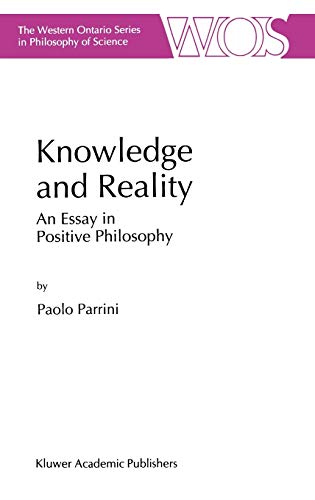
Knowledge and Reality: An Essay in Positive Philosophy: 59 (The Western Ontario Series in Philosophy of Science, 59) - Tapa dura
Sinopsis
XIV The stability of a philosophical construction will depend not only upon the solidity of the blocks, of the pillars and architraves that make it up, but also upon the way in which all these parts are connected. Of course, it will not be possible to argue for every single part of a philosophical building: to do so would mean to embark in a virtually endless enterprise. Accordingly, some of the parts of a philosophical building will have to be taken from the literature on the subject as ’ready made’ or ’semi-finished’ elements, while others will be argued for in the course of building. This is what happened in my work too. In some cases (for in stance, in the case of epistemic relativism), my concern was to illustrate theses which I believed to be sufficiently consolidated, rather than to ar gue for them. In other cases - where I was directly engaged in building the theory that I want to fonnulate - I did exactly the opposite. This is what I have tried to achieve, for example, for those proper architraves of my construction, viz. the connection between scepticism and metaphysi cal realism. and the thesis of the nonnative value of the fundamental epistemological notions (truth, objectivity, and rationality).
"Sinopsis" puede pertenecer a otra edición de este libro.
Reseña del editor
XIV The stability of a philosophical construction will depend not only upon the solidity of the blocks, of the pillars and architraves that make it up, but also upon the way in which all these parts are connected. Of course, it will not be possible to argue for every single part of a philosophical building: to do so would mean to embark in a virtually endless enterprise. Accordingly, some of the parts of a philosophical building will have to be taken from the literature on the subject as 'ready made' or 'semi-finished' elements, while others will be argued for in the course of building. This is what happened in my work too. In some cases (for in stance, in the case of epistemic relativism), my concern was to illustrate theses which I believed to be sufficiently consolidated, rather than to ar gue for them. In other cases - where I was directly engaged in building the theory that I want to fonnulate - I did exactly the opposite. This is what I have tried to achieve, for example, for those proper architraves of my construction, viz. the connection between scepticism and metaphysi cal realism. and the thesis of the nonnative value of the fundamental epistemological notions (truth, objectivity, and rationality).
Reseña del editor
The current debate in philosophy of science and epistemology is characterised by some strong oppositions, such as those between instrumentalism and scientific realism, methodological anarchism and critical rationalism, historical contextualism and metaphysical realism, naturalism and normativism. By means of a close interaction between historical research and theoretical perspective, this book aims to develop a `third way' between absolutism and radical relativism. This new conception is called `positive' because it is linked to the basic features of the esprit positif: empiricism, moderate epistemic relativism, and non-metaphysical objectivism. This book revives the early twentieth century controversy between the immanent and transcendent conception of the object of knowledge, and offers a new interpretation of the relationships between Logical Positivism, Kantian thought, and conventionalist philosophy of science. According to the author, such a `positive philosophy' is able to counter the `conversational' and post-modern attacks on objectivity and truth. Knowledge and Reality presents an original view of the status and role of philosophy, spelling out the intrinsic limitations of the analytic approach, together with the reasons that induce the author to place himself within that tradition.
Audience: Libraries and research workers in epistemology, philosophy of science, metaphysics, history of philosophy and history of science, and philosophy of language.
"Sobre este título" puede pertenecer a otra edición de este libro.
Resultados de la búsqueda para Knowledge and Reality: An Essay in Positive Philosophy:...

Imagen de archivo
Knowledge and Reality : An Essay in Positive Philosophy
Publicado por
Kluwer Academic Publishers, 1998
ISBN 10: 0792349393
ISBN 13: 9780792349396
Antiguo o usado
Tapa dura
Librería: GreatBookPrices, Columbia, MD, Estados Unidos de America
Calificación del vendedor: 5 de 5 estrellas

Condición: As New. Unread book in perfect condition. Nº de ref. del artículo: 3165169
Comprar usado
EUR 126,86
Envío por EUR 2,35
Se envía dentro de Estados Unidos de America
Se envía dentro de Estados Unidos de America
Cantidad disponible: 15 disponibles
Imagen de archivo
Knowledge and Reality: An Essay in Positive Philosophy (The Western Ontario Series in Philosophy of Science, 59)
Publicado por
Kluwer Academic Publishers, 1998
ISBN 10: 0792349393
ISBN 13: 9780792349396
Nuevo
Tapa dura
Librería: Ria Christie Collections, Uxbridge, Reino Unido
Calificación del vendedor: 5 de 5 estrellas
Condición: New. In English. Nº de ref. del artículo: ria9780792349396_new
Comprar nuevo
EUR 129,67
Envío por EUR 13,32
Se envía de Reino Unido a Estados Unidos de America
Se envía de Reino Unido a Estados Unidos de America
Cantidad disponible: Más de 20 disponibles
Imagen de archivo
Knowledge and Reality
Publicado por
Kluwer Academic Publishers, 1998
ISBN 10: 0792349393
ISBN 13: 9780792349396
Nuevo
Tapa dura
Librería: Kennys Bookshop and Art Galleries Ltd., Galway, GY, Irlanda
Calificación del vendedor: 5 de 5 estrellas
Condición: New. This text revives the early 20th-century controversy between the immanent and transcendent conception of the object of knowledge, and offers an interpretation of the relationships between logical positivism, Kantian thought, and conventionalist philosophy of science. Series: The Western Ontario Series in Philosophy of Science. Num Pages: 222 pages, biography. BIC Classification: HPK. Category: (P) Professional & Vocational; (UP) Postgraduate, Research & Scholarly. Dimension: 234 x 156 x 15. Weight in Grams: 526. . 1998. Hardback. . . . . Nº de ref. del artículo: V9780792349396
Comprar nuevo
EUR 133,93
Envío por EUR 9,50
Se envía de Irlanda a Estados Unidos de America
Se envía de Irlanda a Estados Unidos de America
Cantidad disponible: 15 disponibles
Imagen de archivo
Knowledge and Reality : An Essay in Positive Philosophy
Publicado por
Kluwer Academic Publishers, 1998
ISBN 10: 0792349393
ISBN 13: 9780792349396
Nuevo
Tapa dura
Librería: GreatBookPrices, Columbia, MD, Estados Unidos de America
Calificación del vendedor: 5 de 5 estrellas
Condición: New. Nº de ref. del artículo: 3165169-n
Comprar nuevo
EUR 147,33
Envío por EUR 2,35
Se envía dentro de Estados Unidos de America
Se envía dentro de Estados Unidos de America
Cantidad disponible: 15 disponibles
Imagen del vendedor
Knowledge and Reality
Librería: moluna, Greven, Alemania
Calificación del vendedor: 5 de 5 estrellas
Gebunden. Condición: New. XIV The stability of a philosophical construction will depend not only upon the solidity of the blocks, of the pillars and architraves that make it up, but also upon the way in which all these parts are connected. Of course, it will not be possible to argue. Nº de ref. del artículo: 5968375
Comprar nuevo
EUR 118,64
Envío por EUR 48,99
Se envía de Alemania a Estados Unidos de America
Se envía de Alemania a Estados Unidos de America
Cantidad disponible: Más de 20 disponibles
Imagen de archivo
Knowledge and Reality
Librería: Books Puddle, Woodside, NY, Estados Unidos de America
Calificación del vendedor: 4 de 5 estrellas

Condición: New. pp. 248. Nº de ref. del artículo: 26551222
Comprar nuevo
EUR 168,34
Envío por EUR 3,56
Se envía dentro de Estados Unidos de America
Se envía dentro de Estados Unidos de America
Cantidad disponible: 4 disponibles
Imagen de archivo
Knowledge and Reality
Impresión bajo demandaLibrería: Majestic Books, Hounslow, Reino Unido
Calificación del vendedor: 4 de 5 estrellas
Condición: New. Print on Demand pp. 248 52:B&W 6.14 x 9.21in or 234 x 156mm (Royal 8vo) Case Laminate on White w/Gloss Lam. Nº de ref. del artículo: 8378089
Comprar nuevo
EUR 173,91
Envío por EUR 7,67
Se envía de Reino Unido a Estados Unidos de America
Se envía de Reino Unido a Estados Unidos de America
Cantidad disponible: 4 disponibles
Imagen de archivo
Knowledge and Reality
Impresión bajo demandaLibrería: Biblios, Frankfurt am main, HESSE, Alemania
Calificación del vendedor: 4 de 5 estrellas
Condición: New. PRINT ON DEMAND pp. 248. Nº de ref. del artículo: 18551228
Comprar nuevo
EUR 171,88
Envío por EUR 9,95
Se envía de Alemania a Estados Unidos de America
Se envía de Alemania a Estados Unidos de America
Cantidad disponible: 4 disponibles
Imagen de archivo
Knowledge and Reality
Publicado por
Kluwer Academic Publishers, 1998
ISBN 10: 0792349393
ISBN 13: 9780792349396
Nuevo
Tapa dura
Librería: Kennys Bookstore, Olney, MD, Estados Unidos de America
Calificación del vendedor: 5 de 5 estrellas
Condición: New. This text revives the early 20th-century controversy between the immanent and transcendent conception of the object of knowledge, and offers an interpretation of the relationships between logical positivism, Kantian thought, and conventionalist philosophy of science. Series: The Western Ontario Series in Philosophy of Science. Num Pages: 222 pages, biography. BIC Classification: HPK. Category: (P) Professional & Vocational; (UP) Postgraduate, Research & Scholarly. Dimension: 234 x 156 x 15. Weight in Grams: 526. . 1998. Hardback. . . . . Books ship from the US and Ireland. Nº de ref. del artículo: V9780792349396
Comprar nuevo
EUR 172,51
Envío por EUR 9,36
Se envía dentro de Estados Unidos de America
Se envía dentro de Estados Unidos de America
Cantidad disponible: 15 disponibles
Imagen del vendedor
Knowledge and Reality : An Essay in Positive Philosophy
Librería: AHA-BUCH GmbH, Einbeck, Alemania
Calificación del vendedor: 5 de 5 estrellas
Buch. Condición: Neu. Neuware - XIV The stability of a philosophical construction will depend not only upon the solidity of the blocks, of the pillars and architraves that make it up, but also upon the way in which all these parts are connected. Of course, it will not be possible to argue for every single part of a philosophical building: to do so would mean to embark in a virtually endless enterprise. Accordingly, some of the parts of a philosophical building will have to be taken from the literature on the subject as 'ready made' or 'semi-finished' elements, while others will be argued for in the course of building. This is what happened in my work too. In some cases (for in stance, in the case of epistemic relativism), my concern was to illustrate theses which I believed to be sufficiently consolidated, rather than to ar gue for them. In other cases - where I was directly engaged in building the theory that I want to fonnulate - I did exactly the opposite. This is what I have tried to achieve, for example, for those proper architraves of my construction, viz. the connection between scepticism and metaphysi cal realism. and the thesis of the nonnative value of the fundamental epistemological notions (truth, objectivity, and rationality). Nº de ref. del artículo: 9780792349396
Comprar nuevo
EUR 162,93
Envío por EUR 35,00
Se envía de Alemania a Estados Unidos de America
Se envía de Alemania a Estados Unidos de America
Cantidad disponible: 1 disponibles