
Artículos relacionados a Human Resource Development (MBA Masterclass Series)
Sinopsis
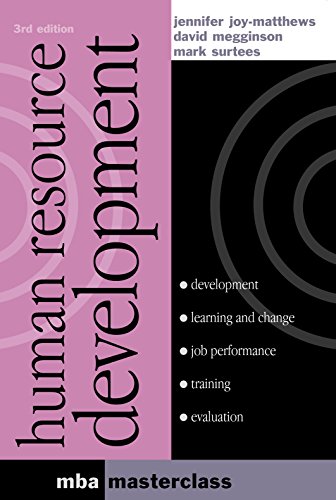
Successful implementation of a successful human resource development (HRD) programme is crucial to any organisation. The third edition of this title lays the foundations for HRD, as well as explaining current ideas and contemporary thinking on the subject.
"Sinopsis" puede pertenecer a otra edición de este libro.
Acerca del autor
<p><b>John P Wilson</b> teaches at Sheffield University Management School and is a tutor at the University of Oxford. His experience in education and consultancy spans a variety of countries and sectors, including aerospace engineering, banking, law and pharmaceuticals and he has worked with the United Nations Development Programme in Ethiopia and Nigeria. </p><p>He is a Fellow of the Higher Education Academy and Fellow of the Chartered Institute of Personnel and Development (CIPD). He has written and edited a number of articles and books, including <i><b>Experiential Learning, International Human Resource Development</b></i> and <b><i>The Call Centre Training Handbook</i></b>, published by Kogan Page.</p>
Fragmento. © Reproducción autorizada. Todos los derechos reservados.
<p>1 Positioning human resource development</p><p> Introduction</p><p> Learning outcomes</p><p> Defining the scope of HRD</p><p> HRD and organizational strategy</p><p> HRD in a context of change</p><p> HRD strategy and policy</p><p> HRD in an international context</p><p> HRD in a UK national context</p><p> Case Study 1.1: Ginsters work-based learning</p><p> Summary: tensions in HRD</p><p> 2 Current leading ideas</p><p> Introduction</p><p> Learning outcomes</p><p> Leading ideas versus fads</p><p> The time-bounded nature of leading ideas</p><p> Developing the set of leading ideas</p><p> The 10 leading ideas in detail</p><p> Case Study 2.1: Communicating the vision</p><p> Survey your own approach to HRD</p><p> Scoring</p><p> Summary</p><p> 3 Approaches to human resource development</p><p> Introduction</p><p> Learning outcomes</p><p> Human resource management</p><p> Performance management</p><p> Organization development</p><p> Facilitating learning</p><p> Communication</p><p> Quality management</p><p> Project management</p><p> Training</p><p> Creativity</p><p> Case Study 3.1: Tetra Pak - continuous improvement</p><p> Summary</p><p> 4 Learning</p><p> Introduction</p><p> Learning outcomes</p><p> Definitions</p><p> The components of learning</p><p> Implications for development and training</p><p> Managing learning</p><p> Problems with learning</p><p> Triggers for learning</p><p> The science of learning</p><p> The learning cycle</p><p> Learning styles</p><p> Self-managed learning</p><p> Lifelong learning</p><p> Continuous professional development</p><p> Summary</p><p> 5 e-Learning and blended learning</p><p> Introduction</p><p> Learning outcomes</p><p> Definitions</p><p> Why e-learning is important</p><p> The Government's response</p><p> Why blended learning is important</p><p> Antecedents and history</p><p> Key concepts and terms</p><p> Processes</p><p> Who is involved?</p><p> Blended learning</p><p> Knowledge management</p><p> Case Study 5.1: Massachusetts Institute of Technology</p><p> Summary</p><p> 6 Continuous Professional Development</p><p> Introduction</p><p> Learning outcomes</p><p> Identifying our own approach to CPD</p><p> Principles of CPD</p><p> Framework for CPD</p><p> Is there another way?</p><p> Corporate case study: Kellogg's Europe</p><p> Case Study 6.1: Career development at Kellogg's</p><p> Summary</p><p> 7 HRD and change through groups</p><p> Introduction</p><p> Learning outcomes</p><p> Groups as strategic entities</p><p> The role of groups in change</p><p> Managing change through groups</p><p> Some ideas about how groups work</p><p> Using groups to progress change</p><p> Differing needs of groups</p><p> Case Study 7.1: Reality culture change programme, 'We Deliver the Goods'</p><p> Summary</p><p> 8 Organizational learning</p><p> Introduction</p><p> Learning outcomes</p><p> Learning faster and competitive advantage</p><p> Single-loop learning at Appleyards</p><p> Double-loop learning by technicians at Appleyards</p><p> Deutero-learning in Chesterfield</p><p> A postscript on Frank Lord and Appleyards of Chesterfield</p><p> Moving the workplace towards becoming a learning company</p><p> Developing the learning company in your workplace</p><p> Research on the 11 characteristics</p><p> Case study of a high-growth knowledge-based company</p><p> Case Study 8.1: Nexor - a learning company</p><p> Summary</p><p> 9 Diagnosis and evaluation in human resource development</p><p> Introduction</p><p> Learning outcomes</p><p> Diagnosis</p><p> Case Study 9.1: XCL Ltd - diagnosis in a contemporary private-sector company</p><p> Evaluation</p><p> Case Study 9.2: Connexions' outdoor development programme</p><p> Summary</p><p> 10 Management development</p><p> Introduction</p><p> Learning outcomes</p><p> Definitions</p><p> The deep shift in ideas about management development</p><p> The changes and challenges for management development</p><p> The processes and practices of the delivery of management development</p><p> The special requirements of different categories of manager</p><p> Case Study 10.1: Village AiD</p><p> Summary</p><p> 11 Leveraging the human resource development function</p><p> Introduction</p><p> Learning outcomes</p><p> Managers, management and the relationship to the HRD/learning function</p><p> The HRD/training function</p><p> Enabling the organization's strategy to drive the development process</p><p> Researching what is needed</p><p> Gaining clarity about what you as a manager want to achieve for yourself, your staff and colleagues</p><p> What managers need to know about HRD</p><p> Who you need to know</p><p> What you need to use</p><p> As a manager you need power</p><p> Ways to keep up to date</p><p> Managing the HRD professionals so they work to your specification</p><p> Harnessing the HRD professionals' expertise to achieve your goals</p><p> Recognizing that you are the client</p><p> Working to change mindsets</p><p> Ways that enable everyone to continue learning</p><p> Case Study 11.1: your own organization</p><p> Summary</p><p> 12 Learning for the future</p><p> Introduction</p><p> Learning outcomes</p><p> Predicting the future</p><p> The contributions</p><p> Summary</p>
"Sobre este título" puede pertenecer a otra edición de este libro.
Resultados de la búsqueda para Human Resource Development (MBA Masterclass Series)

Imagen de archivo
Human Resource Development
Publicado por
Kogan Page, Limited, 2004
ISBN 10: 0749441607
ISBN 13: 9780749441609
Antiguo o usado
Tapa blanda
Librería: Better World Books Ltd, Dunfermline, Reino Unido
Calificación del vendedor: 5 de 5 estrellas

Condición: Very Good. Former library copy. Pages intact with possible writing/highlighting. Binding strong with minor wear. Dust jackets/supplements may not be included. Includes library markings. Stock photo provided. Product includes identifying sticker. Better World Books: Buy Books. Do Good. Nº de ref. del artículo: 38241545-20
Comprar usado
EUR 8,52
Envío por EUR 5,96
Se envía de Reino Unido a Estados Unidos de America
Se envía de Reino Unido a Estados Unidos de America
Cantidad disponible: 2 disponibles
Imagen de archivo
Human Resource Development
Publicado por
Kogan Page, 2004
ISBN 10: 0749441607
ISBN 13: 9780749441609
Antiguo o usado
Tapa blanda
Librería: Anybook.com, Lincoln, Reino Unido
Calificación del vendedor: 5 de 5 estrellas
Condición: Fair. This is an ex-library book and may have the usual library/used-book markings inside.This book has soft covers. In fair condition, suitable as a study copy. Please note the Image in this listing is a stock photo and may not match the covers of the actual item,550grams, ISBN:9780749441609. Nº de ref. del artículo: 9601060
Comprar usado
EUR 3,07
Envío por EUR 15,53
Se envía de Reino Unido a Estados Unidos de America
Se envía de Reino Unido a Estados Unidos de America
Cantidad disponible: 1 disponibles
Imagen de archivo
Human Resource Development
Publicado por
Kogan Page, 2004
ISBN 10: 0749441607
ISBN 13: 9780749441609
Antiguo o usado
Tapa blanda
Librería: Anybook.com, Lincoln, Reino Unido
Calificación del vendedor: 5 de 5 estrellas
Condición: Fair. This is an ex-library book and may have the usual library/used-book markings inside.This book has soft covers. In fair condition, suitable as a study copy. Please note the Image in this listing is a stock photo and may not match the covers of the actual item,550grams, ISBN:9780749441609. Nº de ref. del artículo: 9601061
Comprar usado
EUR 3,07
Envío por EUR 15,53
Se envía de Reino Unido a Estados Unidos de America
Se envía de Reino Unido a Estados Unidos de America
Cantidad disponible: 1 disponibles
Imagen de archivo
Human Resource Development (MBA Masterclass Series)
Librería: Revaluation Books, Exeter, Reino Unido
Calificación del vendedor: 5 de 5 estrellas
Paperback. Condición: Brand New. 3rd edition. 309 pages. 9.00x6.00x1.00 inches. In Stock. Nº de ref. del artículo: zk0749441607
Comprar nuevo
EUR 41,80
Envío por EUR 14,89
Se envía de Reino Unido a Estados Unidos de America
Se envía de Reino Unido a Estados Unidos de America
Cantidad disponible: 1 disponibles