
Artículos relacionados a How Come You Don't Understand Your Accountant?...
Sinopsis
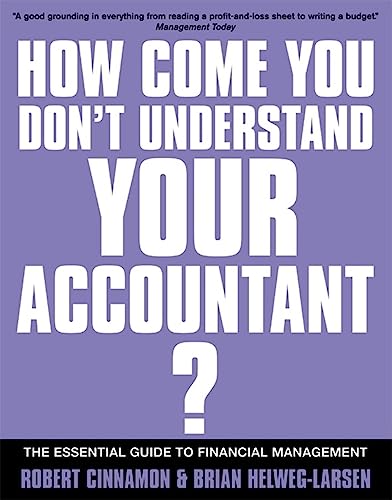
A guide to finance from the perspective of the pursuit of business growth. <i>How Come You Don't Understand Your Accountant?</i> uses the mechanism of a business proceeding from initial set-up through its first year of trading. Topics include: the balance sheet; market dynamics; budgeting and forecasting; fixed and variable costs; and more.
"Sinopsis" puede pertenecer a otra edición de este libro.
Acerca del autor
<b>Bob Cinnamon</b> is an educator with a global reputation. As a director of the international training and consultancy firm, INSIGHT Marketing and People, Bob runs his popular masterclass and in-company training programme, Demystifying Financial Management, that has helped hundreds of managers and company directors from small and medium-sized businesses to major multi-nationals. Operating in some 30 countries, current clients include AstraZeneca, Avecia, BP, BT, Dow Corning, Dulux, DuPont, Glaxo SmithKline, Huntsman, ICI, JD Edwards, Pfizer, PPG, Qiagen and RoyalSunAlliance.
Fragmento. © Reproducción autorizada. Todos los derechos reservados.
<p><b>1 So why do you want to know more about finance? </b></p><p> Learning</p><p> A tale of two languages</p><p> <b>2 The business cycle </b></p><p> Setting up a company</p><p> The Moving Balance Sheet®</p><p> Creating value</p><p> Cash and profit</p><p> Setting up and running the business -- the opening month</p><p> Profit and loss (P&L) account</p><p> The balance sheet</p><p> Month 2 business cycle</p><p> Going to the bank</p><p> Doing the books</p><p> <b>3 The books and double entry bookkeeping </b></p><p> Reports</p><p> Double entry bookkeeping</p><p> Taxation</p><p> <b>4 Where do all the business functions fit in? </b></p><p> Sales</p><p> Marketing</p><p> Manufacturing</p><p> Supply chain management</p><p> Human resources</p><p> IT, maintenance and engineering</p><p> Research and development</p><p> <b>5 Financial planning -- the budgets </b></p><p> Budgeting</p><p> Cash flow forecast</p><p> Avoiding bankruptcy -- how to generate cash</p><p> <b>6 Measuring business performance -- financial ratios </b></p><p> Size</p><p> P&L account (income statement) analysis</p><p> Balance sheet analysis</p><p> <b>7 How our investors see us -- stock market ratios </b></p><p> What accounts do our investors want to see?</p><p> Shares</p><p> <b>8 Valuing a company </b></p><p> Asset value</p><p> Multipliers</p><p> Market capitalization</p><p> Balanced scorecard</p><p> Cash flows</p><p> <b>9 Shareholder value and economic profit </b></p><p> Earnings before interest, tax, depreciation and amortization (EBITDA)</p><p> Economic profit</p><p> Total shareholder return (TSR)</p><p> <b>10 The hidden costs -- depreciation and amortization </b></p><p> Depreciation</p><p> Goodwill</p><p> Intangible assets</p><p> Capitalizing costs</p><p> Earnings before interest, tax, depreciation and amortization (EBITDA)</p><p> <b>11 What must we sell to make a profit? </b></p><p> Variable costs</p><p> Fixed costs</p><p> Break-even point</p><p> <b>12 Tools for evaluating projects </b></p><p> Payback</p><p> Discounted cash flow (DCF)</p><p> Net present value (NPV)</p><p> Internal rate of return (IRR)</p><p> Terminal values</p><p> Economic profit</p><p> Pitfalls</p><p> Other factors</p><p> <b>13 Where is all our cash? -- managing working capital </b></p><p> Stock (inventories)</p><p> Debtors</p><p> Creditors</p><p> Write-offs</p><p> Cash flow implications of working capital</p><p> <b>14 Next Steps </b></p><p> Training</p><p> Contact details</p><p> <b>15 Glossary of financial terms</b></p>
"Sobre este título" puede pertenecer a otra edición de este libro.
Resultados de la búsqueda para How Come You Don't Understand Your Accountant?...

Imagen de archivo
If You're So Brilliant.How Come You Don't Understand Your Accountant?: The Essential Guide to Financial Management
Publicado por
Kogan page 03/04/2002, 2002
ISBN 10: 0749437251
ISBN 13: 9780749437251
Antiguo o usado
Tapa blanda
Librería: AwesomeBooks, Wallingford, Reino Unido
Calificación del vendedor: 5 de 5 estrellas

Condición: Very Good. This book is in very good condition and will be shipped within 24 hours of ordering. The cover may have some limited signs of wear but the pages are clean, intact and the spine remains undamaged. This book has clearly been well maintained and looked after thus far. Money back guarantee if you are not satisfied. See all our books here, order more than 1 book and get discounted shipping. . Nº de ref. del artículo: 7719-9780749437251
Comprar usado
EUR 2,85
Envío por EUR 4,86
Se envía de Reino Unido a Estados Unidos de America
Se envía de Reino Unido a Estados Unidos de America
Cantidad disponible: 1 disponibles
Imagen de archivo
If You're So Brilliant How Come You Don't Understand Your Accountant? : The Essential Guide to Financial Management
Publicado por
Kogan Page, Limited, 2002
ISBN 10: 0749437251
ISBN 13: 9780749437251
Antiguo o usado
Tapa blanda
Librería: Better World Books Ltd, Dunfermline, Reino Unido
Calificación del vendedor: 5 de 5 estrellas
Condición: Very Good. Former library copy. Pages intact with possible writing/highlighting. Binding strong with minor wear. Dust jackets/supplements may not be included. Includes library markings. Stock photo provided. Product includes identifying sticker. Better World Books: Buy Books. Do Good. Nº de ref. del artículo: 818019-6
Comprar usado
EUR 5,68
Envío por EUR 5,89
Se envía de Reino Unido a Estados Unidos de America
Se envía de Reino Unido a Estados Unidos de America
Cantidad disponible: 1 disponibles
Imagen de archivo
How Come You Dont Understand Your Accountant?: The Essential Guide to Financial Management (If Youre So Brilliant)
Librería: Reuseabook, Gloucester, GLOS, Reino Unido
Calificación del vendedor: 5 de 5 estrellas
Paperback. Condición: Used; Good. Dispatched, from the UK, within 48 hours of ordering. This book is in good condition but will show signs of previous ownership. Please expect some creasing to the spine and/or minor damage to the cover. Nº de ref. del artículo: CHL7254988
Comprar usado
EUR 3,81
Envío por EUR 8,25
Se envía de Reino Unido a Estados Unidos de America
Se envía de Reino Unido a Estados Unidos de America
Cantidad disponible: 1 disponibles
Imagen de archivo
If You're So Brilliant.How Come You Don't Understand Your Accountant?: The Essential Guide to Financial Management
Publicado por
Kogan page 03/04/2002, 2002
ISBN 10: 0749437251
ISBN 13: 9780749437251
Antiguo o usado
Tapa blanda
Librería: Bahamut Media, Reading, Reino Unido
Calificación del vendedor: 4 de 5 estrellas

Condición: Very Good. Shipped within 24 hours from our UK warehouse. Clean, undamaged book with no damage to pages and minimal wear to the cover. Spine still tight, in very good condition. Remember if you are not happy, you are covered by our 100% money back guarantee. Nº de ref. del artículo: 6545-9780749437251
Comprar usado
EUR 4,48
Envío por EUR 8,23
Se envía de Reino Unido a Estados Unidos de America
Se envía de Reino Unido a Estados Unidos de America
Cantidad disponible: 1 disponibles
Imagen de archivo
How Come You Dont Understand Your Accountant?: The Essential Guide to Financial Management (If Youre So Brilliant)
Librería: Brit Books, Milton Keynes, Reino Unido
Calificación del vendedor: 4 de 5 estrellas
Paperback. Condición: Used; Very Good. ***Simply Brit*** Welcome to our online used book store, where affordability meets great quality. Dive into a world of captivating reads without breaking the bank. We take pride in offering a wide selection of used books, from classics to hidden gems, ensuring there is something for every literary palate. All orders are shipped within 24 hours and our lightning fast-delivery within 48 hours coupled with our prompt customer service ensures a smooth journey from ordering to delivery. Discover the joy of reading with us, your trusted source for affordable books that do not compromise on quality. Nº de ref. del artículo: 3927705
Comprar usado
EUR 4,46
Envío por EUR 18,85
Se envía de Reino Unido a Estados Unidos de America
Se envía de Reino Unido a Estados Unidos de America
Cantidad disponible: 1 disponibles
Imagen del vendedor
If You're So Brilliant.How Come You Don't Understand Your Accountant?: The Essential Guide to Financial Management
Publicado por
Kogan Page Ltd, 2002
ISBN 10: 0749437251
ISBN 13: 9780749437251
Antiguo o usado
Tapa blanda
Librería: Book Broker, Berlin, Alemania
Calificación del vendedor: 5 de 5 estrellas
Condición: Gut. 190 S. Alle Bücher & Medienartikel von Book Broker sind stets in gutem & sehr gutem gebrauchsfähigen Zustand. Unser Produktfoto entspricht dem hier angebotenen Artikel, dieser weist folgende Merkmale auf: Helle/saubere Seiten in fester Bindung. Schutzumschlag weist Gebrauchsspuren auf. Leichte Gebrauchsspuren. Sprache: Englisch Gewicht in Gramm: 327 Taschenbuch, Maße: 17.02 cm x 1.12 cm x 22.05 cm. Nº de ref. del artículo: 661115998
Comprar usado
EUR 6,98
Envío por EUR 33,93
Se envía de Alemania a Estados Unidos de America
Se envía de Alemania a Estados Unidos de America
Cantidad disponible: 1 disponibles
Imagen de archivo
If You're So Brilliant.How Come You Don't Understand Your Accountant?: The Essential Guide to Financial Management
Publicado por
Kogan Page Ltd, 2002
ISBN 10: 0749437251
ISBN 13: 9780749437251
Antiguo o usado
paperback
Librería: Studibuch, Stuttgart, Alemania
Calificación del vendedor: 5 de 5 estrellas
paperback. Condición: Gut. 190 Seiten; 9780749437251.3 Gewicht in Gramm: 1. Nº de ref. del artículo: 855716
Comprar usado
EUR 6,99
Envío por EUR 62,30
Se envía de Alemania a Estados Unidos de America
Se envía de Alemania a Estados Unidos de America
Cantidad disponible: 1 disponibles