
Artículos relacionados a Towards a Theory of Musical Reproduction: Notes, a...
Sinopsis
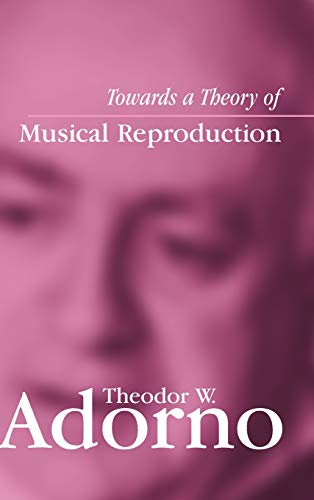
At the beginning of his career in the 1920s, Adorno sketched a plan to write a major work on the theory of musical reproduction, a task he returned to time and again throughout his career but never completed. The choice of the word ‘reproduction’ as opposed to ‘interpretation’ indicates a primary supposition: that there is a clearly defined musical text whose precision exceeds what is visible on the page, and that the performer has the responsibility to reproduce it as accurately as possible, beyond simply ‘playing what is written’. This task, according to Adorno, requires a detailed understanding of all musical parameters in their historical context, and his reflections upon this task lead to a fundamental study of the nature of notation and musical sense.
In the various notes and texts brought together in Towards a Theory of Musical Reproduction, one finds Adorno constantly circling around an irresolvable paradox: interpretation can only fail the work, yet only through it can music’s true essence be captured. While he at times seems more definite in his pronouncement of a musical score’s absolute value – just as a book is read silently, not aloud – his discourse repeatedly displays his inability to cling to that belief. It is this quality of uncertainty in his reflections that truly indicates the scope of the discourse and its continuing relevance to musical thought and practice today.
"Sinopsis" puede pertenecer a otra edición de este libro.
Acerca del autor
Theodor W. Adorno is the author of Towards a Theory of Musical Reproduction: Notes, a Draft and Two Schemata, published by Wiley.
Henri Lonitz is the editor of Towards a Theory of Musical Reproduction: Notes, a Draft and Two Schemata, published by Wiley.
De la contraportada
At the beginning of his career in the 1920s, Adorno sketched a plan to write a major work on the theory of musical reproduction, a task he returned to time and again throughout his career but never completed. The choice of the word reproduction as opposed to interpretation indicates a primary supposition: that there is a clearly defined musical text whose precision exceeds what is visible on the page, and that the performer has the responsibility to reproduce it as accurately as possible, beyond simply playing what is written. This task, according to Adorno, requires a detailed understanding of all musical parameters in their historical context, and his reflections upon this task lead to a fundamental study of the nature of notation and musical sense.
In the various notes and texts brought together in Towards a Theory of Musical Reproduction, one finds Adorno constantly circling around an irresolvable paradox: interpretation can only fail the work, yet only through it can musics true essence be captured. While he at times seems more definite in his pronouncement of a musical scores absolute value just as a book is read silently, not aloud his discourse repeatedly displays his inability to cling to that belief. It is this quality of uncertainty in his reflections that truly indicates the scope of the discourse and its continuing relevance to musical thought and practice today.
"Sobre este título" puede pertenecer a otra edición de este libro.
Resultados de la búsqueda para Towards a Theory of Musical Reproduction: Notes, a...

Imagen del vendedor
Towards a Theory of Musical Reproduction : Notes, a Draft and Two Schemata
Librería: GreatBookPrices, Columbia, MD, Estados Unidos de America
Calificación del vendedor: 5 de 5 estrellas

Condición: As New. Unread book in perfect condition. Nº de ref. del artículo: 4381793
Comprar usado
EUR 70,70
Envío por EUR 2,32
Se envía dentro de Estados Unidos de America
Se envía dentro de Estados Unidos de America
Cantidad disponible: 2 disponibles
Imagen del vendedor
Towards a Theory of Musical Reproduction : Notes, a Draft and Two Schemata
Librería: GreatBookPrices, Columbia, MD, Estados Unidos de America
Calificación del vendedor: 5 de 5 estrellas
Condición: New. Nº de ref. del artículo: 4381793-n
Comprar nuevo
EUR 73,85
Envío por EUR 2,32
Se envía dentro de Estados Unidos de America
Se envía dentro de Estados Unidos de America
Cantidad disponible: 2 disponibles
Imagen de archivo
Towards a Theory of Musical Reproduction
Librería: Books Puddle, Woodside, NY, Estados Unidos de America
Calificación del vendedor: 4 de 5 estrellas

Condición: New. pp. 304 Index. Nº de ref. del artículo: 26373071
Comprar nuevo
EUR 74,46
Envío por EUR 3,51
Se envía dentro de Estados Unidos de America
Se envía dentro de Estados Unidos de America
Cantidad disponible: 1 disponibles
Imagen de archivo
Towards a Theory of Musical Reproduction
Librería: Majestic Books, Hounslow, Reino Unido
Calificación del vendedor: 4 de 5 estrellas
Condición: New. pp. 304. Nº de ref. del artículo: 7474832
Comprar nuevo
EUR 72,47
Envío por EUR 7,55
Se envía de Reino Unido a Estados Unidos de America
Se envía de Reino Unido a Estados Unidos de America
Cantidad disponible: 1 disponibles
Imagen de archivo
Towards a Theory of Musical Reproduction
Librería: PBShop.store UK, Fairford, GLOS, Reino Unido
Calificación del vendedor: 5 de 5 estrellas
HRD. Condición: New. New Book. Shipped from UK. Established seller since 2000. Nº de ref. del artículo: FW-9780745631981
Comprar nuevo
EUR 74,84
Envío por EUR 5,83
Se envía de Reino Unido a Estados Unidos de America
Se envía de Reino Unido a Estados Unidos de America
Cantidad disponible: 2 disponibles
Imagen del vendedor
Towards a Theory of Musical Reproduction
Publicado por
John Wiley and Sons Ltd, GB, 2006
ISBN 10: 0745631983
ISBN 13: 9780745631981
Nuevo
Tapa dura
Librería: Rarewaves.com USA, London, LONDO, Reino Unido
Calificación del vendedor: 5 de 5 estrellas
Hardback. Condición: New. At the beginning of his career in the 1920s, Adorno sketched a plan to write a major work on the theory of musical reproduction, a task he returned to time and again throughout his career but never completed. The choice of the word reproduction as opposed to interpretation indicates a primary supposition: that there is a clearly defined musical text whose precision exceeds what is visible on the page, and that the performer has the responsibility to reproduce it as accurately as possible, beyond simply playing what is written. This task, according to Adorno, requires a detailed understanding of all musical parameters in their historical context, and his reflections upon this task lead to a fundamental study of the nature of notation and musical sense. In the various notes and texts brought together in Towards a Theory of Musical Reproduction, one finds Adorno constantly circling around an irresolvable paradox: interpretation can only fail the work, yet only through it can musics true essence be captured. While he at times seems more definite in his pronouncement of a musical scores absolute value just as a book is read silently, not aloud his discourse repeatedly displays his inability to cling to that belief. It is this quality of uncertainty in his reflections that truly indicates the scope of the discourse and its continuing relevance to musical thought and practice today. Nº de ref. del artículo: LU-9780745631981
Comprar nuevo
EUR 84,25
Gastos de envío gratis
Se envía de Reino Unido a Estados Unidos de America
Se envía de Reino Unido a Estados Unidos de America
Cantidad disponible: 1 disponibles
Imagen del vendedor
Towards a Theory of Musical Reproduction : Notes, a Draft and Two Schemata
Librería: GreatBookPricesUK, Woodford Green, Reino Unido
Calificación del vendedor: 5 de 5 estrellas
Condición: As New. Unread book in perfect condition. Nº de ref. del artículo: 4381793
Comprar usado
EUR 71,90
Envío por EUR 17,42
Se envía de Reino Unido a Estados Unidos de America
Se envía de Reino Unido a Estados Unidos de America
Cantidad disponible: 2 disponibles
Imagen del vendedor
Towards a Theory of Musical Reproduction : Notes, a Draft and Two Schemata
Librería: GreatBookPricesUK, Woodford Green, Reino Unido
Calificación del vendedor: 5 de 5 estrellas
Condición: New. Nº de ref. del artículo: 4381793-n
Comprar nuevo
EUR 73,98
Envío por EUR 17,42
Se envía de Reino Unido a Estados Unidos de America
Se envía de Reino Unido a Estados Unidos de America
Cantidad disponible: 2 disponibles
Imagen de archivo
Towards a Theory of Musical Reproduction: Notes, a Draft and Two Schemata
Librería: THE SAINT BOOKSTORE, Southport, Reino Unido
Calificación del vendedor: 5 de 5 estrellas
Hardback. Condición: New. New copy - Usually dispatched within 4 working days. Nº de ref. del artículo: B9780745631981
Comprar nuevo
EUR 74,25
Envío por EUR 19,01
Se envía de Reino Unido a Estados Unidos de America
Se envía de Reino Unido a Estados Unidos de America
Cantidad disponible: 2 disponibles
Imagen de archivo
Towards a Theory of Musical Reproduction: Notes, a Draft and Two Schemata
Publicado por
John Wiley and Sons Ltd, 2006
ISBN 10: 0745631983
ISBN 13: 9780745631981
Nuevo
Tapa dura
Librería: Kennys Bookshop and Art Galleries Ltd., Galway, GY, Irlanda
Calificación del vendedor: 5 de 5 estrellas
Condición: New. This book collects together Adornos manifold implications for musical interpretation. His reflections lead to a fundamental study of the nature of notation and musical sense. However, it is the quality of uncertainty in his reflections that indicates the scope of the discourse and its continuing relevance to musical thought today. Editor(s): Lonitz, Henri. Translator(s): Honban, Weiland. Num Pages: 304 pages, Illustrations, music. BIC Classification: AVX. Category: (P) Professional & Vocational. Dimension: 234 x 158 x 21. Weight in Grams: 532. . 2006. Hardcover. . . . . Nº de ref. del artículo: V9780745631981
Comprar nuevo
EUR 86,63
Envío por EUR 9,50
Se envía de Irlanda a Estados Unidos de America
Se envía de Irlanda a Estados Unidos de America
Cantidad disponible: 1 disponibles