
Artículos relacionados a Understanding the Process of Economic Change: 32 (The...
Understanding the Process of Economic Change: 32 (The Princeton Economic History of the Western World) - Tapa blanda
Libro 5 de 58: The Princeton Economic History of the Western World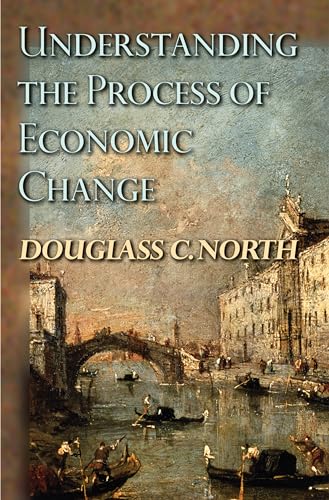
Sinopsis
In this landmark work, a Nobel Prize-winning economist develops a new way of understanding the process by which economies change. Douglass North inspired a revolution in economic history a generation ago by demonstrating that economic performance is determined largely by the kind and quality of institutions that support markets. As he showed in two now classic books that inspired the New Institutional Economics (today a subfield of economics), property rights and transaction costs are fundamental determinants. Here, North explains how different societies arrive at the institutional infrastructure that greatly determines their economic trajectories.
North argues that economic change depends largely on "adaptive efficiency," a society’s effectiveness in creating institutions that are productive, stable, fair, and broadly accepted--and, importantly, flexible enough to be changed or replaced in response to political and economic feedback. While adhering to his earlier definition of institutions as the formal and informal rules that constrain human economic behavior, he extends his analysis to explore the deeper determinants of how these rules evolve and how economies change. Drawing on recent work by psychologists, he identifies intentionality as the crucial variable and proceeds to demonstrate how intentionality emerges as the product of social learning and how it then shapes the economy’s institutional foundations and thus its capacity to adapt to changing circumstances.
Understanding the Process of Economic Change accounts not only for past institutional change but also for the diverse performance of present-day economies. This major work is therefore also an essential guide to improving the performance of developing countries.
"Sinopsis" puede pertenecer a otra edición de este libro.
Acerca del autor
Douglass C. North is professor of economics and Spencer T. Olin Professor in Arts and Sciences at Washington University in St. Louis. He was the corecipient of the Nobel Prize in Economic Sciences in 1993.
De la contraportada
"Just as Douglass North's earlier classic, Institutions and Institutional Change, ushered in the revolution in understanding institutions that dominated the nineties, his new book, Understanding the Process of Economic Change, seeks an equally revolutionary change. North now integrates the cognitive component into this analysis: how the mind works, how we form beliefs and understandings about the world, and how societies solve--or fail to solve--the problems they face. This book is vintage North."--Barry Weingast, Professor of Political Science, Stanford University
"In this book Douglass North once again opens new frontiers in economic research. He calls for probing into the human mind to seek an understanding of how knowledge acquired by individuals and societies manifests itself culturally and institutionally to shape processes of change. The analysis makes a courageous foray into territories unfamiliar to most economists, such as social psychology and cognitive science, and uses the findings to further our understanding of the most pressing economic question of our time: why, despite the production capacity of modern technology, do many economies fail to prosper?"--Avner Greif, Bowman Family Professor in the Humanities and Sciences and Professor of Economics, Stanford University
"This short book by a great master will be read, discussed, and debated widely. It boldly goes where few have dared to tread. It is a book about something more ambitious than economic growth or even economic history. It is about economic change, and it dares to ask questions that the profession will still be scratching its head over for many years to come."--Joel Mokyr, Northwestern University, author of The Gifts of Athena: Historical Origins of the Knowledge Economy
"This deeply exciting book culminates North's research agenda, and points the way to solving the most valuable but intractable problem in economics today: how institutions evolve. When I first read it I immediately saw implications for my own research, and began rethinking several fundamental ideas about how economies and their governments interrelate. What you learn from North changes how you think, and changing how people think is the best measure of intellectual influence."--John Joseph Wallis, University of Maryland
"Sobre este título" puede pertenecer a otra edición de este libro.
Resultados de la búsqueda para Understanding the Process of Economic Change: 32 (The...

Imagen de archivo
Understanding the Process of Economic Change
Publicado por
Princeton University Press, 2010
ISBN 10: 0691145954
ISBN 13: 9780691145952
Antiguo o usado
Tapa blanda
Librería: Better World Books, Mishawaka, IN, Estados Unidos de America
Calificación del vendedor: 5 de 5 estrellas

Condición: Good. Former library copy. Pages intact with minimal writing/highlighting. The binding may be loose and creased. Dust jackets/supplements are not included. Includes library markings. Stock photo provided. Product includes identifying sticker. Better World Books: Buy Books. Do Good. Nº de ref. del artículo: 8902921-75
Comprar usado
EUR 15,20
Gastos de envío gratis
Se envía dentro de Estados Unidos de America
Se envía dentro de Estados Unidos de America
Cantidad disponible: 1 disponibles
Imagen del vendedor
Understanding the Process of Economic Change (The Princeton Economic History of the Western World)
Publicado por
Princeton University Press, 2010
ISBN 10: 0691145954
ISBN 13: 9780691145952
Antiguo o usado
Tapa blanda
Librería: Zoom Books East, Glendale Heights, IL, Estados Unidos de America
Calificación del vendedor: 5 de 5 estrellas
Condición: good. Book is in good condition and may include underlining highlighting and minimal wear. The book can also include "From the library of" labels. May not contain miscellaneous items toys, dvds, etc. . We offer 100% money back guarantee and 24 7 customer service. Nº de ref. del artículo: ZEV.0691145954.G
Comprar usado
EUR 17,56
Gastos de envío gratis
Se envía dentro de Estados Unidos de America
Se envía dentro de Estados Unidos de America
Cantidad disponible: 1 disponibles
Imagen del vendedor
Understanding the Process of Economic Change
Publicado por
Princeton University Press, 2010
ISBN 10: 0691145954
ISBN 13: 9780691145952
Antiguo o usado
Tapa blanda
Librería: GreatBookPrices, Columbia, MD, Estados Unidos de America
Calificación del vendedor: 5 de 5 estrellas
Condición: As New. Unread book in perfect condition. Nº de ref. del artículo: 7594889
Comprar usado
EUR 28,44
Envío por EUR 2,35
Se envía dentro de Estados Unidos de America
Se envía dentro de Estados Unidos de America
Cantidad disponible: Más de 20 disponibles
Imagen del vendedor
Understanding the Process of Economic Change
Publicado por
Princeton University Press, 2010
ISBN 10: 0691145954
ISBN 13: 9780691145952
Nuevo
Tapa blanda
Librería: GreatBookPrices, Columbia, MD, Estados Unidos de America
Calificación del vendedor: 5 de 5 estrellas
Condición: New. Nº de ref. del artículo: 7594889-n
Comprar nuevo
EUR 29,90
Envío por EUR 2,35
Se envía dentro de Estados Unidos de America
Se envía dentro de Estados Unidos de America
Cantidad disponible: Más de 20 disponibles
Imagen de archivo
Understanding the Process of Economic Change
Librería: PBShop.store US, Wood Dale, IL, Estados Unidos de America
Calificación del vendedor: 5 de 5 estrellas
PAP. Condición: New. New Book. Shipped from UK. Established seller since 2000. Nº de ref. del artículo: WP-9780691145952
Comprar nuevo
EUR 32,33
Gastos de envío gratis
Se envía dentro de Estados Unidos de America
Se envía dentro de Estados Unidos de America
Cantidad disponible: 4 disponibles
Imagen del vendedor
Understanding the Process of Economic Change
Publicado por
Princeton University Press, US, 2010
ISBN 10: 0691145954
ISBN 13: 9780691145952
Nuevo
Paperback
Librería: Rarewaves USA, HEBRON, KY, Estados Unidos de America
Calificación del vendedor: 5 de 5 estrellas
Paperback. Condición: New. In this landmark work, a Nobel Prize-winning economist develops a new way of understanding the process by which economies change. Douglass North inspired a revolution in economic history a generation ago by demonstrating that economic performance is determined largely by the kind and quality of institutions that support markets. As he showed in two now classic books that inspired the New Institutional Economics (today a subfield of economics), property rights and transaction costs are fundamental determinants. Here, North explains how different societies arrive at the institutional infrastructure that greatly determines their economic trajectories. North argues that economic change depends largely on "adaptive efficiency," a society's effectiveness in creating institutions that are productive, stable, fair, and broadly accepted--and, importantly, flexible enough to be changed or replaced in response to political and economic feedback. While adhering to his earlier definition of institutions as the formal and informal rules that constrain human economic behavior, he extends his analysis to explore the deeper determinants of how these rules evolve and how economies change.Drawing on recent work by psychologists, he identifies intentionality as the crucial variable and proceeds to demonstrate how intentionality emerges as the product of social learning and how it then shapes the economy's institutional foundations and thus its capacity to adapt to changing circumstances. Understanding the Process of Economic Change accounts not only for past institutional change but also for the diverse performance of present-day economies. This major work is therefore also an essential guide to improving the performance of developing countries. Nº de ref. del artículo: LU-9780691145952
Comprar nuevo
EUR 32,75
Gastos de envío gratis
Se envía dentro de Estados Unidos de America
Se envía dentro de Estados Unidos de America
Cantidad disponible: Más de 20 disponibles
Imagen de archivo
Understanding the Process of Economic Change
Librería: PBShop.store UK, Fairford, GLOS, Reino Unido
Calificación del vendedor: 5 de 5 estrellas
PAP. Condición: New. New Book. Shipped from UK. Established seller since 2000. Nº de ref. del artículo: WP-9780691145952
Comprar nuevo
EUR 29,88
Envío por EUR 4,88
Se envía de Reino Unido a Estados Unidos de America
Se envía de Reino Unido a Estados Unidos de America
Cantidad disponible: 3 disponibles
Imagen del vendedor
Understanding the Process of Economic Change
Publicado por
Princeton University Press, US, 2010
ISBN 10: 0691145954
ISBN 13: 9780691145952
Nuevo
Paperback
Librería: Rarewaves.com USA, London, LONDO, Reino Unido
Calificación del vendedor: 5 de 5 estrellas
Paperback. Condición: New. In this landmark work, a Nobel Prize-winning economist develops a new way of understanding the process by which economies change. Douglass North inspired a revolution in economic history a generation ago by demonstrating that economic performance is determined largely by the kind and quality of institutions that support markets. As he showed in two now classic books that inspired the New Institutional Economics (today a subfield of economics), property rights and transaction costs are fundamental determinants. Here, North explains how different societies arrive at the institutional infrastructure that greatly determines their economic trajectories. North argues that economic change depends largely on "adaptive efficiency," a society's effectiveness in creating institutions that are productive, stable, fair, and broadly accepted--and, importantly, flexible enough to be changed or replaced in response to political and economic feedback. While adhering to his earlier definition of institutions as the formal and informal rules that constrain human economic behavior, he extends his analysis to explore the deeper determinants of how these rules evolve and how economies change.Drawing on recent work by psychologists, he identifies intentionality as the crucial variable and proceeds to demonstrate how intentionality emerges as the product of social learning and how it then shapes the economy's institutional foundations and thus its capacity to adapt to changing circumstances. Understanding the Process of Economic Change accounts not only for past institutional change but also for the diverse performance of present-day economies. This major work is therefore also an essential guide to improving the performance of developing countries. Nº de ref. del artículo: LU-9780691145952
Comprar nuevo
EUR 35,85
Gastos de envío gratis
Se envía de Reino Unido a Estados Unidos de America
Se envía de Reino Unido a Estados Unidos de America
Cantidad disponible: 2 disponibles
Imagen de archivo
Understanding the Process of Economic Change (The Princeton Economic History of the Western World)
Publicado por
Princeton University Press, 2010
ISBN 10: 0691145954
ISBN 13: 9780691145952
Nuevo
Tapa blanda
Librería: California Books, Miami, FL, Estados Unidos de America
Calificación del vendedor: 5 de 5 estrellas
Condición: New. Nº de ref. del artículo: I-9780691145952
Comprar nuevo
EUR 38,46
Gastos de envío gratis
Se envía dentro de Estados Unidos de America
Se envía dentro de Estados Unidos de America
Cantidad disponible: Más de 20 disponibles
Imagen de archivo
Understanding the Process of Economic Change (eng)
Publicado por
Princeton University Press, 2010
ISBN 10: 0691145954
ISBN 13: 9780691145952
Nuevo
Tapa blanda
Librería: Brook Bookstore On Demand, Napoli, NA, Italia
Calificación del vendedor: 5 de 5 estrellas
Condición: new. Nº de ref. del artículo: b2e7d24d2dad92bb86aa0a6b704e22ab
Comprar nuevo
EUR 34,17
Envío por EUR 5,50
Se envía de Italia a Estados Unidos de America
Se envía de Italia a Estados Unidos de America
Cantidad disponible: 4 disponibles