Discovering Complexity: Decomposition and Localization as Strategies in Scientific Research - Tapa dura
Sinopsis
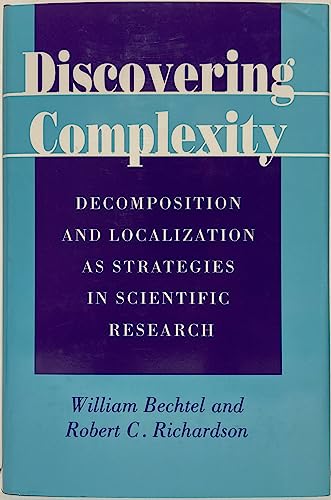
Discovering Complexity offers an account of scientific discovery that aims to be psychologically and historically realistic. Drawing on cases from a number of life sciences, including biochemistry, genetics, and neuroscience, this study of the dynamics of theory development focuses on two psychological heuristics, decomposition and localization. William Bechtel and Robert Richardson identify a number of "choice-points" that scientists confront in developing mechanistic explanations and describe how different choices result in divergent explanatory models. According to Bechtel and Richardson's analysis, decomposition is the attempt to differentiate components of a system, while localization assigns responsibility for specific tasks to these components. The book examines in detail the usefulness of these heuristics in biological science, but also discusses their fallibility: underlying their use is the sometimes false assumption that nature is significantly decomposable and hierarchical. When a system does not appear to be decomposable, a classic response has been to abandon the pursuit of mechanistic explanation and to settle for accurate descriptions of phenomena. More recently, with advances in mathematical modeling, an alternative has emerged. Described in this work is an approach to explanation that appeals to interactions between simple components, rather than assigning functions to individual components.
"Sinopsis" puede pertenecer a otra edición de este libro.
Reseña del editor
Discovering Complexity offers an account of scientific discovery that aims to be psychologically and historically realistic. Drawing on cases from a number of life sciences, including biochemistry, genetics, and neuroscience, this study of the dynamics of theory development focuses on two psychological heuristics, decomposition and localization. William Bechtel and Robert Richardson identify a number of "choice-points" that scientists confront in developing mechanistic explanations and describe how different choices result in divergent explanatory models. According to Bechtel and Richardson's analysis, decomposition is the attempt to differentiate components of a system, while localization assigns responsibility for specific tasks to these components. The book examines in detail the usefulness of these heuristics in biological science, but also discusses their fallibility: underlying their use is the sometimes false assumption that nature is significantly decomposable and hierarchical. When a system does not appear to be decomposable, a classic response has been to abandon the pursuit of mechanistic explanation and to settle for accurate descriptions of phenomena. More recently, with advances in mathematical modeling, an alternative has emerged. Described in this work is an approach to explanation that appeals to interactions between simple components, rather than assigning functions to individual components.
"Sobre este título" puede pertenecer a otra edición de este libro.
Otras ediciones populares con el mismo título

Resultados de la búsqueda para Discovering Complexity: Decomposition and Localization...

Imagen de archivo
Discovering Complexity: Decomposition and Localization as Strategies in Scientific Research
Publicado por
Princeton University Press, U.S.A., 1993
ISBN 10: 0691087628
ISBN 13: 9780691087627
Antiguo o usado
Tapa dura
Librería: ABOXABOOKS, Bristol, VT, Estados Unidos de America
Calificación del vendedor: 5 de 5 estrellas

Hardcover. Condición: Good. Moderate wear on jacket edges. Otherwise in very good condition. Nº de ref. del artículo: 009939
Comprar usado
EUR 15,99
Gastos de envío:
EUR 4,74
A Estados Unidos de America
Cantidad disponible: 1 disponibles
Imagen del vendedor
Discovering Complexity Decomposition and Localization As Strategies in Scientific Research
Publicado por
Princeton, New Jersey : Princeton University Press, 1993
ISBN 10: 0691087628
ISBN 13: 9780691087627
Antiguo o usado
Tapa dura
Librería: avelibro OHG, Dinkelscherben, Alemania
Calificación del vendedor: 5 de 5 estrellas
24 x 16 cm. Condición: Gut. XIV, 286 Pages ; With Figures Original Leineneinband mit Bibliotheksrückenschild. Etwas verschossen. Innen mit Bibliotheksstempeln, Legende, sauberer, sehr guter Zustand. Englische Sprache - Original Cloth-Binding with Library label. Little faded. Inside with Library stamps, Legend, in very good condition. English Language B03-03-05F|S6 Sprache: Englisch Gewicht in Gramm: 595. Nº de ref. del artículo: 69672
Comprar usado
EUR 20,00
Gastos de envío:
EUR 10,00
De Alemania a Estados Unidos de America
Cantidad disponible: 1 disponibles
Imagen de archivo
Discovering Complexity: Decomposition and Localization as Strategies in Scientific Research
Publicado por
Princeton University Press, 1993
ISBN 10: 0691087628
ISBN 13: 9780691087627
Antiguo o usado
Tapa dura
Librería: HPB-Red, Dallas, TX, Estados Unidos de America
Calificación del vendedor: 5 de 5 estrellas
Hardcover. Condición: Good. Connecting readers with great books since 1972! Used textbooks may not include companion materials such as access codes, etc. May have some wear or writing/highlighting. We ship orders daily and Customer Service is our top priority! Nº de ref. del artículo: S_394313698
Comprar usado
EUR 30,03
Gastos de envío:
EUR 3,23
A Estados Unidos de America
Cantidad disponible: 1 disponibles
Imagen de archivo
Discovering Complexity: Decomposition and Localization As Strategies in Scientific Research
Publicado por
Princeton Univ Pr, 1993
ISBN 10: 0691087628
ISBN 13: 9780691087627
Antiguo o usado
Tapa dura
Librería: ThriftBooks-Atlanta, AUSTELL, GA, Estados Unidos de America
Calificación del vendedor: 5 de 5 estrellas
Hardcover. Condición: Good. No Jacket. Missing dust jacket; Pages can have notes/highlighting. Spine may show signs of wear. ~ ThriftBooks: Read More, Spend Less. Nº de ref. del artículo: G0691087628I3N01
Comprar usado
EUR 33,58
Gastos de envío:
GRATIS
A Estados Unidos de America
Cantidad disponible: 1 disponibles
Imagen de archivo
Discovering Complexity: Decomposition and Localization as Strategies in Scientific Research
Publicado por
Princeton University Press, 1993
ISBN 10: 0691087628
ISBN 13: 9780691087627
Antiguo o usado
Tapa dura
Librería: Brused Books, Pullman, WA, Estados Unidos de America
Calificación del vendedor: 5 de 5 estrellas
Hardcover. Condición: Fine. Estado de la sobrecubierta: Near Fine. Hardcover and dust jacket are almost like new. No writing or names inside. Small bump to top corner. 1993 first printing. Book. Nº de ref. del artículo: 042591
Comprar usado
EUR 39,97
Gastos de envío:
GRATIS
A Estados Unidos de America
Cantidad disponible: 1 disponibles
Imagen de archivo
Discovering Complexity Decomposition and Localisation as Strategies in Scientific Research
Publicado por
Princeton University Press, Princeton, 1993
ISBN 10: 0691087628
ISBN 13: 9780691087627
Antiguo o usado
Tapa dura
Original o primera edición
Librería: Webbooks, Wigtown, Wigtown, Reino Unido
Calificación del vendedor: 5 de 5 estrellas
Hard Cover. Condición: Good. No Jacket. First Edition. From an academic library with the usual stamps etc. Nº de ref. del artículo: PF450
Comprar usado
EUR 14,11
Gastos de envío:
EUR 34,25
De Reino Unido a Estados Unidos de America
Cantidad disponible: 1 disponibles
Imagen de archivo
Discovering Complexity: Decomposition and Localization As Strategies in Scientific Research
Publicado por
Princeton University Press, 1993
ISBN 10: 0691087628
ISBN 13: 9780691087627
Antiguo o usado
Tapa dura
Librería: Antiquariat Armebooks, Frankfurt am Main, Alemania
Calificación del vendedor: 5 de 5 estrellas
Gebundene Ausgabe. Condición: Gut. 286 Seiten; Princeton University - 1993 : William Bechtel - gb + Su. Gr. - 6-71-2-L2 ZY-QC2I-FEZG Sprache: Englisch Gewicht in Gramm: 635. Nº de ref. del artículo: 347513
Comprar usado
EUR 32,99
Gastos de envío:
EUR 20,00
De Alemania a Estados Unidos de America
Cantidad disponible: 1 disponibles
Imagen de archivo
Discovering Complexity: Decomposition and Localization As Strategies in Scientific Research
Librería: Toscana Books, AUSTIN, TX, Estados Unidos de America
Calificación del vendedor: 5 de 5 estrellas
Hardcover. Condición: new. Excellent Condition.Excels in customer satisfaction, prompt replies, and quality checks. Nº de ref. del artículo: Scanned0691087628
Comprar nuevo
EUR 76,67
Gastos de envío:
EUR 3,71
A Estados Unidos de America
Cantidad disponible: 1 disponibles
Imagen de archivo
Discovering Complexity: Decomposition and Localization as Strategies in Scientific Research
Publicado por
Princeton University Press, 1993
ISBN 10: 0691087628
ISBN 13: 9780691087627
Nuevo
Tapa dura
Librería: BennettBooksLtd, San Diego, NV, Estados Unidos de America
Calificación del vendedor: 5 de 5 estrellas
Hardcover. Condición: New. In shrink wrap. Looks like an interesting title! Nº de ref. del artículo: Q-0691087628
Comprar nuevo
EUR 110,52
Gastos de envío:
EUR 5,99
A Estados Unidos de America
Cantidad disponible: 1 disponibles