
Artículos relacionados a American Scripture: Making the Declaration of Independence
Sinopsis
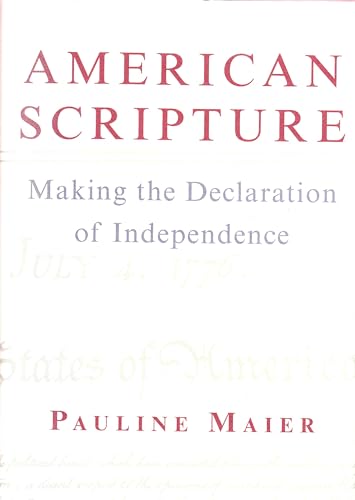
A history professor reveals the origins of the Declaration's ideas and phrases, unravels the story of its drafting, follows its role in the nineteenth century, and explores the implications of its treatment as a sacred text. 30,000 first printing. Tour.
"Sinopsis" puede pertenecer a otra edición de este libro.
Acerca del autor
Pauline Maier was born in St. Paul, Minnesota. She received her B.A. from Radcliffe College in 1960, was a Fulbright Scholar at the London School of Economics in 1960-61, and took her Ph.D. at Harvard University in 1968. She has taught at Harvard, the University of Massachusetts (Boston), University of Wisconsin, Yale University, and Massachusetts Institute of Technology, where she has been William R. Kenan, Junior, Professor of American History since 1990. She is the author of From Resistance to Revolution, The Old Revolutionaries, and The American People: A History, a single-authored text for junior high school, as well as numerous other articles and reviews.
De la solapa interior
r shows us the Declaration as both the defining statement of our national identity and the moral standard by which we live as a nation. It is truly "American Scripture," and Maier tells us how it came to be -- from the Declaration's birth in the hard and tortuous struggle by which Americans arrived at Independence to the ways in which, in the nineteenth century, the document itself became sanctified.
Maier describes the transformation of the Second Continental Congress into a national government, unlike anything that preceded or followed it, and with more authority than the colonists would ever have conceded to the British Parliament; the great difficulty in making the decision for Independence; the influence of Paine's []Common Sense[], which shifted the terms of debate; and the political maneuvers that allowed Congress to make the momentous decision.
In Maier's hands, the Declaration of Independence is brought close to us. She lets us hear the voice o
"Sobre este título" puede pertenecer a otra edición de este libro.
Resultados de la búsqueda para American Scripture: Making the Declaration of Independence

Imagen de archivo
American Scripture: Making the Declaration of Independence
Publicado por
Alfred A. Knopf, 1997
ISBN 10: 0679454926
ISBN 13: 9780679454922
Antiguo o usado
Tapa dura
Librería: World of Books (was SecondSale), Montgomery, IL, Estados Unidos de America
Calificación del vendedor: 5 de 5 estrellas

Hardback. Condición: Good. Pauline Maier shows us the Declaration as both the defining statement of our national identity and the moral standard by which we live as a nation. It is truly American Scripture, and Maier tells us how it came to be -- from the Declaration's birth in the hard and tortuous struggle by which Americans arrived at Independence to the ways in which, in the nineteenth century, the document itself became sanctified. Maier describes the transformation of the Second Continental Congress into a national government, unlike anything that preceded or followed it, and with more authority than the colonists would ever have conceded to the British Parliament; the great difficulty in making the decision for Independence; the influence of Paine's Common Sense, which shifted the terms of debate; and the political maneuvers that allowed Congress to make the momentous decision. In Maier's hands, the Declaration of Independence is brought close to us. She lets us hear the voice of the people as revealed in the other declarations of 1776: the local resolutions -- most of which have gone unnoticed over the past two centuries -- that explained, advocated, and justified Independence and undergirded Congress's work. Detective-like, she discloses the origins of key ideas and phrases in the Declaration and unravels the complex story of its drafting and of the group-editing job which angered Thomas Jefferson. Maier also reveals what happened to the Declaration after the signing and celebration: how it was largely forgotten and then revived to buttress political arguments of the nineteenth century; and, most important, how Abraham Lincoln ensured its persistence as a living force in American society. Finally, she shows how by the very act of venerating the Declaration as we do -- by holding it as sacrosanct, akin to holy writ -- we may actually be betraying its purpose and its power. Nº de ref. del artículo: 00108178934
Comprar usado
EUR 4,59
Gastos de envío gratis
Se envía dentro de Estados Unidos de America
Se envía dentro de Estados Unidos de America
Cantidad disponible: 3 disponibles
Imagen de archivo
American Scripture: Making the Declaration of Independence
Publicado por
Alfred A. Knopf, 1997
ISBN 10: 0679454926
ISBN 13: 9780679454922
Antiguo o usado
Tapa dura
Librería: World of Books (was SecondSale), Montgomery, IL, Estados Unidos de America
Calificación del vendedor: 5 de 5 estrellas
Hardback. Condición: Fair. Pauline Maier shows us the Declaration as both the defining statement of our national identity and the moral standard by which we live as a nation. It is truly American Scripture, and Maier tells us how it came to be -- from the Declaration's birth in the hard and tortuous struggle by which Americans arrived at Independence to the ways in which, in the nineteenth century, the document itself became sanctified. Maier describes the transformation of the Second Continental Congress into a national government, unlike anything that preceded or followed it, and with more authority than the colonists would ever have conceded to the British Parliament; the great difficulty in making the decision for Independence; the influence of Paine's Common Sense, which shifted the terms of debate; and the political maneuvers that allowed Congress to make the momentous decision. In Maier's hands, the Declaration of Independence is brought close to us. She lets us hear the voice of the people as revealed in the other declarations of 1776: the local resolutions -- most of which have gone unnoticed over the past two centuries -- that explained, advocated, and justified Independence and undergirded Congress's work. Detective-like, she discloses the origins of key ideas and phrases in the Declaration and unravels the complex story of its drafting and of the group-editing job which angered Thomas Jefferson. Maier also reveals what happened to the Declaration after the signing and celebration: how it was largely forgotten and then revived to buttress political arguments of the nineteenth century; and, most important, how Abraham Lincoln ensured its persistence as a living force in American society. Finally, she shows how by the very act of venerating the Declaration as we do -- by holding it as sacrosanct, akin to holy writ -- we may actually be betraying its purpose and its power. Nº de ref. del artículo: 00110590806
Comprar usado
EUR 4,59
Gastos de envío gratis
Se envía dentro de Estados Unidos de America
Se envía dentro de Estados Unidos de America
Cantidad disponible: 1 disponibles
Imagen de archivo
American Scripture: Making the Declaration of Independence
Publicado por
Alfred A. Knopf, 1997
ISBN 10: 0679454926
ISBN 13: 9780679454922
Antiguo o usado
Tapa dura
Librería: World of Books (was SecondSale), Montgomery, IL, Estados Unidos de America
Calificación del vendedor: 5 de 5 estrellas
Hardback. Condición: Very Good. Pauline Maier shows us the Declaration as both the defining statement of our national identity and the moral standard by which we live as a nation. It is truly American Scripture, and Maier tells us how it came to be -- from the Declaration's birth in the hard and tortuous struggle by which Americans arrived at Independence to the ways in which, in the nineteenth century, the document itself became sanctified. Maier describes the transformation of the Second Continental Congress into a national government, unlike anything that preceded or followed it, and with more authority than the colonists would ever have conceded to the British Parliament; the great difficulty in making the decision for Independence; the influence of Paine's Common Sense, which shifted the terms of debate; and the political maneuvers that allowed Congress to make the momentous decision. In Maier's hands, the Declaration of Independence is brought close to us. She lets us hear the voice of the people as revealed in the other declarations of 1776: the local resolutions -- most of which have gone unnoticed over the past two centuries -- that explained, advocated, and justified Independence and undergirded Congress's work. Detective-like, she discloses the origins of key ideas and phrases in the Declaration and unravels the complex story of its drafting and of the group-editing job which angered Thomas Jefferson. Maier also reveals what happened to the Declaration after the signing and celebration: how it was largely forgotten and then revived to buttress political arguments of the nineteenth century; and, most important, how Abraham Lincoln ensured its persistence as a living force in American society. Finally, she shows how by the very act of venerating the Declaration as we do -- by holding it as sacrosanct, akin to holy writ -- we may actually be betraying its purpose and its power. Nº de ref. del artículo: CIN0679454926VG
Comprar usado
EUR 4,59
Gastos de envío gratis
Se envía dentro de Estados Unidos de America
Se envía dentro de Estados Unidos de America
Cantidad disponible: 1 disponibles
Imagen de archivo
American Scripture: Making the Declaration of Independence
Librería: New Legacy Books, Annandale, NJ, Estados Unidos de America
Calificación del vendedor: 5 de 5 estrellas
hardcover. Condición: Good. Fast shipping and order satisfaction guaranteed. A portion of your purchase benefits Non-Profit Organizations, First Aid and Fire Stations! Nº de ref. del artículo: mon0000199071
Comprar usado
EUR 3,99
Envío por EUR 2,22
Se envía dentro de Estados Unidos de America
Se envía dentro de Estados Unidos de America
Cantidad disponible: 1 disponibles
Imagen del vendedor
American Scripture: Making the Declaration of Independence
Librería: Dream Books Co., Denver, CO, Estados Unidos de America
Calificación del vendedor: 5 de 5 estrellas
Condición: acceptable. This copy has clearly been enjoyedâ"expect noticeable shelf wear and some minor creases to the cover. Binding is strong, and all pages are legible. May contain previous library markings or stamps. Nº de ref. del artículo: DBV.0679454926.A
Comprar usado
EUR 6,41
Gastos de envío gratis
Se envía dentro de Estados Unidos de America
Se envía dentro de Estados Unidos de America
Cantidad disponible: 1 disponibles
Imagen de archivo
American Scripture: Making the Declaration of Independence
Publicado por
Alfred A. Knopf, 1997
ISBN 10: 0679454926
ISBN 13: 9780679454922
Antiguo o usado
Tapa dura
Librería: World of Books Inc, Montgomery, IL, Estados Unidos de America
Calificación del vendedor: 4 de 5 estrellas

Hardback. Condición: Good. Pauline Maier shows us the Declaration as both the defining statement of our national identity and the moral standard by which we live as a nation. It is truly American Scripture, and Maier tells us how it came to be -- from the Declaration's birth in the hard and tortuous struggle by which Americans arrived at Independence to the ways in which, in the nineteenth century, the document itself became sanctified. Maier describes the transformation of the Second Continental Congress into a national government, unlike anything that preceded or followed it, and with more authority than the colonists would ever have conceded to the British Parliament; the great difficulty in making the decision for Independence; the influence of Paine's Common Sense, which shifted the terms of debate; and the political maneuvers that allowed Congress to make the momentous decision. In Maier's hands, the Declaration of Independence is brought close to us. She lets us hear the voice of the people as revealed in the other declarations of 1776: the local resolutions -- most of which have gone unnoticed over the past two centuries -- that explained, advocated, and justified Independence and undergirded Congress's work. Detective-like, she discloses the origins of key ideas and phrases in the Declaration and unravels the complex story of its drafting and of the group-editing job which angered Thomas Jefferson. Maier also reveals what happened to the Declaration after the signing and celebration: how it was largely forgotten and then revived to buttress political arguments of the nineteenth century; and, most important, how Abraham Lincoln ensured its persistence as a living force in American society. Finally, she shows how by the very act of venerating the Declaration as we do -- by holding it as sacrosanct, akin to holy writ -- we may actually be betraying its purpose and its power. Nº de ref. del artículo: CIN0679454926G
Comprar usado
EUR 6,43
Gastos de envío gratis
Se envía dentro de Estados Unidos de America
Se envía dentro de Estados Unidos de America
Cantidad disponible: 3 disponibles
Imagen de archivo
American Scripture: Making the Declaration of Independence
Publicado por
Alfred A. Knopf, 1997
ISBN 10: 0679454926
ISBN 13: 9780679454922
Antiguo o usado
Tapa dura
Librería: World of Books Inc, Montgomery, IL, Estados Unidos de America
Calificación del vendedor: 4 de 5 estrellas
Hardback. Condición: Very Good. Pauline Maier shows us the Declaration as both the defining statement of our national identity and the moral standard by which we live as a nation. It is truly American Scripture, and Maier tells us how it came to be -- from the Declaration's birth in the hard and tortuous struggle by which Americans arrived at Independence to the ways in which, in the nineteenth century, the document itself became sanctified. Maier describes the transformation of the Second Continental Congress into a national government, unlike anything that preceded or followed it, and with more authority than the colonists would ever have conceded to the British Parliament; the great difficulty in making the decision for Independence; the influence of Paine's Common Sense, which shifted the terms of debate; and the political maneuvers that allowed Congress to make the momentous decision. In Maier's hands, the Declaration of Independence is brought close to us. She lets us hear the voice of the people as revealed in the other declarations of 1776: the local resolutions -- most of which have gone unnoticed over the past two centuries -- that explained, advocated, and justified Independence and undergirded Congress's work. Detective-like, she discloses the origins of key ideas and phrases in the Declaration and unravels the complex story of its drafting and of the group-editing job which angered Thomas Jefferson. Maier also reveals what happened to the Declaration after the signing and celebration: how it was largely forgotten and then revived to buttress political arguments of the nineteenth century; and, most important, how Abraham Lincoln ensured its persistence as a living force in American society. Finally, she shows how by the very act of venerating the Declaration as we do -- by holding it as sacrosanct, akin to holy writ -- we may actually be betraying its purpose and its power. Nº de ref. del artículo: CIN0679454926VG
Comprar usado
EUR 6,43
Gastos de envío gratis
Se envía dentro de Estados Unidos de America
Se envía dentro de Estados Unidos de America
Cantidad disponible: 1 disponibles
Imagen de archivo
American Scripture: Making the Declaration of Independence
Librería: Wonder Book, Frederick, MD, Estados Unidos de America
Calificación del vendedor: 5 de 5 estrellas
Condición: Good. Good condition. Good dust jacket. A copy that has been read but remains intact. May contain markings such as bookplates, stamps, limited notes and highlighting, or a few light stains. Nº de ref. del artículo: Q10F-03568
Comprar usado
EUR 6,43
Gastos de envío gratis
Se envía dentro de Estados Unidos de America
Se envía dentro de Estados Unidos de America
Cantidad disponible: 2 disponibles
Imagen de archivo
American Scripture: Making the Declaration of Independence
Librería: Wonder Book, Frederick, MD, Estados Unidos de America
Calificación del vendedor: 5 de 5 estrellas
Condición: Very Good. Very Good condition. Very Good dust jacket. A copy that may have a few cosmetic defects. May also contain light spine creasing or a few markings such as an owner's name, short gifter's inscription or light stamp. Nº de ref. del artículo: K01M-01669
Comprar usado
EUR 6,43
Gastos de envío gratis
Se envía dentro de Estados Unidos de America
Se envía dentro de Estados Unidos de America
Cantidad disponible: 1 disponibles
Imagen de archivo
American Scripture: Making the Declaration of Independence
Publicado por
Alfred A. Knopf, 1997
ISBN 10: 0679454926
ISBN 13: 9780679454922
Antiguo o usado
Tapa dura
Librería: World of Books Inc, Montgomery, IL, Estados Unidos de America
Calificación del vendedor: 4 de 5 estrellas
Hardback. Condición: Fair. Pauline Maier shows us the Declaration as both the defining statement of our national identity and the moral standard by which we live as a nation. It is truly American Scripture, and Maier tells us how it came to be -- from the Declaration's birth in the hard and tortuous struggle by which Americans arrived at Independence to the ways in which, in the nineteenth century, the document itself became sanctified. Maier describes the transformation of the Second Continental Congress into a national government, unlike anything that preceded or followed it, and with more authority than the colonists would ever have conceded to the British Parliament; the great difficulty in making the decision for Independence; the influence of Paine's Common Sense, which shifted the terms of debate; and the political maneuvers that allowed Congress to make the momentous decision. In Maier's hands, the Declaration of Independence is brought close to us. She lets us hear the voice of the people as revealed in the other declarations of 1776: the local resolutions -- most of which have gone unnoticed over the past two centuries -- that explained, advocated, and justified Independence and undergirded Congress's work. Detective-like, she discloses the origins of key ideas and phrases in the Declaration and unravels the complex story of its drafting and of the group-editing job which angered Thomas Jefferson. Maier also reveals what happened to the Declaration after the signing and celebration: how it was largely forgotten and then revived to buttress political arguments of the nineteenth century; and, most important, how Abraham Lincoln ensured its persistence as a living force in American society. Finally, she shows how by the very act of venerating the Declaration as we do -- by holding it as sacrosanct, akin to holy writ -- we may actually be betraying its purpose and its power. Nº de ref. del artículo: CIN0679454926A
Comprar usado
EUR 6,43
Gastos de envío gratis
Se envía dentro de Estados Unidos de America
Se envía dentro de Estados Unidos de America
Cantidad disponible: 1 disponibles