
The Emergence of Probability: A Philosophical Study of Early Ideas About Probability Induction and Statistical Inference (Cambridge Series on Statistical And Probabilistic Mathematics) - Tapa blanda
Sinopsis
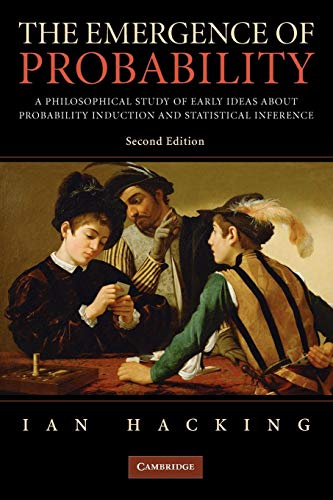
Historical records show that there was no real concept of probability in Europe before the mid-seventeenth century, although the use of dice and other randomizing objects was commonplace. Ian Hacking presents a philosophical critique of early ideas about probability, induction, and statistical inference and the growth of this new family of ideas in the fifteenth, sixteenth, and seventeenth centuries. Hacking invokes a wide intellectual framework involving the growth of science, economics, and the theology of the period. He argues that the transformations that made it possible for probability concepts to emerge have constrained all subsequent development of probability theory and determine the space within which philosophical debate on the subject is still conducted. First published in 1975, this edition includes an introduction that contextualizes his book in light of developing philosophical trends. Ian Hacking is the winner of the Holberg International Memorial Prize 2009.
"Sinopsis" puede pertenecer a otra edición de este libro.
Acerca del autor
Ian Hacking holds the chair of philosophy and history of scientific concepts at the College de France. Until recently he was a University Professor of philosophy at the University of Toronto. He is the author of many books, including Representing and Intervening, The Taming of Chance, Probability and Inductive Logic, and most recently Historical Ontology. He is a fellow of the Royal Society of Canada, the American Academy of Arts and Science, and the British Academy. In 2004 he was elected a Companion of the Order of Canada. He is also the winner of the Holberg International Memorial Prize 2009.
"Sobre este título" puede pertenecer a otra edición de este libro.
Otras ediciones populares con el mismo título

Resultados de la búsqueda para The Emergence of Probability: A Philosophical Study...

Imagen del vendedor
The Emergence of Probability: A Philosophical Study of Early Ideas about Probability, Induction and Statistical Inference (Cambridge Series on Statistical And Probabilistic Mathematics)
Publicado por
Cambridge University Press, 2006
ISBN 10: 0521685575
ISBN 13: 9780521685573
Antiguo o usado
Tapa blanda
Librería: Austin Goodwill 1101, Austin, TX, Estados Unidos de America
Calificación del vendedor: 4 de 5 estrellas

Condición: good. Book shows general signs of use and handling. May have light wear on the cover or edges and minimal writing or highlighting. Binding remains tight, and pages are clean and readable. Nº de ref. del artículo: CTXV.0521685575.G
Comprar usado
EUR 9,83
Envío por EUR 2,90
Se envía dentro de Estados Unidos de America
Se envía dentro de Estados Unidos de America
Cantidad disponible: 1 disponibles
Imagen de archivo
The Emergence of Probability: A Philosophical Study of Early Ideas about Probability, Induction and Statistical Inference (Cambridge Series on Statistical & Probabilistic Mathematics)
Publicado por
Cambridge University Press, 2006
ISBN 10: 0521685575
ISBN 13: 9780521685573
Antiguo o usado
Paperback
Librería: HPB-Red, Dallas, TX, Estados Unidos de America
Calificación del vendedor: 5 de 5 estrellas

Paperback. Condición: Good. Connecting readers with great books since 1972! Used textbooks may not include companion materials such as access codes, etc. May have some wear or writing/highlighting. We ship orders daily and Customer Service is our top priority! Nº de ref. del artículo: S_473910725
Comprar usado
EUR 9,83
Envío por EUR 3,29
Se envía dentro de Estados Unidos de America
Se envía dentro de Estados Unidos de America
Cantidad disponible: 1 disponibles
Imagen de archivo
The Emergence of Probability: A Philosophical Study of Early Ideas about Probability, Induction and Statistical Inference (Cambridge Series on Statistical & Probabilistic Mathematics)
Publicado por
Cambridge University Press, 2006
ISBN 10: 0521685575
ISBN 13: 9780521685573
Antiguo o usado
Paperback
Librería: HPB Inc., Dallas, TX, Estados Unidos de America
Calificación del vendedor: 5 de 5 estrellas
Paperback. Condición: Very Good. Connecting readers with great books since 1972! Used books may not include companion materials, and may have some shelf wear or limited writing. We ship orders daily and Customer Service is our top priority! Nº de ref. del artículo: S_472239021
Comprar usado
EUR 10,84
Envío por EUR 3,29
Se envía dentro de Estados Unidos de America
Se envía dentro de Estados Unidos de America
Cantidad disponible: 1 disponibles
Imagen de archivo
The Emergence of Probability A
Publicado por
Cambridge University Press, 2006
ISBN 10: 0521685575
ISBN 13: 9780521685573
Antiguo o usado
Tapa blanda
Librería: World of Books (was SecondSale), Montgomery, IL, Estados Unidos de America
Calificación del vendedor: 5 de 5 estrellas
Condición: Good. Item in good condition. Textbooks may not include supplemental items i.e. CDs, access codes etc. Nº de ref. del artículo: 00105563674
Comprar usado
EUR 15,13
Gastos de envío gratis
Se envía dentro de Estados Unidos de America
Se envía dentro de Estados Unidos de America
Cantidad disponible: 1 disponibles
Imagen del vendedor
Emergence of Probability : A Philosophical Study of Early Ideas About Probability, Induction And Statistical Inference
Publicado por
Cambridge University Press, 2006
ISBN 10: 0521685575
ISBN 13: 9780521685573
Nuevo
Tapa blanda
Librería: GreatBookPrices, Columbia, MD, Estados Unidos de America
Calificación del vendedor: 5 de 5 estrellas
Condición: New. Nº de ref. del artículo: 4231625-n
Comprar nuevo
EUR 20,07
Envío por EUR 2,32
Se envía dentro de Estados Unidos de America
Se envía dentro de Estados Unidos de America
Cantidad disponible: Más de 20 disponibles
Imagen del vendedor
The Emergence of Probability: A Philosophical Study of Early Ideas about Probability, Induction and Statistical Inference (Paperback or Softback)
Publicado por
Cambridge University Press 9/1/2006, 2006
ISBN 10: 0521685575
ISBN 13: 9780521685573
Nuevo
Paperback or Softback
Librería: BargainBookStores, Grand Rapids, MI, Estados Unidos de America
Calificación del vendedor: 5 de 5 estrellas
Paperback or Softback. Condición: New. The Emergence of Probability: A Philosophical Study of Early Ideas about Probability, Induction and Statistical Inference. Book. Nº de ref. del artículo: BBS-9780521685573
Comprar nuevo
EUR 22,46
Gastos de envío gratis
Se envía dentro de Estados Unidos de America
Se envía dentro de Estados Unidos de America
Cantidad disponible: 5 disponibles
Imagen de archivo
The Emergence of Probability: A Philosophical Study of Early Ideas About Probability Induction and Statistical Inference (Cambridge Series on Statistical & Probabilistic Mathematics)
Publicado por
Cambridge University Press, 2006
ISBN 10: 0521685575
ISBN 13: 9780521685573
Nuevo
Tapa blanda
Librería: Lakeside Books, Benton Harbor, MI, Estados Unidos de America
Calificación del vendedor: 5 de 5 estrellas
Condición: New. Brand New! Not Overstocks or Low Quality Book Club Editions! Direct From the Publisher! We're not a giant, faceless warehouse organization! We're a small town bookstore that loves books and loves it's customers! Buy from Lakeside Books! Nº de ref. del artículo: OTF-S-9780521685573
Comprar nuevo
EUR 20,51
Envío por EUR 3,50
Se envía dentro de Estados Unidos de America
Se envía dentro de Estados Unidos de America
Cantidad disponible: Más de 20 disponibles
Imagen de archivo
The Emergence of Probability: A Philosophical Study of Early Ideas about Probability, Induction and Statistical Inference (Cambridge Series on Statistical And Probabilistic Mathematics)
Publicado por
Cambridge University Press, 2006
ISBN 10: 0521685575
ISBN 13: 9780521685573
Nuevo
Tapa blanda
Librería: California Books, Miami, FL, Estados Unidos de America
Calificación del vendedor: 4 de 5 estrellas
Condición: New. Nº de ref. del artículo: I-9780521685573
Comprar nuevo
EUR 24,41
Gastos de envío gratis
Se envía dentro de Estados Unidos de America
Se envía dentro de Estados Unidos de America
Cantidad disponible: Más de 20 disponibles
Imagen del vendedor
The Emergence of Probability
Publicado por
Cambridge University Press, GB, 2006
ISBN 10: 0521685575
ISBN 13: 9780521685573
Nuevo
Paperback
Librería: Rarewaves USA, OSWEGO, IL, Estados Unidos de America
Calificación del vendedor: 5 de 5 estrellas
Paperback. Condición: New. Historical records show that there was no real concept of probability in Europe before the mid-seventeenth century, although the use of dice and other randomizing objects was commonplace. Ian Hacking presents a philosophical critique of early ideas about probability, induction, and statistical inference and the growth of this new family of ideas in the fifteenth, sixteenth, and seventeenth centuries. Hacking invokes a wide intellectual framework involving the growth of science, economics, and the theology of the period. He argues that the transformations that made it possible for probability concepts to emerge have constrained all subsequent development of probability theory and determine the space within which philosophical debate on the subject is still conducted. First published in 1975, this edition includes an introduction that contextualizes his book in light of developing philosophical trends. Ian Hacking is the winner of the Holberg International Memorial Prize 2009. Nº de ref. del artículo: LU-9780521685573
Comprar nuevo
EUR 24,81
Gastos de envío gratis
Se envía dentro de Estados Unidos de America
Se envía dentro de Estados Unidos de America
Cantidad disponible: Más de 20 disponibles
Imagen de archivo
The Emergence of Probability: A Philosophical Study of Early Ideas about Probability, Induction and Statistical Inference (Paperback)
Publicado por
Cambridge University Press, Cambridge, 2006
ISBN 10: 0521685575
ISBN 13: 9780521685573
Nuevo
Paperback
Librería: Grand Eagle Retail, Bensenville, IL, Estados Unidos de America
Calificación del vendedor: 5 de 5 estrellas
Paperback. Condición: new. Paperback. Historical records show that there was no real concept of probability in Europe before the mid-seventeenth century, although the use of dice and other randomizing objects was commonplace. Ian Hacking presents a philosophical critique of early ideas about probability, induction, and statistical inference and the growth of this new family of ideas in the fifteenth, sixteenth, and seventeenth centuries. Hacking invokes a wide intellectual framework involving the growth of science, economics, and the theology of the period. He argues that the transformations that made it possible for probability concepts to emerge have constrained all subsequent development of probability theory and determine the space within which philosophical debate on the subject is still conducted. First published in 1975, this edition includes an introduction that contextualizes his book in light of developing philosophical trends. Ian Hacking is the winner of the Holberg International Memorial Prize 2009. Historical records show that there was no real concept of probability in Europe before the mid-seventeenth century, although the use of dice and other randomizing objects was commonplace. Ian Hacking presents a philosophical critique of early ideas about probability, induction, and statistical inference and the growth of this new family of ideas in the fifteenth, sixteenth, and seventeenth centuries. The contemporary debates center around figures such as Pascal, Leibniz, and Jacques Bernoulli. Hacking invokes a wider intellectual framework involving the growth of science, economics, and the theology of the period. He argues that the transformations that made it possible for probability concepts to emerge have constrained all subsequent development of probability theory and determine the space within which philosophical debate on the subject is still conducted. First published in 1975, this edition includes a new introduction that contextualizes his book in light of new work and philosophical trends. Shipping may be from multiple locations in the US or from the UK, depending on stock availability. Nº de ref. del artículo: 9780521685573
Comprar nuevo
EUR 26,96
Gastos de envío gratis
Se envía dentro de Estados Unidos de America
Se envía dentro de Estados Unidos de America
Cantidad disponible: 1 disponibles